Friday, April 15, 2016

#AtoZChallenge, M is for Morning Tea (and Other Small Pleasures)


It's Friday and here I still am: collaging, journaling, blogging my way through the alphabet, landing on M and thanking the heavens for my morning cup of tea. 


Ah, tea. Solves everything, in my opinion! It also makes a good subject for drawing and art journaling.
For today's journal page I drew (during my morning tea break!) my office tea cup, adding, amongst other things, the tag from one of my favorite tea bag flavors: Jasmine Green, and a scrap of origami paper.

For me, my morning tea is a much-needed daily ritual and respite. I don’t like to hurry any aspect of it. It's also loaded with memories: tea shops in England and New Zealand as a child;  visiting an organic tea plantation in Taiwan last year; my parents receiving annual shipments of Murfee’s tea from Canada when we lived in California. I remember when we went together to Vancouver to place that first order. The building was from another century, dark and paneled in Tudor black oak, with all the bins of tea arranged in orderly rows that made me feel I was on board an old clipper ship. I really can't drink tea without thinking about it at least once!

Tea, writing, drawing, and "M is for memories" just all seem to go together. Some journal questions you might like to ask are:

  • Did you ever play "tea party" as a child? You know, with a little tea-set and mud-pies?
  • What morning rituals do you now follow every day? (Even making your bed can take on quiet significance).
  • What's your favorite way to take a break from daily stress, e.g., daily blogging?
  • If you are a tea-drinker, what are your favorite brands and flavors? (Fortnum and Mason’s Royal Blend for me!) 
  • If you're not into tea, what makes a good morning for you?

Tip of the Day: Art journaling can be about the simplest things. Tomorrow morning, make yourself a cup of tea. Sit down with your journal. Watch the steam rise. Take a sip. Start writing.

Thursday, April 14, 2016

#AtoZChallenge, L is for Let's Go!


One of my most beloved toys as a child was actually a greeting card. Sent to me when I was five years old and cooped up in bed with the chicken pox, it arrived in the form of a multi-page booklet telling the story of a paper doll named Ginger. Ginger and her wardrobe had perforated edges that allowed me to easily extract the whole kit and kaboodle as quickly as possible while I sat up in bed supported by a mountain of pillows.

The cover of the card was pink and decorated with iconic landmarks from various countries: the Eiffel Tower for France, a windmill for Holland, the leaning tower of Pisa for Italy. Ginger was a twenty-something flight attendant, or as we said back then, a stewardess. She had beautiful long red hair, a perky figure, and a sense of style straight out of Mad Men. I remember being particularly entranced with her white fencing outfit complete with netted helmet and mask. There were also evening gowns, a trench coat, and best of all, her suitcase. Brown cardboard "leather," it was covered in travel stickers from all around the world, stickers that matched many of the icons on the front of the card. As far as I was concerned, Ginger was the It Girl, putting all my other dolls and toys far back into a lowly second- and third-place.

Looking back, it's amazing how much pleasure I received from a flimsy little card, but from that moment on I was determined to travel. To me, Ginger signified much more than a toy; she was the real, adult world I couldn't wait to be a part of. As I waltzed her across my bedspread and blankets, I imagined myself traveling just like she did, wearing, of course, her white fencing outfit I was certain was de rigeur for foreign travel. Ginger became my childhood role model, and every time I pack my bag or board an airplane, I still think of her.

Today's journal page celebrates the spirit of adventure. Where do you want to go for your next holiday? What steps do you need to take to get there? Dream big. En garde!

Tip of the Day: Write it down, make it happen. Your art journal makes an excellent vision board or treasure map for creating your next vacation. Find images in travel magazines or travel agency brochures (that's where I found the printed stamps to cut out for today's page). Paste everything in place along with some positive affirmations, a list of wardrobe items to take and sights to see, and off you go. Send a postcard!

Wednesday, April 13, 2016

#AtoZChallenge, K is for Kid-Lit


Today's post celebrates Kid-Lit, all the wonderful children's books in the world and what a fantastic subject they make for art journaling. Besides the hundreds of fairy tales I read as a child: The Blue Fairy Tale Book, The Red Fairy Tale Book and on and on through the entire rainbow, some of my favorite titles were:

  • Lona
  • The Diamond in the Window
  • The Door in the Wall
  • Little Bear
  • Little Women

Authors:
  • Zilpha Keatley Snyder
  • Edgar Eager
  • Lloyd Alexander
  • Laura Ingalls Wilder


Characters:
  • Trixie Belden
  • Donna Parker
  • Madeline
  • Babar

Of course there are hundreds more, far too many to list here, but I'm convinced that my early reading and love of picture books is what led me to become a writer, and what then later encouraged my deep interest in art. How about you? What were some of your favorites, and how did they help you become who you are today? Drop a line!
Tip of the Day: For today's journal page I started with a doodle of a frog, as in The Princess and the Frog. I'm a little rushed at the moment so I had to leave out the princess, as well as the kissing part, but it made me think how neat it would be to create an art journal based solely on fairy tales, myths, legends, or perhaps a children's story of your own. Who knows, it might even turn into a publishable picture book!

Tuesday, April 12, 2016

#AtoZChallenge, Just Show Up!


So much of creativity is really all about just showing up. You don't have to know what you're going to do once you get there, but you do need to get there: to your desk, your studio, your kitchen table. No big deal.

But just in case you do think it's such a big deal you'd rather clean your base-boards and check all your clothes for loose buttons rather than face your journal, here are my favorite tips for showing up with a free and easy attitude:

  • Assemble what you need ahead of time. Give yourself as long as you need to find and collect collage and other papers, paints, pencils, stickers, etc. Set up a small but usable work-space that makes you want to go there to play.
  • Having everything in place, including hand-wipes and other clean-up materials will help keep you in place without constantly having to get up and find yet another missing piece.
  • Start a weekly or daily habit of going through magazines in search of images and word-prompts. Collating images when you don't have the energy or will to write or draw in your journal is a strong part of the process and will help ease you into a creative frame of mind.
  • If the idea of an actual real-life journal is too intimidating at first, take time to play with the basics: some newsprint or old printed-out pages (back or front) from your printer you no longer need, and crayons or felt-tip markers. Just scribble, doodle, have fun and toss if you don't want to keep any of it.
  • Another alternative to a journal is to start out with one of the thousands of adult coloring books currently available. Color in the designs then add your own words or other embellishments later on.
  • Buy a "how-to" book on collage, art journaling, or other technique and follow along with the lessons. Choose one day a week to make your "class time" and don't be late!
  • Sit down at your workspace and set a timer. It's amazing what you can achieve in 15-20 minutes. (I bet you stay long after the bell has rung!)
  • Join or start an art journal group. There's nothing more motivating, or fun, than group creativity at a set time and a set place.

Tip of the Day: If you find that even after trying these methods you're still resisting showing up to work in your art journal, you might want to find out what's really stopping you. Dialogue with yourself, or perhaps with your journal. Ask what's going on. I know that when I first started out with art I could find dozens of other things to do other than finally sitting down to work. Looking back into my past, way back, I realized it all stemmed from kindergarten (seriously!) and being afraid of getting paint on my dress. I was terrified of that dripping paintbrush. Now I wear jeans and fling that paint like there's no tomorrow! (And if there is, I'll see you there with the letter K!)

Monday, April 11, 2016

#AtoZChallenge, I is for Inspiration


They say you can't wait around for inspiration to strike before you start writing or creating, but one of my big problems is trying to get away from inspiration. Maybe it's living in Albuquerque, or I read too much, or have too many creative friends, but sometimes it's all I can do to not have any new ideas.

A while back I wrote a post listing my main literary influences and inspirations. The list still holds true today and I enjoyed going over it before writing today. Making a list of your own in your art journal could include:

  • Spiritual mentors.
  • Authors.
  • Artists.
  • Teachers.
  • Blogs you enjoy reading.
  • Heroic historical figures.
  • Colors.
  • Places.
  • Friends and family.

Besides listing your primary movers-and-shakers, you might like to explore questions about how you work with inspiration, for instance, when you're feeling down and defeated, how do you bring yourself back up? What kinds of activities or happenings actually un-inspire you? How can you detach yourself from their toxicity?

Tip of the Day: I'm a big fan of altars, especially the small, unassuming sort you make at home without really trying, such as a windowsill where you keep, say, a collection of stones and shells from a favorite beach, or a shelf filled with childhood memorabilia. Even the way you set up your art and journaling supplies can be considered a kind of altar to your creativity. 

In that spirit, why not set aside a few art journal pages to create a visual altar, a place where you can visit whenever the well seems a bit dry. Design and color it in a way that makes you want to return again and again for further inspiration!

Saturday, April 9, 2016

#AtoZChallenge, H is for Hot (and Cold)


Happy Saturday! I've been at the zoo all day with Urban Sketchers, hence this very late post. When we first got there, it was freezing, but now, 5.30 PM, it's hotter than a New Mexico chili pepper, good weather for today's topic: Hot and Cold.

What I'm talking about here are hot and cold colors, or in other words, the backgrounds to your journal designs. When I sit down to create a collage or mixed media piece, I often don't know what will be in it, or what colors I'll choose. Sometimes I just let my hand wander over my supplies until I find something that feels right. 

For today's piece, I seemed to have needed hot, bright red, orange and yellow. Immediately the idea of "heat in the kitchen" came to mind, meaning, I think, "If you can't take the heat, stay out of the kitchen." I may have sub-consciously been thinking about the A-Z Challenge, i.e., if you can't handle blogging every day, out you go, LOL. 

But on a more serious level, I started to think about my grandmother's infamous goulash, so hot it quite literally brought tears to the eyes. And she made it all the time! In retrospect, I know I would probably enjoy it much better today than I did as a child, but back then, it was pure torture to eat. All the same, I loved watching her prepare the dish: getting out the big Dutch oven; tying up the spices and peppercorns in cheesecloth bags; the deep red of the gravy once it had simmered all day. I remember having a special fondness for the bay leaves, not quite believing that you could actually use real leaves to cook with.

Today's art page is rather simple, but the kitchen and cooking theme is one I could go on about forever. If the weather today had been a little warmer, I might have gone for a "cold" page of icy blue, leading me back to those long-ago summers when my best friend and I would ride our bikes to the closest 7-11 for electric-blue Slurpees. Or the time I experimented with blue food coloring for the frosting on a batch of cupcakes, and kind of overdid the color.

There is so much you can do in an art journal based on food, so much that I sometimes think it's one of my favorite themes! For instance:

  • Beloved (and secret) family recipes.
  • Special occasion and holiday meals.
  • "Dream" meals and baked good you'd love to try making.
  • Recalling when you learned (or didn't learn!) to cook or bake.
  • Ethnic foods from various cultures.
  • Our relationships to food; the good, the bad, the hopelessly tempting.
  • Trying a new and healthier lifestyle: making better choices and celebrating the changes.
  • Must-have ingredients, and why you rely upon them.

The combination of food, art, and writing has always been special to me, starting with a workshop I took on the poetry of food, led by the poet and food diva extraordinaire, Denise Brennan Watson. Her book, The Undertow of Hunger showed me how eloquent, necessary, and astonishing food can be, from a simple clove of garlic to the satisfying feel of a warm eggplant held in one's hand. Which reminds me--I have to go make dinner! See you on Monday.

Tip of the Day: Art journals aren't always for ourselves. An illustrated journal based solely on recipes and kitchen memories makes a beautiful gift, especially for a younger friend, or  member of the family just starting out and learning there's more to life than the microwave. Bon appetit!

Friday, April 8, 2016

#AtoZChallenge, G is for Grow


It's a rainy day in Albuquerque, just right for spring planting and today's topic of GROW: 

Mary, Mary, quite contrary, how does your garden grow? 

Looking at the page I've created for today, I guess my garden is full of kittens (and one lone puppy). I'm not sure why, but I do remember how much I enjoyed watching my cats grow from little balls of fluff to grand masters of stealth and grace.

Using your art journal to record and examine your own personal growth can be a very helpful and encouraging exercise. Some questions you might want to ask yourself along the way could include: 

  • In what areas of life would you like to grow stronger, wiser, more informed, more forgiving, etc.?
  • What actions can you take to get there?
  • What's been stopping your growth now or in the past?
  • What new projects would you like to plant the seeds for?
  • How can you best take stock of, and celebrate, the growth you've already achieved?

Besides examining your own personal growth, you might like to use your journal to record and express:

  • Your children's growth and achievements.
  • Pets, too!
  • An actual garden journal, with notes on planting dates, successes (and failures--my own gardening disasters could fill a whole book. . . ), and wish-lists for future gardens.

As I write this post, sitting under lamplight while the skies remain dark and cloudy and the whole world seems muffled in fog, I'm reminded of elementary school and that constant question: What do you want to be when you grow up? 

For me it was always an archaeologist. That is, until I learned archaeologists had to dig ditches in hot climates and get all dusty and dirty. Yuk! Looking back I think what I really meant was I wanted to work in a beautiful museum, hushed and scholarly, and where the only "dirt" was the collection of rock and gem specimens behind glass. But it makes an interesting study, to see where I came from and where I landed, and where I'm still growing (other than my waistline. . .). So how about you?

Tip of the Day: What did you want to be when you "grew up"? Did you achieve your goal, or did life show you an entirely different path you followed instead? And what about now, any plans for the future? Write, collage, draw and get them down on paper--make that garden grow.

Thursday, April 7, 2016

#AtoZChallenge, F is for Focus


It's ironic that today's theme is FOCUS when I'm running late writing this post, while at the same time trying to cram in all my day-job duties, and trying to eat my lunch. To make matters worse, I was so rushed this morning I left my To-Do list at home, and it was a long one. Now I'm trying to figure out what was on it other than "Write Blog Post" scrawled at the very top. Grrr!

So, about focusing . . . what on earth is that??

As I'm typing this, I can hear my co-workers eating their lunch, talking at the top of their voices, and playing the radio full blast (I think it's rap). I just had to get up and shut my door. Not very friendly, but I had to do something to cut out the chaos.

Which is how I view my art journal when things get wild; making it a little sacred space of concentration, just for me. It's where I can go to rest and to play with color, design, and words in ways that feed my spirit and soul more than anything else I know.

Some of the ways I've learned to focus on my journal rather than the noise on the other side of the door are:

  • Schedule in the time. For today that meant: get up early, and write before I even got dressed.
  • Finish what I start. It's so important to me, I wrote it on today's page! It's fun to start various projects, and I, like most writers and artists, have several awaiting completion. But I do, and will, complete them before they become unmanageable. In fact, that's what I've been doing this year, focusing on one project at a time so I can have a clean slate by 2017.
  • Still, despite my best intentions, I'm constantly tempted to begin yet another new project. To maintain some kind of order, I keep a special file for ideas, and pictures I want to use "one day," but not now. Once the idea or image is in the file, I don't have to think about it again until later. Much later.
  • Too many art supplies can be a big distraction: which one to use first? A good way to solve this is to work your way through them without buying anything new. For instance, use two, and only two, items until you use them up, e.g. charcoal pencils and watercolors only. If you find you really are resisting using them, give them away, and choose two more until you find your true medium.
  • The same applies to collage papers and other decorative items. Work your way through what you have. Even if you dislike a certain color or texture--use it anyway, taking each piece from the top of the pile. Afterwards, step back from the page--you may be very surprised at how things have worked out, and well.
  • Prepare your art journal supplies in advance. The night before your scheduled session, gather and arrange the items you'll be using and place them on your desk or table. Having your glue stick, water, paints and brushes, cut-out pictures, and even some clean-up wipes all set in place for when you sit down, is both inviting and time-saving.

Tip of the Day: Create a journal section--or perhaps an entire journal--on the theme of focusing. You might want to include things such as inspiring quotes; peaceful scenes of nature; pictures of candles, altars or other spiritual images; short "recipes" for rituals to follow before you begin working. Enjoy the process, enjoy the quiet.

Wednesday, April 6, 2016

#AtoZChallenge, E is for Endings


Endings come in all shapes and sizes: from "happily ever after," to "Gosh, am I ever glad that's over." Your art journal is the perfect place to explore, record, and re-imagine a wide variety of endings in your life.

Some of the questions and topics surrounding the theme of "endings" can include:

  • Taking a good, long look at endings you've never quite been able to accept: the sudden and unexpected end of a job or relationship; moving from a much-loved home or city; losing a loved one.
  • Endings that need closure so you can move on to enjoy and more fully appreciate your current situation.
  • Areas in your life that need to end in order to keep your health and sanity, for instance a toxic friendship; a dead-end, low-paying job; an organization that requires far too much of your time with little return or appreciation.

On a lighter note, endings, can also be something to celebrate, especially when the end of one chapter opens the door to a new and brighter future. For instance:

  • Graduations.
  • Retirement.
  • Getting out of a thankless situation.
  • Selling a home or business.
  • Leaving a job to become self-employed.
  • Significant birthdays.
  • Moving.

All of these experiences make good fodder for collage, artwork, poetry; creative work that goes a long way toward accepting and even thanking the endings in our lives.

Tip of the Day: If the idea of working with real-life endings sounds too painful right now, or you're just not ready to go there, try this: Consider all the fictional endings you've either enjoyed,or have been disappointed in. What are your favorite book endings? What movies left you saying, "Huh? What just happened there?" How would you change them to create a more satisfying conclusion? And don't forget about all those non-conclusive fairy tale endings. What if Snow White and Cinderella decide they don't want to marry princes after all, or Little Red Riding Hood is really the wolf's accomplice and it's all just a big set-up? Have fun!

Tuesday, April 5, 2016

#AtoZChallenge, D is for Dress it Up!


Today's topic, Dress it Up!, goes way back to my very first NaNoWriMo effort (2004!) when I made dozens of character, setting, and wardrobe collage pages to go along with my text. I still have that draft as well as all the accompanying illustrations. The reason it stays in a cardboard box is complicated, but let's just say it's got a lot to do with the story being a genre-authentic romance, and I don't know if I'm very good at writing romances. I love the story, I love my characters, but I have other projects with louder voices calling for my attention right now, so . . . maybe one day I'll re-open that manuscript box!

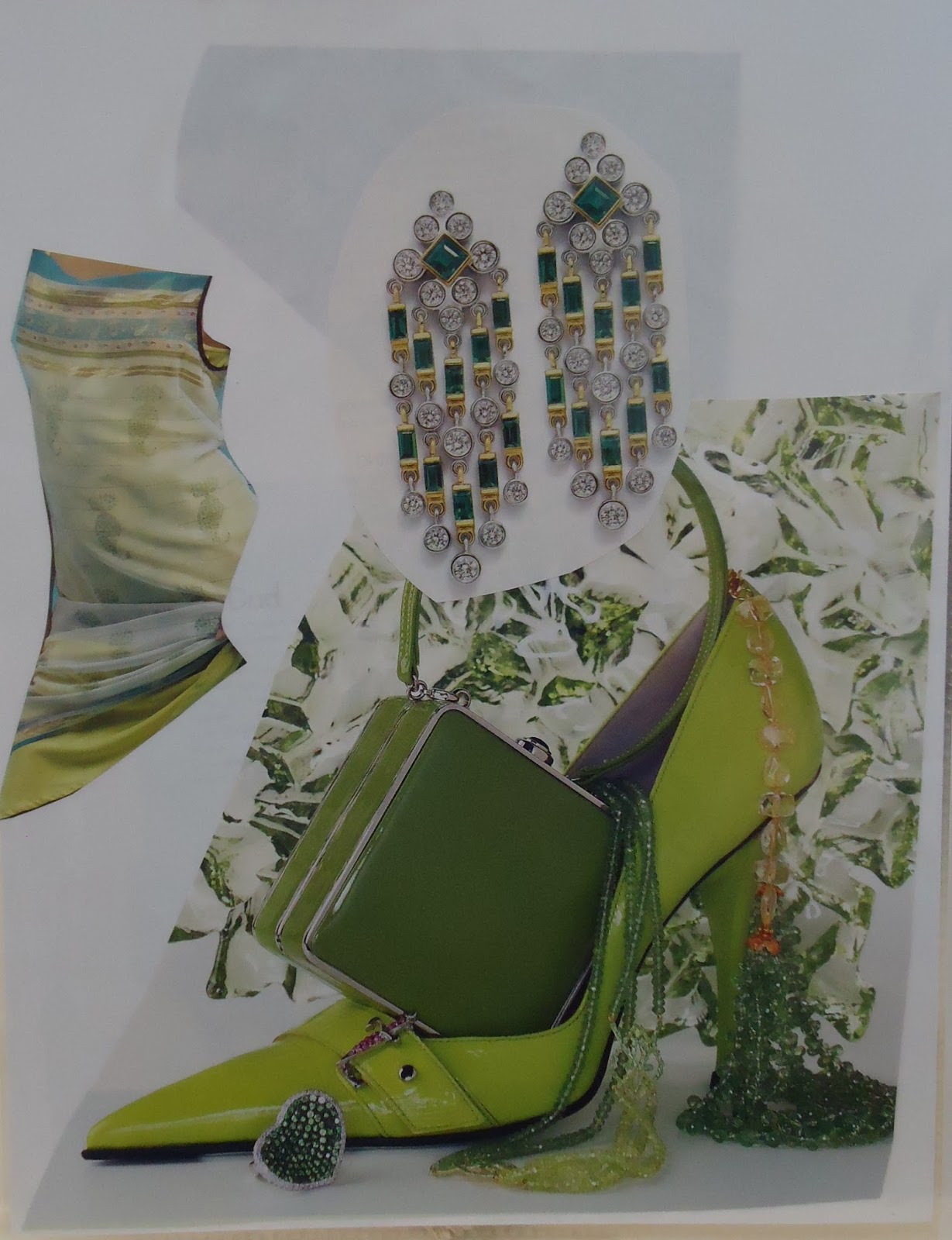
In the meantime, though, I enjoy riffling through those pages of magazine cut-outs I made to go with the story, remembering how much fun I had putting them together. Part of the story is set in an Italian fashion house. Here's a glimpse of Gina, the beautiful designer and evil villain of the story:


She loves to accessorize:


One of my favorite scenes in the plot is when Bailey, my beautiful (all my characters are beautiful, LOL!) heroine is tricked into "borrowing" items from Gina's storerooms so she can go out on a date with Gina's equally villainous accomplice, Ashe, the hero's brother. Bailey goes a little wild for green and gets into a lot of trouble for wearing these items when Gina finds out.


I've got dozens of these pages: outfits for Bailey when she goes to Paris with the hero, Declan, (under duress, of course. The old "on the road together, but they hate each other" scenario); pictures of Bailey as a little girl in jeans and T's, and ending with her gorgeous wedding dress when she finally marries Declan (and they don't hate each other any more).

These and other clothing pages I've made for my various drafts and published work since then have been, for me, one of the great delights of writing. Life in Albuquerque is casual--we hardly ever dress up to the extent I sometimes find myself longing to do, and I admit many of my outfit-collages stem from some kind of wish-fulfillment. Probably the same reason why I prefer to read novels and watch movies filled with fabulous clothes!

Adding clothing pages to your art journal doesn't have to be linked to a manuscript, however.  For today's page I've glued in another of my practice sketches of a dress I liked, and added a few little embellishments. The flower piece actually fell out of an old journal--the glue must have evaporated to nothing, one of the hazards of living in the high desert--so I stuck it on here just because I liked it. It made me think of old prom dresses and yearbooks and that's probably what I'll be writing about later tonight.

Other prompts to get you started on some clothing pages could include:

  • Organizing your wardrobe and choosing the pieces you want to keep and those that need to be tossed or donated.
  • Memories: favorite dresses, fashion changes throughout your life, fabulous outfit "flops" you'll never recover from . . . 
  • Make a list of "What I Wore" on different occasions, e.g., "What I wore on the first day of school throughout the years," or "What I wore to friends' and family weddings," or "What I wore for on first dates."
  • Recalling what your mother, grandmother, aunts wore, especially the clothes you loved or that intrigued you in some way. I remember being fascinated by my great-grandmother's old-fashioned black lace-up shoes when I sat on the floor by her feet playing with my tea-set and pouring her cup of air.
  • Wish lists of clothes you'd like to own. Past experience has taught me that shopping with intention, not only saves money, but goes a long way to avoiding those "flops" mentioned above.

Another good reason to include clothing in your art journal is that it's super-fun to draw or paint. The colors are pretty, working with the draping, shadows and highlights can help your drawing skills, and there's no dry cleaning bills!

Tip of the Day: When I'm not cutting up fashion magazines, my favorite go-to place for design inspiration is Polyvore.com, a digital fashion collage site that's more fun than a barrel of monkeys. (Warning: it's extremely addictive.) But once you've learned to pace yourself and only go there once a day, you can quickly design all kinds of fashion plates you can then print out and paste straight into your journal. Very easy and very effective.

Monday, April 4, 2016

#AtoZChallenge, C is for Core Values


Core values matter to me. I don't know how to live without values, even though they're far from popular, and ascribing to them lost me a chance to attend teacher's training college when I was eighteen and living in New Zealand. 

The interview was conducted in a stuffy little room with a hard-backed chair for me, and a long table with padded chairs for the twelve formidable professors asking the questions, questions I found confusing and difficult to answer. I was an American living abroad and still unsure about where I fit in, if at all. Finally, the head interrogator asked if I believed in teaching values. Ah, I could get this one, I thought, so I promptly replied, "Yes." 

I don't think I'll ever forget the look of horror that stole across those twelve faces. After a long, uncomfortable pause, the same woman asked, "What values?" Unaware I was committing career-suicide, I listed things such as not stealing, not hitting, forgiveness, not being cruel. You know: be nice! Duh!  

The panel remained grim-faced and after another interminable amount of time shuffling papers and shaking their heads, they calmly announced that I was a very unsuitable candidate for teaching and would be better off finding a job as a shop assistant. 

I don't remember what happened after that, how I got home, how I faced my parents as a reject and a failure. But later that week I took the panel's advice, went to work in a bookstore, loved it, and never looked back. Later, after saving enough money, I went on to get a degree in Spanish Literature from the University of Auckland, all the while thanking my stars that I didn't have to spend my life in a value-free classroom filled with biting, hitting, mean little kids raised without values. Whew! Saved!

I still don't understand what is so awful or backward about having values, and quite frankly, I hope I never do. Admittedly, what I consider to be my values has shifted, changed, and matured over the years, but I will always hold on to an essential code of ethics that makes me, me. 

Which is why I like using my journals, and especially my art journals, to learn more about my values and what I believe in, and why. It's not always an easy process. But after deciding  on today's topic, I realized my core values can easily distill into one important core belief: Make every day count. Make every day matter.

That's it. Every day I'm grateful to be alive, and every day I realize how lucky I am to still be alive. So I do my best to make my day matter with not only journaling, but writing, drawing, helping, encouraging, fulfilling my day-job role with enthusiasm, and most of all, being as aware as I can be of the world around me. It's a good world, and I value it, deeply. And I want to thank you for being part of it. Really and sincerely.

Oh, and why a horse with the Eiffel Tower on a page of values? I simply gathered from my collage supplies what spoke to me: maybe strength, service, enjoy the ride? That's the beauty of art journaling--you never know what will happen, but you can always make a connection, if not now, then down the road. It's all good. See you tomorrow.

Tip of the Day: Using your journal, and especially an art journal, is a wonderful way to connect with your personal, professional, and spiritual being. Whether or not you want to call any of it "values" (you can just call it "The Important Things About Being a Human" if you prefer), creating a dedicated journal solely for your core-self is a valuable exercise (no pun intended) for discovering your very own road map to life.

Saturday, April 2, 2016

#AtoZChallenge, B is for Buy a Butterfly


Happy Saturday, all! The perfect day for some art journaling and for today's topic: Buy a Butterfly, or, Sometimes it's Good to Shop.

In yesterday's post I emphasized the importance of using as much FREE STUFF as possible for your journal, but today I'm singing the praises of treating yourself to a trip to the hobby-, dollar-, thrift-, or art supply store. Nothing fancy, mind you, but every now and then your journal could use a little store-bought item or two. And taking yourself to buy some supplies makes the perfect Artist's Date.

My favorite way to do this is to set a budget of about $10 - $20 max, and then drive off with no expectations whatsoever, just an open mind and a sense of adventure. Some of the things I'll look for include: 

  • Bags of collage goodies: from paper scraps to die-cut card pieces, such as the butterfly featured above. I've bought collections that are based on a theme, such as beaches and ocean-side designs, or vintage clothing and Victorian sayings. Other bags have included a variety of fascinating but totally unrelated items; one bag I bought even had tiny little clothes-pegs and safety pins in the mix. None of these bags cost more than $5.00 and they were jam-packed with inspiration.
  • Old and very-bad-condition books. These are excellent for tearing up and re-using the pages of text and/or illustration for journal backgrounds. (Note: if the book isn't completely falling apart, it can be turned into your actual journal as an "altered book.")
  • Bags of ribbon scraps.
  • Pre-cut fabric quilting squares. These are usually bundled into small color-coordinated packages.
  • Stick-on pearls, rhinestones, and other blingy-type thingies.
  • Jewelry-making components such as pendants and miniature printed pictures for inserting into clear pendant-cases. (I don't know how to exactly describe these pictures, but they're wonderful for collage. Each sheet usually has about 20-30 different designs.)
  • Stickers! So many to choose from!
  • Scrapbook pages sold in tablets or as individual sheets. (The tablets can be pricey, but they're often on sale, especially at the discount stores.)
  • Origami papers.
  • Craft magazines. Good for inspiration and cutting up for a wealth of words and images.

And that's just for starters. After I come home with my treasures I usually sort them into different categories of size, theme, or color. I then keep everything in a series of cigar boxes for the smaller pieces, and photo-storage boxes (decorated of course!) for the larger bits.

On today's page I've used a background of watercolor crayon, some leftover strips of a scrapbook page, four pieces of die-cut card from a purchased package, and a lovely quote from a lovely member of my writer's group. She had included these in our Christmas cards a few years back and I always knew I'd use mine in some meaningful way down the road--like today. 

For the written part of my journal, I'm going to continue with "I remember. . ." recalling the time my first-grade teacher brought caterpillars to class and we placed them in an aquarium filled with leaves and branches. I'll never forget watching the "worms" (I was a rather squeamish child) form their cocoons, and then the wondrous day when the butterflies emerged to fly out the window. Some things stick with you forever, with or without the glue-gun.

Tip of the Day: The next time someone asks what you'd like for a birthday or holiday gift, why not suggest some supplies for your art journal? I love it when someone surprises me with a grab-bag of notions and "puzzle pieces." Not only does it give me some interesting insights into how other people think (i.e., why they chose particular items over others), but I enjoy the challenge of using things I may not have picked out for myself. Wishing you all a creative weekend!


Friday, April 1, 2016

#AtoZChallenge, A is for Art Journal


Hello, everyone, and welcome to the first day of the A-Z Blogging Challenge! As promised in my last post, my theme for the 2016 A-Z will be art journaling, with a new entry for every day of the challenge.

My plan is to base each of my journal pages on a letter of the alphabet, giving myself about 30 minutes a day to put together a visual page (the part I'll be sharing) from the easiest and cheapest materials available, and another half hour to freewrite about what I find in the images. All along the way I'll also be providing tips and ideas for you to create an art journal of your own.

But before we begin: If you're a first-time art-journaler, please don't think you need to go out and buy tons of supplies. One main point I want to demonstrate over the month is how little you need in both materials and time: an hour at the most broken up into several 15- or 20- minute segments, a journal or notebook, some glue sticks, a pair of scissors, some junk mail/every-day ephemera ("The Moon" is torn from the bottom of a sheet of postage stamps), old magazines, some colored pencils, felt tip markers or watercolors, and optional decorative papers which can range from gift wrap to plain papers you paint and decorate yourself. Chances are you probably have everything at home already; even if you don't have a journal, you can just use individual sheets of paper and staple, sew, or tie them together at a later date.

So what have I got here for this first entry? Scraps! For instance, the green piece of paper in the background up there is a leftover from cutting out some star-shapes for another journal project. I kept it because I liked the unintentional design and also because I'm a great fan of "waste not, want not." The little colored pencil piece I glued in beneath it is a practice drawing on vellum from last year that seemed to fit the overall design in both shape and color--especially as I could then title the piece "A is for Apricot"! And that, along with "Reach for the Moon" is going to be my writing prompt for the day. 

Hint: Apricots always remind me of my childhood in California's San Fernando Valley. A great way to start off your art journal, especially if you're feeling a bit stuck or uninspired is to begin with those wonderful words: "I remember. . . "

Tip of the Day: Did you know cabbage leaves, kale, and collards make excellent journal pages? Oh, okay--April Fools!! See you tomorrow with the letter B.

Monday, March 21, 2016

A to Z Blogging Challenge Theme Reveal: An Art Journal Page a Day


Hello, Everyone! Today I'm revealing my A to Z theme: An Art Journal Page a Day. For anyone unfamiliar with the challenge, the idea is to blog every day during the month of April except for Sundays, and to base each post on a letter of the alphabet. 

This year I'll be creating a small art journal for the month along with tips so you can try something similar yourself. I can't promise it will be a fantastically beautiful journal (see Help, I Hate My Art Journal!), but it will be fun, and it will be a good discipline to collage and journal on a near-daily basis.

To get us all in the art journaling mood, I thought I'd share some pages from past journals. 

I used an actual piece of papyrus on this page. I'm not sure why I associated
Paris with Egypt, but it might have had something to do with the Louvre.
Whatever, to me art journaling is about emotion, not precision.

I found these Betsy McCall paper dolls on line.  I loved
Betsy as a child, but she was a difficult role model
to live up to. My mother had an even more difficult time
trying to understand why I couldn't be as band-box perfect
as dear Betsy, even when I explained to her Betsy was a doll, while I 
was a real little girl. The story of our entire relationship.

This particular collage was in memory of my grandmother. The
picture of the little girl isn't of  her, but reminds me of her all the same.

I put these maps together for a short story I was writing at the time.
My favorite technique was coloring in the black-and-white photocopy of rocks
and sea with colored pencil.

I created this spread after reading a novel set in Africa.

I made this page after I finished writing my novel, Overtaken
The bracelet had been one of my  initial writing prompts 
that fueled much of the story.

After Overtaken was published, I wanted to do something with the
old manuscript pages. So I did this.

Using old, failed, watercolors in a new way.

These two pages were created months apart. I was first intrigued enough by
"The Lady in White" to consider using her as the model for a
possible novel set in Egypt. Then when I came across her again in an orange
sweater, I knew there really was a story to write. Currently it's still very much
a WIP, but I'd like to return to it one day. These pages
are a good inspiration and starting point.

So start collecting your junk mail, magazines, ribbons and bows and get ready to journal. See you on April 1, and don't forget your glue sticks!

Thursday, March 10, 2016

Urban Sketchers for Writers, Potters, Designers . . . Everyone!


I don't think I'm alone in being a writer who's just as passionate about my artwork as I am about my writing. Clay, collage, pencils, watercolors, beads . . . they're all poetry to me. Each one of these mediums and disciplines informs and inspires my writing life, and I can't imagine dropping any of them.

But one of the things I've struggled with for a long time is finding the right kind of art group, one that matches my wonderful writer's group: a free-form meeting of women with interests that range from screenwriting to structured poetry to pithy vignettes. When we meet every two weeks, it's to write, not critique. We freewrite for about 30-40 minutes, and then we read aloud to each other. Our very informal meetings conclude with conversation and a chance to catch up on each other's personal news. It's a great system, and I've been trying to find that same kind of experience in an artistic environment. Enter: Urban Sketchers!

I discovered Urban Sketchers while I was searching Pinterest for examples of travel journal lay-outs. Over and over my favorite illustrations came from Urban Sketchers' members and I was uber-curious to find out who they were. A few Google searches later, and yay, I found a chapter here in Albuquerque.

I've been attending their various events off-and-on now for about nine months, and I love the way the format follows that of my writer's group: a group of enthusiastic people gathering in an interesting place; setting off on our own to sketch; then meeting up again to share and discuss our morning's work. I particularly enjoy the positive, warm atmosphere of viewing the various sketchbooks without tearing them apart in search of perceived flaws or "mistakes."

I've grown to love Urban Sketchers so much that I want to spread the word to everyone I know--not just my artist friends, but with my writing friends, too, as well as those who are photographers, potters, jewelry makers--everyone. There's so much to be gained from being with creative people regardless of whatever medium you work with. For instance, even if you've never dreamed of doodling in the margins of your latest draft, you can still: 
  • Take note of settings. Many of the places we've sketched in are venues I've never been to before. Making notes on all the fresh sights and sounds and smells, recording what I liked about the place (and what I didn't) has all gone into my sketch journals along with my drawing.
  • Take note of details: Architecture, clothing, people watching. So much of what makes a story come to life depends on the details. Taking a few hours to really concentrate on every single little thing can only add to your next story project.
  • Photography. Okay, let's say you really, really don't want to draw. Take pictures instead! Who knows, photography may become an entirely new vocation for you, one that fits your written work perfectly.
  • Artist's Date: Before, during, and after. Most writers I know find the hardest advice to follow in Julia Cameron's The Artist's Way to be taking the "Artist's Date," probably because it involves a) going by yourself, and b) treating yourself to something fun. Writers are notoriously mean to themselves, especially when they feel they haven't written enough or to the quality they expect on any given day. Hence the need for the artist's date. Urban Sketchers allows you to start out in the security of a group, but then sends you on your way to discover your own unique path for a few hours. Take advantage of the time alone to do something that pleases your writer-self while feeding your entire creative being. (And you can buy yourself a treat somewhere along the way too!)
  • Meet creative people. Who knows? They might be writers! (Or want to read your books, buy your jewelry!) Seeing the work of others is always inspiring.
  • Get out of your comfort zone. Sketching, especially in public, might seem scary if you've never tried it before. But if you can get over your initial fear of "What will people think?" wow, imagine how confident you'll be pitching a manuscript, or cold-calling on bookstores. Or even starting a new manuscript!
  • Sketching is meditative. Remember how much fun you had when you were a  little kid and able to zone out with your crayons and paper? Believe it or not, you were meditating at the same time. Giving yourself that same childlike joy for a few hours now and then can help you solve a myriad of character and/or plot problems. 
Some samples from my own meditations over the last two months include imagining myself as a cave-dweller at the Maxwell Museum of Anthropology:


Going back even further in time at the Natural History Museum:


If you do decide to visit your local Urban Sketchers, some essentials you'll need to bring along are: a collapsible camping-type stool, a set of color pencils (much easier and cleaner than fussing with watercolors or felt pens), a pencil sharpener, a sketch pen that you also like to write with, a hardback journal or sketchbook, hat and/or sunglasses, optional camera. Minimal tools for maximum fun.

Tip of the Day: Urban Sketchers is a world-wide phenomenon. Any Internet search will help you find a group somewhere in your area or close enough to travel to. Toss out your inhibitions and tag along--I know you'll be welcome!

Thursday, February 25, 2016

Why I Write

I love bringing home old magazines from the library. They're where I find the majority of my writing prompts, drawing references, and materials for collage and art journaling. But sometimes I just love them for the articles, especially when I come across a copy of a magazine I don't often find, such as the December 2010 copy of Poets and Writers I was able to salvage over the weekend. 

One essay I particularly liked in this issue was titled "Why We Write" by Laura Maylene Walter. In the piece, Walter outlines her struggles and successes as a short story writer. In one paragraph she lists some of her reasons for continuing to write despite numerous rejections and setbacks: for practice, for fun, to discover, to explore, to play. And also: "I wrote because I was never more content than when I was sitting quietly at my writing desk, churning out pages."

All of these reasons, and more, resonated with why I, too, write. The article got me so inspired that as soon as I had finished reading I had to run to my journal and create my own list:

Why I Write
  • To find out what happens.
  • Because if I don't write it down, the story keeps me awake at night.
  • I love the Zen quality of a daily discipline.
  • I love being in a community of writers.
  • I am drawn like a magnet to journals, pens, pencils, sketchbooks, and anything that makes a mark.
  • I enjoy the problem/puzzle-solving each new story provides.
  • Writing gives me a voice.
  • Writing provides a platform for so many spin-off activities: creating book covers and book trailers; making tote bags, T-shirts, and bookmarks; illustrating my scenes, settings, and characters. So many avenues for fresh creativity.
  • Writing, aka "creative daydreaming" keeps me from needlessly (and unproductively) worrying about "real world" problems I can rarely, if ever, change.
  • I can live vicariously through my characters--all those clothes, all that travel!
Going over my list, I was a little bemused that I hadn't mentioned things like "I write to sell books," or "I want to make tons of of money," or even, "to be super-famous." Maybe I should be thinking about those things, but that just isn't me. I write because I have to. On top of that, I can't think of a better way to use my time than to write, or to create artwork and other projects based on, or related to my writing. Which reminds me, I have a story to start from yet another series of magazine cut-outs I just collated . . . see you next time . . .

Tip of the Day: You don't always have to have a reason for writing or for any other creative outlet, but sometimes it's helpful to clarify exactly why you've chosen to do what you do. Set aside some time and journal pages to write down your answers, and be sure to leave an idea or two in my Comments section!