Showing posts with label Collage. Show all posts

Monday, March 21, 2022

Creating With the Seasons, Part I: Artwork

Happy Spring!

For everything there is a season . . . A time to write, and a time to paint. A time to be totally inspired and a time to completely lose it--

Hello, everyone! Time, where does it go? It seems like forever since I've had "time to blog" or do much of anything else for that matter.

My time shortage started early this year when I found myself fostering a stray kitten at work. I was well aware that 2022 was the Year of the Tiger, but the last thing I ever expected to find outside my back door was a tiny, hungry baby cat. She was adorable and I would have done anything to keep her (impossible at this current point in my life). Despite my lack of space and ability to be with her as much as I wanted, I did everything I could over a six week span to get her healthy, playful, and ready for adoption. It was one of the most fun things I've ever done and I still miss her to pieces, but now that I know she's in good hands and safely onto the next stage of her journey, it's time to get back to work: writing, painting, and yes, blogging.

Prior to kitten-sitting I had been planning to write a post about my intention to draw and paint within a series of some kind for the year. I'd often heard of artists painting a series of pictures as a way to go deeper into a single subject or theme and also bring some unity to their work. The idea appealed to me as I thought it could bring more focus and discipline to my daily sketching practice, focus that would help me produce more finished, polished pieces. The trouble was I didn't know what kind of series I wanted to try.

I tossed around a lot of ideas, e.g., choose a building I liked in town and paint it multiple times from different angles; create a series of pictures based on the displays at the dinosaur museum; sketch people and dogs at the dog park. Unfortunately, none of these ideas felt like something I wanted to work on more than once. Yes, they were interesting enough on their own, but to paint over and over? I was worried I would become so bored after my third attempt to sketch the downtown Wells Fargo building I'd never want to open my sketchbook again. It wasn't until my husband suggested I try basing some work on the seasons of the year that everything fell into place.

Suddenly I had specific goals to pursue. My first step was to sit down and make numbered lists under the broad headings of each season, brainstorming subjects that fit each particular time of the year. After that I created lists of sub-categories, for instance, under the heading of "autumn" the first images that came to mind were acorns and squirrels, sweaters and scarves, bonfires, steaming mugs of tea, rainy skies, and beautiful trees. Once I had those things listed I continued mapping entirely new ideas for a seasonal series based on each subject, e.g., squirrels in summer, squirrels in spring, squirrels bounding through the snow . . . it eventually became quite endless.

Another advantage to this plan that I liked besides never having to decide "what to paint" again is that, at least for me, the seasons signify different emotional and spiritual states to explore. Themes such as renewal, growth, and letting go, topics I would usually write about are now themes I can express through color and composition, showing joy or even a little sadness through a seasonal lens. 

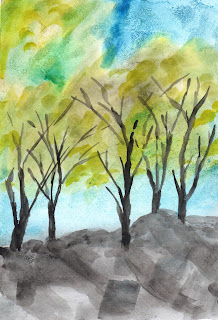
Right now my first attempts to go with the seasons revolve around my sketchbooks and a small painting-a-day practice. I'm currently concentrating on trees including the quick sketch I've put at the top of this post, but soon those trees will be full of birds, flowers, squirrels and even kittens. I only hope I have enough time each day to keep going!

Tip of the Day: Spring is in the air, a great time for both writers and artists to consider starting a nature journal. Always keep in mind that you don't have to draw or paint to create a beautiful journal. Instead of drawing, try some collage using items like seed packets, handmade papers, or fabric. Experiment with dipping leaves, sticks, or pods in ink or paint and printing your impressions onto your journal pages, or paste in the actual plant materials. Take photographs and add them to your words. 

And speaking of words, that's exactly what I'll be taking a look at in my next post: Creating with the Seasons, Part II: Writing. See you soon!

Thursday, March 25, 2021

Spring into Spring! Try Something New


© Creative Commons Zero / Dreamstime.com

Happy Spring, Everyone! What are you going to do with this happy and colorful season? How about giving yourself the gift of a brand new creative start? For instance:

  • Try writing in a new genre. Although I primarily consider myself a literary author with a background in writing for young readers, I've always wanted to try writing a traditional mystery for grown-ups. With that goal in mind, I've purchased a copy of Hallie Ephron's How to Write and Sell Your Mystery Novel. The book is brimming with dozens of useful exercises designed to cover all aspects of the genre, exactly what I needed to get going. Conversely, if you've written several mysteries already, you might want to try writing a historical romance, or a children's picture book. Spread your wings!
  • Draw or paint in a new medium. (Even one you usually resist.) The key here is to not worry about results and to focus on exploration. If you've only painted with watercolor, try oil paint, charcoal, or melted crayon. Often you can surprise yourself by using untried materials in your own way, rather than "following the directions."
  • Take a Five-day Challenge. Five-day challenges are a great way to start or finish a particular project, especially one that's caused you to stall or procrastinate. Five days may not seem like a lot, but it's astonishing how much you can accomplish if you make the effort to show up every day. So what have you been putting off? Starting your novel? Hemming a quilt? Painting a series of animal portraits? Set aside a dedicated time to work for five days straight and plan to be amazed at your progress.
  • Buy a new journal or sketchbook and use it for a single theme. While it's easy and tempting to use your journal or sketchbook as a catch-all for every fresh idea or observation that pops into your head, it can be far more rewarding to assign one subject per book. Using one sketchbook for drawing faces and hands, and another for ink studies of trees can help eliminate the problem many artists have of wondering "what to draw or paint" every day. It's the same with writing. Having a journal solely for, say, character studies, and another for poetry means you'll be ready to write the minute you sit down at your desk.
  • Choose a subject to research. A good friend of mine has just returned to her home in Mexico from a trip to Guatemala. I'd love to do something similar, but travel's not an option for me right now. However, that doesn't mean I can't go for a little armchair travel with the help of my laptop and local library. One of the subjects I've decided to explore based on my friend's journey is Mayan clothing. I've become captivated with the hand woven and embroidered huipiles that Frida Kahlo so famously wore. After only a few pages of research I'm already inspired to dive into some new sewing, drawing, and painting projects utilizing these wonderful designs. 
  • Write some flash fiction. The beauty of flash fiction is its brevity. Set a timer, set a word length, choose a word prompt, and get ready to write. Although you may want to edit, revise, and polish your work at a later date, the secret to good flash fiction is to immerse yourself in the moment: write as fast as you can in as short a space as you can. Let the words take over. Approach the exercise as a game or challenge rather than a race to perfection.
  • Try virtual school: watch a series of how-to videos and don't forget to do your homework. While my favorites are always the art classes, there is simply no limit to what you can learn online. What's important here, though, is to go beyond being a passive viewer and to put what you've learned into practice before moving on to the next video.
  • Find a discarded manuscript or some old sketchbook pages and rework them. If you're anything like me, you have a cupboard or storage box filled with practice work: sketches and story snippets that may not be your best but certainly helped you reach the skill level you have today. Open the box and see if there's anything you can salvage and re-use. Is there a story you can completely revamp with new characters and settings? Can you draw or paint fresh pictures based on your old sketches? (Bonus tip: Is there anything you can part with and declutter while you're at it?)
  • Write, draw, or paint with an unusual implement. Try writing or drawing with a coffee stirrer, a bamboo stick, a broken twig, a feather, your fingertips. Pencil tip erasers. Your non-dominant hand. Gold ink, tea bags, squashed flower petals. Play with a variety of supports: cardboard, newspaper, an old sheet or a piece of unwanted clothing. Let your creativity flow.
  • Create some found poetry. Found poetry is much more than cutting out groups of eye-catching words and phrases from old books and magazines, or reassembling the entrees listed in a menu to read like a sonnet: it's what you bring to the table as a writer and artist that turns the mundane into a work of art. Rather than transcribing a handful of found words from junk mail and shopping lists onto a blank page, try gluing your finds onto an interesting background, one you've painted, or in the same way as your text, rescued from the trash.
  • Explore nature. There's nothing like being outside to clear the mind and get the ideas rolling. Creative activities can span the range from planting a garden to starting a nature journal. Try sketching or writing outdoors more than you usually do; visit a botanic reserve or park; sew an apron for yard-work. Buy some cheap terra cotta planters and decorate them with paint or collage you varnish onto the surface. Glue on some seashells or glass tiles.
  • Leap out of your comfort zone. Yes, leap! And don't overlook stretching, bending, walking, dancing and moving in any direction you can. One of the greatest dangers of modern creative life is the tendency to sit still for hours and hours at a time while your brain is moving at lightning speed. If you've ever stood up from a lengthy computer session and groaned from the kink in your back, you'll know exactly what I mean. Not only will moving at regular intervals help to improve and maintain your physical health, it's important for your emotional well-being, too. Writers and artists can be hard on themselves and a quick walk around the block has the power to change everything. 

Tip of the Day: Creative exploration should be fun--and easy. If you're a writer who's never picked up so much as a pink pastel, don't pass up an attractive paint-by-number kit or an adult coloring book. It's the same for artists; your local bookstore or library has shelves and shelves of inspiring how-to books for beginners wishing to take their first steps into poetry or memoir. Go for the basics and see what you like. It might be the start of something big!

Monday, January 11, 2021

Start a Creativity Journal for 2021


© creativecommonstockphotos / dreamstime.com

Happy 2021! What are you going to write or make this year? Whatever it is, a good way to get started and stay on track is to use what I call a "creativity journal." Unlike a journal that records general daily thoughts and events, a creativity journal is a dedicated space solely for dreaming, planning, and keeping all of your "how to" notes and supply lists in one convenient place.

The notebook I'm using this year is the "Celeste" edition from Paperblanks and is meant to represent "a Venetian morning alight with marvels." (Sounds good to me!)

The journal is a handy 7" x 5", just right for quick thoughts as well as more serious contemplation. I especially like the elastic band (not shown) attached to the back cover that keeps the journal closed when I'm not using it. I also like the creamy, high-quality paper and the nifty pocket glued to the inside back cover, great for business cards, receipts, and oh, you know, stuff.

One of the first things I like to do with my creativity journal is divide the pages into various sections and headings that I can complete, and refer to, throughout the year. Once these sections are in place I can go back to them at any time. For instance, I have sections for each month of the year with further areas to list how I plan to fill in the weeks. Other sections are specifically to log my ongoing progress with tasks such as manuscript drafts, painting series, or maintaining my blog. My final journal pages are left blank for all those deep, meaningful questions always at the top of my mind, e.g., What do you long to make if time, money, and skill wasn't a problem? Very important issues!

More journal sections I've included in the past that you might like to try using are:  

  • A place to record accomplishments, finished projects, sales and reviews.
  • A section for how-to notes taken from books or magazine articles.
  • Areas to paste in small motivational magazine photos and quotes.
  • Pages for baby steps: things to do on a daily basis that will take me to the finishing line.
  • A place to list favorite supplies or ones I'd like to try in the future.
  • Sales opportunity pages: lists of agents, editors, craft fairs, online sales outlets
  • Pages devoted to ideas for branding, asking myself, What's my message; what's my theme?
  • A place to list possible workshops, classes, books to read, or any areas I need to research in order to accomplish my goals.
I'm sure you have plenty of other ideas for things to include in your own journal, but the one section I most enjoy is my vision board. This is something I usually spread over two facing pages, or better yet, the journal cover itself (unless, of course, I'm using a Paperblanks "Celeste" journal and wouldn't dream of pasting on a single sticker!). 
 
To make a vision board in your journal, simply start by asking: Where do I want to be by the end of the year? What kind of creative life do I want that will express my highest potential? 
 
Rather than writing out your answers, go with your intuition and fill your board with collage and artwork. Use magazine cut-outs, glitter pen doodles, fortune cookie sayings, vintage ephemera, bits of junk mail, anything that visually portrays your goals for a colorful, exciting, and satisfying year ahead.

Tip of the Day: Go slow. Take your time with your journal and remember creativity is a process. You've got a whole year ahead to fill in your journal pages with lists, plans, and ways to make your dreams come true; there's no need to rush. Some years I've had to wait all the way until December to know exactly what it was I wanted or needed to do. The main thing is to look upon your journal as yet another part of your creativity, so make it a joy to use. 

Wishing you the happiest of journal discoveries for a bright new year!

Tuesday, March 17, 2020

Staying Home? Make an Altered Journal!

© Honourableandbold / Dreamstime.com

It's springtime in Albuquerque and the streets are stunning right now: trees in full blossom, daffodils glowing golden-yellow in every yard, birds bustling in the branches, and hardly a car to be seen thanks to the sudden need to "self isolate" and keep a low profile. Many of us will be staying home more than usual, cancelling social activities and group meetings and doing our best to stay safe and sane. In other words, it's a perfect time to start (or to at least take a fresh look) at one of my favorite creative activities: journaling! 

Without a doubt journaling has been the single most valuable tool and practice of my writing and artistic life. Rarely a day has gone by that I haven't journaled in one way or another, whether it was to record my joy, work through my despair, or simply to find an inventive way to deal with plot-bunnies.
 

Although the majority of my journals fall into the category of hodge-podge grab bags, i.e., volumes of complaints, gratitude lists, poetry, and to-do lists all in one convenient spot, I've also written and created many journals dedicated to a single theme, e.g., nature, haiku, or travel. Over the coming weeks I thought it would be fun to share some of the different types of journals I've enjoyed best, starting with A, the Altered Journal.
 

In reality, "altered journaling" is a bit of a redundancy as any journal you work with is altered from the minute you fill in the first page! All that white paper quickly transforms into an individual form of expression that will never be matched again. But sometimes it's fun--and necessary--to go a step further beyond simply writing down your thoughts. That's where the altered journal comes into play, turning your words and ideas into a stand-alone work of art that can be enjoyed for the sheer beauty or individuality of the journal.
Starting an altered journal is easy, and relatively inexpensive. Most if not all of the materials you need are probably right in your house (great for when you can't leave home!). 

So, how to start?
 

- Begin with an old, possibly ruined book, one that's truly beyond its shelf life. Whether the subject is years out of date, the condition is poor, or it's just a book that never was, um, that well-written, choosing a hardback rather than a paperback to alter is often best. (Tip: unused, unloved cookbooks are an excellent choice. The size and paper weight is often larger and heavier than a novel or work of nonfiction, giving you plenty of room for writing and artwork.)
 

- Once you've got your book, I've learned from hard experience that it's imperative to not fall into the trap of journaling on every single page. In fact, unless you want to end up with an unwieldy, never-ending project that you will be sorely tempted to abandon halfway through (been there, done that) it's best to limit your page length. To make your journal easier to work with you can either remove a number of pages, or you can use thin coats of gesso to glue sections of pages together, leaving just as many surfaces to work on as you think you can comfortably handle. 

- If destroying books no matter how bad their quality breaks your heart, then how about using something like an old calendar? Once again, liquid gesso can be your best friend as you can use it to paint over any of the date pages or artwork you don't want while leaving a nice white (or any other color; a little acrylic paint mixed with the gesso works a treat) surface to work upon. 

- If you really want to keep things simple, try just altering the cover to any kind of blank composition book. Collage, paint, doodle--express yourself! 

- Another easy way to start an altered journal is to rework an old journal you already have, one that has served its purpose and you no longer want to re-read or keep. Collage or gesso over the existing pages, isolate certain passages to create found poetry, cut and tear the edges into interesting shapes and patterns. 

- For a super-simple altered journal, take a new or used greeting card and staple several folded blank or printed pages down the center. Consider using handmade, watercolor, construction, or even wrapping paper for your pages. 

- "Found" pages stapled or sewn together can create interesting journals in a wide variety of sizes. Recycle and combine old postcards, junk mail, and magazine cut-outs to create something unique and brand new! 

- How about making a journal out of used paper shopping bags? I have always loved drawing on what's called "bogus" or "kraft" paper, the same stuff they use to make brown paper grocery bags. Besides cutting down the bags into pages, you might like to fold one big piece of paper accordion-style or into a cube that opens into a series of smaller "pages."

Whatever you use for your altered journal, be sure to fill your pages with more than writing. Experiment with rubber stamping, glitter glue, ribbon and fabric, any kind of sticker, and your own artwork Most of all, enjoy the process and don't stress about the outcome. Whatever you make, I know it will be beautiful!


Tip of the Day: Currently it seems as if our daily lives and routines are being altered by the minute. It can be scary and for some people I am sure it has been deeply tragic. My sincere sympathies go out to those who have lost friends and loved ones. 

While we wait for things to improve, I believe it's truly important to stay active and to stay positive. Journaling in all its many forms is the best way I know to remain focused, involved, and engaged with your creative self no matter what may come. Wishing you all a safe and happy passage through these troubled times.

Wednesday, April 17, 2019

CampNaNoWriMo 2019: The Seaweed Collector


"Tide Pool." Mixed-media piece from a long ago class . . .

Until a few weeks ago, I always thought #CampNaNoWriMo was in July. Then, thanks to a stray tweet I happened to spot mentioning it was also in April, well, my course was set, and here I am: once I hear of a writing or art challenge, that's it, I'm lost. I HAVE to participate.

Despite having written with my cabin mates a couple of years ago, I wasn't very well prepared for camp this time around. No sleeping bag, no name labels sewn into my clothing, not even a bag of Fritos for late-night snacking. Suddenly it was April and I had to show up at the blank page with a rather hazy idea and not much else.

Fortunately, CampNaNoWriMo isn't anywhere near as stressful as November's 50-thousand-word-novel-in-a-month ordeal. At camp you're expected to play. You set your own rules and goals, write in any format or genre of your choice, from screenplay to memoir, or you can even go for a full novel if you so desire. For me this freedom translated into the decision to go down a strange path of my own invention: 50 pages of narrative prose poetry handwritten into a journal with collage on the corresponding pages.

My title for this project, The Seaweed Collector, was inspired by a photo on Pinterest of an old nonfiction book of the same name. When I saw it, all I could think of was: Who is the Seaweed Collector? What does he/she do? Where does he/she store all that seaweed? How many kinds of seaweed are there to collect? After some research I found that the original book was printed in 1923 and is actually an encylopedia of British seaweeds. Because it's in the public domain now, you can buy what sounds like a photo-copied reprint on Amazon. com.

At first I was worried that this side trip was going to detract me from my daily page quota on my current WIP novel, Ghazal. But then something interesting happened; I realized that I wanted to add pages and lines from this new work to my novel, making them all part of a mysterious "book within a book" that the characters read, pass on to each other, and that changes them all in some way. Needless to say, I'm pretty excited about this development. I'm also grateful that I haven't just gone running after some time-wasting diversion that keeps me from my "real work." Now to go build my blanket fort. . . . Catch you next time.

Tip of the Day: A fun way to start any new project is to borrow the title of an existing book, especially one that's fairly old, or out of print, and that nobody could possibly associate with a well-known narrative such as Gone With the Wind, or Peter Rabbit. You don't even have to buy the book; browsing the library or a used-book store should give you plenty of fresh ideas!

Thursday, March 14, 2019

Old Books for New Art


This week I've been tearing up books. Lots of them. Not because I have anything against books (no!), or have a particular fondness for the sound of tearing paper, but because sometimes the best thing to do with a dog-eared, multi-read, falling-apart old paperback is to turn it into, you guessed it: collage! Or, better yet, an altered book of its own.

My love of using books as the basis for collage or as backgrounds for artwork started several years ago when I tried using a second-hand volume of architectural renderings as an art journal. At the time, I was so new to the process I thought you had to gesso, paint, and alter every single page of a book to have it qualify as an "altered book." I hadn't yet learned that the established technique most book-altering artists use is to glue or gesso several pages of an old book together in such a way that you end up with about a dozen or so very stiff, very solid "boards" to work on. Instead, I water colored, drew, pasted, and wrote on every single page of my altered journal, back and front. It took months (years) to complete and I still see room on the pages for more I can do. The end result was a monstrosity so thick it has to be held together with the kind of rubber band used to bind a bundle of asparagus or broccoli crowns.

Despite the enormity of my task, or maybe because of it, I learned an enormous amount from that first effort, mainly that one of the best collage materials available were the pages of other old books. Torn or cut up, the pages yielded all sorts of treasures, from weird illustrations to bizarre snippets of text just right for the type of mood or atmosphere I was trying to evoke. And I haven't stopped.

My method for  choosing which books to tear up is most often related to the age of the book, e.g.:
  • The book is at least 50 years old, but is in no way a collector's edition. This especially applies to books printed on acidic paper and that (unfortunately) are disintegrating on their own with no help from me.
  • If I do use a newer book, such as a mass-market paperback from the '90s, it's amazing how even a 20-year-old book can age to the point of having a broken spine, dog-eared and brittle pages, and the entire thing has yellowed to an unattractive yuck-color. No one could possibly enjoy reading the book in its current state of decay, and that's why it's on the "please take me away" free shelf at the library or similar.
  • Sometimes, just sometimes, a brand new book can also be a total disaster due to an accident of some kind: the cover is missing as are several key sections or pages, the remaining pages are beverage-stained, mud-smeared, and/or water-logged,  and the whole thing is destined for the trash.
  • Mass-produced nonfiction books, regardless of age, often have amazing illustrations and photographs, but contain very little informative text, especially if the research or covered topics are hopelessly out-of-date, or the quality of the writing is below par. Ho-hum cookbooks, history texts, and how-to books you find on bookstore bargain shelves are all good examples.
  • Finally, magazines of all ages are always a good stand-by if you just can't bring yourself to tear up a beloved book, no matter how bad the condition.
Next step: what to do with all this paper madness. How about
  1. Pasting the torn strips and pieces of text into a random pattern on top of another kind of support, e.g., a journal page, a Masonite board, or Bristol board, etc. 
  2. Turning chapter titles, lines of text, and individual words into found poetry.
  3. Covering the text with thinned gesso, acrylic paint, clear gel medium, or even watercolors. I like to vary the thickness of this coating, sometimes like it to be completely clear, or quite heavy to just leave the faintest amount of ghost text in the background.
  4. Drawing on complete pages that have been torn from the binding, but not cut up in any way.
  5. Cutting, folding, and gluing the pages into decorative shapes or small envelopes to paste throughout my journal.
  6. Photocopying the various pages to create different sizes, distortions, or stronger backgrounds to then color or paint upon.
  7. Label or title an existing collage or mixed-media piece.
The best part of tearing up books for me has been discovering the perfect piece of text through the happy accidents of randomness. For example, I might find in my pile of shreds a passage about the beauty of gardening. Matching and pasting these lines on to a scene of urban decay creates a tension that I don't think I could express any other way. It's magic!

Tip of the Day:  Book lovers, please don't despair. I realize how painful the idea of tearing up books can be for some of you, but look at it this way: when you tear up an old book, you're actually saving it (or at least the best parts). What would normally end up in the trash can now be a serious creative tool.

Tuesday, January 15, 2019

I Miss Polyvore

One of my early Polyvore creations . . .

No two ways about it: ever since Polyvore.com disappeared from the Internet a few months ago, life just hasn't been the same. Some days I miss the site so much I could cry. Why'd it have to go?  Polyvore was fun. Polyvore was creative. Polyvore was inspiring. And now it's been sold off to a company that isn't, well, into what Polyvore was all about it. Instead of being a collage/fashion/art/community-building site, it's turned into a not-very-interesting shopping outlet.
 
For those of you who have no idea what I'm talking about (sorry!) Polyvore.com was a do-it-yourself, drag-and-drop Internet playground for making online collages. Membership was free, and members had access to thousands of photo images, background colors, text fonts, and tons of digital ephemera to make some of the most amazing digital artwork I have ever seen. For me it was a huge opportunity to learn and practice alongside those same artists. 

I owe a lot to Polyvore. I was a member for a full 10 years and especially enjoyed the way the site was organized into groups of people with similar interests, e.g., Writers; We Love Dresses; Travel; Antique Furniture; Book Club; Shoes Rule!; Cats; Bracelets; Working Moms . . . and so on. Joining a group was optional, but being part of one provided certain advantages such as being able to participate in various contests, e.g., "Make a set that includes at least one cat," or, "Create the perfect steam punk outfit." Contests were a great motivation to do your best and most original work and winning was a blast, even if the "prize" was simply recognition and applause from the group. 

More than anything else, however, Polyvore for me a way to:
  • Design writing prompts.
  • Create blog post headings (like the one at the top of this post).
  • Help with my website design.
  • Illustrate my WIPs (especially in the wardrobe department).
  • Experiment with color combinations for drawing and painting.
  • Stay in touch with pen pals from across the world. My own little circle included creative and friendly women from Saudi Arabia, Germany, New Zealand, and Brazil. Because we only communicated via Polyvore email, and most user IDs were simply first- or nicknames, I have no way to reach any of them ever again.
One of the worst things to happen to the vast majority of Polyvore fans when the site went down was they lost all of their online creations. Fortunately, I kept every single one of my own, putting them into a separate file on my computer each time I made one. Something must have told me that doing this would come in handy one day, and it certainly did. I think if I had lost my sets along with everyone else, I'd be even more devastated than I already am. Truly my heart goes out to every member who lost hours and hours, if not years, of beautiful work.

Polyvore.com definitely enriched my life. Now that it's gone, it's up to me to motivate myself and to continue making collages the old-fashioned way, on paper and in art journals. Not quite so easy to do during a quick lunch break or just before going to bed, and don't even get me started on cleaning up the aftermath of glue sticks and paper scraps, but it's all I've got left. Maybe not such a bad thing in the end, but boy, do I miss those happy days of instant gratification! See you next time.

Tip of the Day: Without Polyvore, I'm relying a lot on Pinterest.com. It's not nearly as fun nor as interactive as Polyvore was, but it's a good resource for illustrating my characters' homes, closets, and vacation destinations. I can still bring my WIPs to life visually, just in a different way.

Wednesday, June 21, 2017

Food, Glorious Food!


I've been thinking a lot about food, mainly because I haven't been able to eat much of it thanks to an emergency dental issue. All my favorite go-to writing snacks, e.g. carrot sticks, wasabi crackers, tortilla chips, cheese, etc. have been put on hold in favor of soup and endless glasses of water-and-lemon. And if you think writing and liquids make a good combo, let me tell you, they do not.

I don't know why I get so hungry when I write, and it's even worse when I read. I am a born snacker-grazer (thank goodness I love carrots) and one of my pet peeves when reading an otherwise engaging book is the lack of any mention or description of food. Whether the characters are dining on lobster bisque at a five-star luxury resort, or heating up beenie-weenies on a campfire, I want to know. 

Food, to me, is vital to a story: Meg's first disastrous dinner "party" in Little Women; Proust and his madeleine dipped in tea; "Babette's Feast"; Like Water for Chocolate; William Saroyan eating a messy peach in The Human Comedy. In other words, a story without food is like some miserable diet--impossible to follow!

Both the consumption and preparation of food can play a magical part in your own writing. For instance,
  • Food can be the basis of an entire memoir: one triggered by family recipes; favorite holiday meals; what you cooked when where, and why; favorite cookbooks; good and bad restaurant experiences. Tip: a fun way to start is to write a recipe as a letter to a friend--real or imaginary. Spin off into tangents of freewriting as you go.
  • Food can be the subject of a poem or short story, or a whole collection.
  • Food and meal prep can be great ways to "show, don't tell" when exploring fictional characters, and even writing action scenes. What do your characters love, hate, won't for anything? What about their attitudes to cooking--good, bad, indifferent? Do they prefer to order take-out? How do they feed kids, pets, spouses? Are they vegetarian, gluten-free, suffer from unusual food allergies? What's their favorite snack, adult beverage, brand of chocolate? There are so many possibilities I sometimes think you could write a complete character-bio made up solely of food choices and experiences.
Some other ways to include food in your writing can be to:
  • Create a character who specializes in food preparation and the pleasures of the table: A chef, a restaurant owner, a food critic, an artisan cheese maker.
  • Dig into cookbooks and food magazines. Both are excellent resources when you need to find new meals for your characters to enjoy, especially if you're writing about characters in foreign settings. I'm a great fan of food magazines in particular and often cut out the actual recipes along with the accompanying gorgeous photos to place in my work-in-progress files. The photos can later be used for painting references and collage elements. 
  • Use your favorite restaurant as a setting. Better yet--try writing while you're there!
  • Never overlook the opportunity to write your own cookbook, how-to article, or restaurant review, whether for print or online. The same applies to starting and maintaining a food blog if you find yourself falling in love with the idea of culinary writing in all its many aspects.
However you choose to write about food, the one thing I'd like to suggest is never ignore it. There's nothing worse, I think, than to read about a character who never eats unless he or she is some kind of mystic or suffering from an eating disorder. I once read an otherwise excellent mystery set in Barcelona, the home of the world's best tapas, where the characters lived on nothing but coffee. They didn't even get cake! I couldn't stop wondering how they maintained enough energy to catch the bad guys when they never stopped at a single cafe or convenience store. I was starving by the time I finished the book. 

Tip of the Day: As fun as it is to gorge characters on sushi and streudel, you don't want to bore your readers with endless step-by-step descriptions of all-day banquets or baking marathons. Like the best recipes: keep it light, keep it simple, and always keep it tasty. Bon appétit! 

P.S. The good news is my mouth is on the mend--I'll soon be crunching on those yummy carrots in no time at all! See you next time.