Showing posts with label Writing. Show all posts

Saturday, March 7, 2026

Back from England, Part 3: Writing the Book I Wasn't Supposed to Write

Autumn + Fog = Endless Inspiration!

Welcome to my final post on my multi-week visit to Faversham last winter. In my previous posts I've described my general impressions of being in England, as well as my daily art practice. Today I want to go over what was probably the most valuable take-home from my stay: the manuscript I wrote in between sketching, shopping, and sightseeing. 

Writing will always be my primary creative pursuit, and no matter where I travel to I always take a journal and pen with me. It's not unusual to find me spending several hours a day (or night) in a cafe or my hotel room writing down my impressions and recording my memories.

For this trip, however, I gave myself a much more serious writing goal than keeping track of how many historic sites I could cram into seven weeks, and it couldn't have been a worse decision: I thought I wanted to write a grief book.

Before I left home, I had the idea that my time in England would be well spent if I finally tackled writing the book I had wanted to read when my husband died; the one I couldn't find on any bookshelf regardless of how hard I looked.

Don't get me wrong: it wasn't that I couldn't find any grief books. Dozens of titles, ranging from the widely-recommended It's OK to Not be OK by Megan Devine, to Carol Cornish's The Undistracted Widow are readily available anywhere that sells books. The trouble I had with these and others like them was that not one addressed my particular situation. I didn't have children to help me navigate bereavement; my immediate family was already deceased; and my circle of friends is close, but small. All of the books seemed to take for granted that of course your adult children will handle cremation or funeral arrangements, and yes, you'll have casseroles piling up on your back porch, and yes, your fellow church members will do everything they can to be of assistance--they'll even bring more casseroles! But I didn't want advice on casseroles or church services; I wanted a book that told me how to sell a business while my bank accounts were frozen.

With that in mind, I decided I wanted to write a book for other widows who might find themselves in circumstances similar to mine; widows who were suddenly alone without practical hands-on knowledge or support while dealing with utter despair. In short, I wanted to write a cross between a road map and a how-to instruction manual that included all the things I had learned to do by being forced into action.

With this lofty goal in mind, I set out on my very first day in Faversham to buy a large-sized notebook (I already had my pens) that I began to fill the minute I returned home.

For the next forty days (and it was exactly forty days with all the symbolism that brings to mind) I was more than diligent. I made an outline with chapter headings. I wrote a full two pages every morning as soon as I finished cleaning up from breakfast. I wrote notes for the next day before I went to bed. I brainstormed marketing ideas. I started a bibliography. And with each writing session I became more and more despondent. Not because my subject was grief, but because I was bored beyond human endurance. Worst of all, I wasn't saying the things I wanted to say in the way I wanted to say them. By the end of the forty days I was basically ready to scream, "Oh, hell, who cares about grief! It's crappy and it sucks and it's the worst thing that will ever happen to you, but you will survive. You will. I promise. Look at me, here in Faversham writing a whole book when I couldn't get off the floor three years ago." And that was the entire message in a nutshell.

The minute I stopped long enough to truly listen to myself and to hear what it was I truly wanted I realized that the only way I had learned so much about a grief-filled life was because there wasn't a manual. There was no "rule book." Things that seemed hard at the time were only difficult because I was so deeply caught in grief and no book would ever have made any difference or my tasks any lighter.

Which is why after forty days and nights of dutifully plowing through a first draft I was beginning to hate, I suddenly wanted with all my heart and soul to tear up the field with my bare hands and burn down the barns while I was at it. I wanted to write a different book. I wanted to write a gothic romance (my ultimate favorite genre), one that included themes of grief, loneliness, betrayal and loss, but in a way that gave me, as well as potential readers a sense of . . . entertainment. I wanted to express my feelings and experiences through art, not a homework assignment. 

The next morning after what I consider a genuine epiphany, I went out once again into the cold and bought a fresh set of lovely notebooks to start writing the real grief book; the one that was begging to be written as fiction--the absolute best way I know to tell the truth.

As soon as I set my mind to following my heart rather than my "shoulds" all kinds of magical things happened. I saw a little cat who would become a character in my story (I named him Mango) disappear through his own little portal cut into a church door. I saw where some of my characters would live:


 Or haunt:

Or meet for a long history of fatal duels:


Overnight the Kentish wintry miasma of gray skies and dropping temperatures became as necessary to me as breathing. Best of all was coming home from my endlessly soggy walks, making a cup of tea, and sitting down to work at something I loved doing. As a child growing up in California I had always dreamed of one day writing in a garret with the rain pouring down and here I was!

So I say, write what calls the loudest to you, not what you think is the literary equivalent of liver and onions because it's "good for you." Creativity should be fun and satisfying; go for the eclairs. There's no shame or sense of defeat in abandoning a manuscript that bores or keeps you from wanting to continue, because essentially nothing is ever wasted. That same boring manuscript that has become an exercise in torture is in actuality a gift, the stimulus for writing something much, much better and more meaningful to you. For me, writing about my personal run-in with grief was--until it became a chore-- cathartic. It helped me to release a lot of my old thought patterns and examine why I was holding onto them in the first place. More importantly, having the discipline to write every day eventually led me to discover what it was I really wanted to write. If I hadn't made that initial effort I still would be thinking there was a book I was "supposed" to write, which after forty days there was. It just had vampires rather than tips on how to file estate taxes. And what could be better than that?

Tip of the day: Never refuse an eclair. Unless you're offered a sherry trifle instead.

Thank you so, so much to everyone who has taken the time to read these last few UK posts. Going to England on my own was one the most challenging, and rewarding things I have ever done, and I'm not finished by a long shot. Believe it or not (and I can hardly believe it myself) my next post will be coming from New Zealand. I'm leaving Albuquerque again for six weeks to draw, swim, and eat some of the best cakes on the planet while retracing my steps from a former life in downtown Auckland. See you soon!


Thursday, January 15, 2026

Back from England! Part 1

 
Faversham! Grey skies and all.

Hello, Everyone! The last time I posted it was about my art retreat journey to France and the artwork I did (and didn't do) there. Several months later I'm
now back in Albuquerque after a seven-week visit to England where I stayed in Faversham on the southeast coast. 
 
 
Although I confined my stay to a town the size of a bread box, I managed to do so much that a single post won't cover it all. With that in mind, I'll be writing some future posts about not only what I painted during my visit, but also about starting a brand new manuscript inspired by my surroundings. So please consider this current entry as a general overview of what got me motivated to "stay creative every day" and how much fun I had discovering that same motivation.
 
Returning to Albuquerque during the holiday season gave me plenty of time to regroup and go through the pages and pages of manuscript and sketchbook studies I brought back along with three new sweaters and a set of the best drawing pencils I've ever owned (roughly the equivalent of $5.00 from the discount store. Go figure.). It also gave me some time to think about how on earth I had the fortitude to make such a lengthy and productive trip.

The only explanation I can come up with is that in the three years since my husband died I've encountered so many challenges related to loss and grief I've become much braver than I ever could have imagined. Going to France only weeks before leaving for the UK was another confidence-builder. Admittedly, staying in a French art retreat was hardly a grueling test of will-power and determination (other than surviving for nine days without my luggage). Instead, I traveled with a group, many of whom were friends I already knew, and our days were exquisitely pre-planned with food, transport, sightseeing, and art instruction served on a plate, usually with a glass of wine.

This latest trip to England, on the other hand, couldn't have been more different, and that was exactly how I wanted it. Apart from the freezing cold and having to constantly boil kettle after kettle whether for filling the hot water bottle I carried close to my chest like a beloved pet, or for making endless cups of tea just to wrap my hands around the cup for the warmth alone (drove me nuts, people. Drove me nuts.) I learned I could, well, cope and even be happy about. Good thing, too, because it wasn't the weather alone or never quite understanding the recycling system that forced me into a learning curve. I had to learn to not leave the house without an umbrella or my own shopping bag. 


My Halloween-themed bag I wanted to use every day! Boo!


I had to learn to accept and not go on and on and on about the weather (or at least no more than anyone else), or about never seeing the sun or never being warm enough to sketch outdoors. I had to learn to cross roads without pedestrian markings and never being certain which direction the British "wrong side of the road" traffic would be coming from (impossible for someone who when told to turn left turns right).

I had to get used to near-daily food shopping because my very-typical under-the-counter refrigerator couldn't hold more than six eggs and a cauliflower, and I particularly had to get used to not having access to a clothes dryer because there weren't any. In the end and more than anything else, I simply learned to be resourceful--the most British trait of all! Even on the rare occasions when I was consumed by homesickness: "England is such hard work! It's so cold! My clothes won't dry! Why is the sky so dark? I wanna go home!" had me laughing at the absurdity of my situation and looking for a solution, e.g., wear more clothes! That, and speed dry them with my hair dryer.

And once my fingers thawed out enough to hold a pen, I filled notebook after notebook with what felt like a wealth of material: the perpetual sound of inland seagulls crying overhead; the unexpected rumble of passing trains; the melancholy non-stop patter of rain hitting my windows; a cat slipping through its own swing door fitted into a gothic archway. Over the weeks most everything I did or saw turned into a story-line and I couldn't stop painting or writing about every piece of it, including:

1. The town being so pretty, especially at twilight (which by November arrived very early). Little medieval or Tudor shops and inns, narrow winding streets, green spaces and water in-between made every exploration memorable.  


2. Pops of color. Often I'd be walking along thinking the world couldn't get any grayer than an English afternoon when suddenly I would see a surprise burst of color. The combination of bright oranges or pinks against a moody sky gave me some interesting sketchbook ideas I'm still experimenting with.


Yes, I know the sun is out . . . lasted only a minute or two . . .


Quick ink and gouache sketch using a twig. (Brought indoors, of course!)

3. Coffee shops. It took me longer than I thought it would to find the English equivalent of the type of coffee shop I'm used to here in Albuquerque, one where I can sit and write without feeling I'm taking up space or staying too long. Eventually I discovered the cozy, brick-lined basement at The Refinery where I was able to get coffee AND toasted crumpets (we don't have that in the Duke City). I'll be discussing the manuscript I wrote there in another post, but I will always remember writing, writing, writing by hand and with a fountain pen in that little basement. 


This ISN'T The Refinery, but I like the bricks!

4. Speaking of little . . . The attic flat I rented was worthy of a novel of its own. Up several flights of stairs in a lovely Georgian home, despite its miniature size and sloped ceilings it turned out to be the perfect creative space for when I wasn't exploring coffee shops. In all honesty I was a bit tall for rooms I'm assuming once housed a much-shorter serving class, and I was in constant danger of splitting my head open like a melon. What made up for having to remember to always duck if I wanted to go through a doorway was the fact the rooms had recently been painted and refurbished and the abundance of light that came through the windows provided much-needed morale. Another benefit was being so well-situated, smack in the middle of where I wanted to be and I could go absolutely anywhere within minutes. 


The view from my bedroom.


5. If you look closely at the photo above you will see the unintentional inclusion of a dog, and my goodness, but there were a lot of dogs. Before I go any further, let me say that most people know I'm not what you'd call a "dog person," being a committed member of Team Cat, but after seeing the huge variety of beautifully groomed, well-behaved silky, fluffy, and sleek breeds parading through the streets (Whippets! Collies! Chows! Terriers! Poodles!), even I started to see the charm in owning a little oodle-doodle of some sort. Never in my life have I seen so many sophisticated animals in one square mile. 


Stole this off the Internet. No idea who to attribute copyright to, but thank you! Also note summer clothes: not my experience at all.


Besides mistaking the town for the Westminster Dog Show, I basically spent the vast majority of my time as I've already mentioned: writing and painting, plus visiting wonderful people (probably shaking their heads in disbelief now that I've gone: "Yes, she was very strange. Obsessed with laundry!") and walking. I did a lot of walking.

Walking, wherever I am, has been my most reliable grief "go-to" and by now I'm sure I've circumnavigated the entire globe no less than twice, all the while thinking about my husband with every step. This time as I walked through quaint and bustling streets filled with as many prams as pups, or out toward the marshes where all I could hear was the wind, I thought about how much he would have liked being there with me. I thought about how much he, being English himself, would have laughed at all the silly and surreal moments only life in Britain can provide. I thought about how many of the same places I loved he would have also enjoyed stopping in to have a drink, a conversation, a piece of cake (he loved cake!). At the same time I felt confident that going it alone was exactly what he would have wanted me to do at this point in my life, and how very proud he would have been of me for doing so.  

(OK. Not crying. It's a stuffy nose from all that cold weather. Right.)

Next post: What I painted, how I painted, and why: 

Traveling with Makeshift, Limited, and Unexpectedly Good Art Supplies

Here's a glimpse of what's to come. See you soon!


Tuesday, May 27, 2025

Freewriting on a Sunday (or Any Day You Can!)

Albuquerque Morning; watercolor crayons and indigo ink

It's Sunday morning and I'm doing my best to recreate an earlier life: walk to the museum, buy coffee, write to a prompt.

Once I sit down, the background noise holds a familiarity that is good to write to: the coffee machine hisses, children run around the lobby, people stand in line and can't make up their minds what to order: quiche or a chocolate croissant? The cafe tables, as always, are unbalanced, their legs too short on one side and the floor is tiled. The only difference between then and now is I am alone; my writer's group disbanded long ago. And that's okay--writing is a solitary activity and I've learned to be comfortable with solitude.

And just like in the past, I've got a handful of prompts: magazine photos and snippets of text. What to choose? I place everything face-down on the table and pick a few at random before turning them over and surprising myself with the myriad of possibilities. I set the time (how about forty minutes?) and I begin . . . flash fiction, essay, poetry, new chapter for a work-in-progress . . . ?

Whatever I end up writing, though, isn't half as important as the fact I showed up. I did what I set out to do. And that's the beauty of freewriting: taking the time, making the effort, and being perpetually surprised at how much I can write even when I don't really want to.

I can't say enough about freewriting. Ever since I first read (and re-read) Natalie Goldberg's Writing Down the Bones and followed her advice on the topic I've been hooked. Here's why:

1. Freewriting is good for absolutely everything: short stories; novels; memoir; screenplays; poetry, even business correspondence. You can't go wrong with a "don't think, just write" first draft.

2. Breaking freewriting sessions (or anything else for that matter) into timed segments makes me far more productive than when I force myself into hours and hours of non-stop work--which never really works. Note: If you don't like the pressure of a time frame, going for several word- or page-count sessions is equally effective; 500 words per session or 3-5 pages are doable goals.

3. I love prompts. I've written about this before, my last post for National Poetry Month being one example. Prompts save time--no more thinking about what to write--and they don't have to be snipped from magazines or other printed materials. How about choosing an item from your handbag, or writing about a person, animal, object, or piece of artwork right in the area you're sitting?

4. Freewriting gives me a great sense of daily accomplishment. My favorite quote from Dorothy Parker is: "I hate writing, I love having written." While I'd never say I hate writing (because I don't), there are, of course days, I'm not particularly motivated, or I'm too preoccupied with some kind of boring energy drain (e.g., taxes) to sit down and write. Which are the very times that I need to sit down and write. So I do--even if it's only for fifteen minutes.

5. Freewriting has given me what I can only describe as an attitude of "joyful discipline." It's something I've learned to extend into a wide variety of creative pursuits, from gesture drawing and watercolor play to making memory-wire bracelets. Working with a dedicated focus inside a set time frame really boosts my energy and desire to create, and without making me feel the time spent is some kind of horrible homework assignment.

6. I get to use supplies, supplies, supplies! Freewriting by hand is essentially about mark-making, expressing how you feel or think at any given moment in the most honest way possible. To really get those feelings out, try using: giant sketchpads, glitter gel pens, exquisite fountain pens, fancy leather-bound journals, purple ink!

 7. Freewriting gets me out of the house. Writing in cafes, the park, and of course the art museum is more than inspiring, it's fun. Conversely, if you have to go somewhere, e.g., some dull appointment where you have to wait for hours before you're seen, freewriting can make the time go more quickly and enjoyably.

Tip of the Day: No prompt? No problem! Whenever you're stuck, tired, or can't lay your hands on a single magazine, you can always fall back on Natalie Goldberg's elegant go-to: I remember. Fifteen minutes, people--no excuses--keep those pens moving!


Monday, January 27, 2025

Happy 2025; My Year to Go Forward


© Creative Commons Zero / Dreamstime.com


Happy 2025! Happy-to-be-back-blogging-again! Happy just to be here at all! 

2024 wasn't exactly a stellar year for this blog; three whole posts for an entire twelve months due to lengthy eye surgery and subsequent recuperation. I couldn't see, so I couldn't write. (Or read very much, for that matter, either.)

But that didn't mean the year was lost, or solely centered on measuring out eye drops. Before I was totally out of action, I did get a lot done, including:

  • Upgrading my website to now sell my jewelry and artwork.
  • Completing the 100-Day Project. Some of the pieces from the project can now be purchased at my site.
  • Going on numerous local adventures with my wonderful friends. Favorite trips were visiting Albuquerque's Turquoise Museum and afternoon tea at The St. James Tea Room.
  • Finding some great books, the best being The Riders and Dirt Music, both by Australian author, Tim Winton.
  • Discovered graphite watercolors--an amazing product I can't imagine how I ever lived without. Prior to finding them by chance on a YouTube channel, I had used water-soluble graphite pencils, but watercolors mixed with graphite in pans? Never. I'll be writing more about why I'm such a fan in my next post.
  • Finished, edited, and polished both the final draft of my novel, Writing a Ghazal by Moonlight and my novella The Seaweed Collector. (At last. The End.)
  • Created a series of illustrations for The Seaweed Collector.
  • Walked (almost) every day as best I could.
  • And finally the big one: I signed up for a 2025 art trip to France. Yes, I did. I will be staying in a former sixteenth-century convent-turned-art-retreat just outside of Toulouse for a new splash ink class taught by my friend and art teacher, Ming Franz.

While the trip to France might sound like the most exciting thing I have to look forward to, I do have some other equally important plans, starting with:

  • Spend more time on market research and manuscript submission. Whether it's seeking out agents and editors for my yet-to-be-published manuscripts, or increasing exposure for my existing books, artwork, and jewelry, I want to up my marketing by assigning a daily time slot dedicated to business.
  • Organize and polish my many short stories into a series of three anthologies.
  • Finish my dystopian novella work-in-progress.
  • Draft out and sketch two new picture book ideas: (Hint: they involve furry little animals wearing clothes.)
  • Revive this blog and get back to a better posting schedule.
  • Re-arrange and streamline my apartment to become a more functional art studio. For a long time I've been looking for an art studio to rent when it hit me: I have walls, I have space, I have good light--and far too much furniture. As soon as I return from France I'll be changing, well, everything.

In the same way that I like to list my past highlights and future goals, I also like to choose a word for the year, and this year the word is: Courage. And I must say, I can't think of anything scarier.

However, given that 2025 is the Year of the Snake (I HATE SNAKES!) I'm going to try my best to look 'em in the face, even pick one or two up by the tails, and hey, you never know. I might just make friends with a couple. So here I go: new year, new me, new vision. I hope you will find an equally inspiring, if not challenging, word for your own great year ahead.

Tip of the Day: Pick one thing that frightens you the most about creativity (and we all have at least one). Write it down, and then ask yourself why you're so afraid. It could be as simple as "fear of failure," or, "There's too much to learn. I'll never manage it all." Or, "Editors are so mean. Rejection makes me feel worthless."

One of the reasons I have always feared snakes is that my father was from New Zealand where there are no snakes. I was raised with terrible phobias because any kind of snake was considered a potentially deadly foe; no thought was ever given to non-venomous varieties or how helpful snakes can be maintaining their environment. 

Creativity can be just as frightening when we don't know what we're doing, or why we want to do it. This year, make a commitment to conquer that fear by learning as much as you can about whatever is calling you. You'll be surprised at how harmless it can be! 


Tuesday, March 26, 2024

13 Reasons to (Not) Cut Up a Magazine

Hello! Happy Spring! The last two months have found me on a blogging hiatus and for a very good reason: I was busy revamping my website, Valeriestorey.com. It was time for a change, and most of all, time to start selling my beaded bookmarks, jewelry, and artwork online. Hope to see you there!

Now that's done, however, it's back to blogging and one of my favorite topics: using magazines as a source for art and writing prompts.

I love prompts for any kind of creativity, even for game playing. Over the years I've used prompts in so many ways I can barely remember a time when I didn't use them. From Susan G. Wooldridge's Poemcrazy and her idea of creating "word pools," to simply having stacks of photo references for NaNoWriMo, magazine prompts have been my go-to method of writing forever. In my opinion, nothing matches an intriguing photo or a mysterious phrase to get a new scene or manuscript really going.

There's just one small problem: I can't find enough magazines! Always in the past free magazines seemed to be everywhere I went. I found them in local tiny libraries or for the grand price of twenty-five cents in thrift stores. Friends would happily give me several at a time, saying, "Oh, you like to cut things up. Take these--please!"

But lately my sources have dwindled. People don't subscribe like they did before, or they read online. So when I do come across a magazine full of great pictures or stories, I don't automatically grab my scissors. Instead, I'm keeping the pages intact and using every little thing they have to offer.

The upside to keeping magazine pages whole rather than shredded is I have a fresh outlook on how I use them, almost as if they were a type of multi-purpose reference book. I've discovered that I can more easily carry an individual magazine with me any time I choose to write outside or at my favorite cafe--no more dropped cut-outs scattering each time there's a breeze. Another benefit to working from a single magazine is I've discovered each issue will have a certain consistency that brings cohesion to a theme or a "look" for when I'm searching out characters or settings. For instance, take:

1. Characters. Because so many magazine issues are built around a single theme or subject, especially the month-by-month issues, it's easy to find groups of people (characters) who belong together. Whether they're all on vacation, all bankers, all celebrating Easter, or all wearing the strangest clothes ever designed in the whole of human history, page after page will feature people in related poses or situations. Regarding them as a group can create a cast of characters with a natural reason for knowing or meeting each other. Even the people and pets in the ads can fit into this united gathering.

2. Settings. Travel destinations. Art galleries. Home improvement. Magazines dedicated to single subjects will have multiple articles and ad repetitions of offices, bathrooms, bedrooms, kitchens, gardens, hotel rooms and restaurants providing so much detail, detail, detail you might never stop writing. When these details come from the same source, you once again have a more unified vision of where your characters interact and why.

3. Phrases. Article titles or ad-copy headlines are perfect for structuring story themes, or even adding to dialogue when they share a common purpose. For instance, art and design magazines will use a lot of technical references; literary magazines tend to be more poetic. Having a full list of phrases from a single source can be an excellent way, for instance, to title chapters or create a logical plot.

4. Found poetry. I love found or "black-out" poetry, taking shortened versions of existing phrases or lines out of context and placing them into new--often startling--arrangements. My personal preference is to use food magazines, but any magazine focusing on just one topic can provide an underlying consistency to your work, resulting in a more complete and better-crafted poem. To keep the magazine in top shape, consider photocopying the pages so that you can experiment with different ideas more than once.

5. And speaking of food . . .  Recipes! It's rare for a magazine that includes recipes to simply present a grab-bag of ideas somewhere on the back pages. Individual issues will instead usually choose one food type, such as salads, pasta, or a thousand-ways-with-eggs to complete each month's edition. "Recipe groupings" are great sources for character "show, don't tell" when you want to describe any of your characters' food preferences, dislikes, or allergies. They can eat the same thing over and over but cooked in a variety of ways, or avoid certain dishes with valid authority rather than "I don't like it."

6. Respond to a magazine's theme. Study each page and/or article as a whole and freewrite your feelings about what you read or saw. Sometimes the general color scheme alone can inspire a wealth of emotional response.

7. Add your own article or story. When you're finished reading a magazine, write something of your own to add to it. You might even want to write a piece in the voice of one of your characters to explore what truly interests them or how they feel about any given subject.

8. Get mad! Conversely, something about a magazine might bother you. You don't like the message, or how it was presented. Get snarky, be rude! Throw it at those horrible people in their dreadful glass houses with too much furniture and artwork. Let 'em have it. And make sure your characters behave even worse.

9. Get published. Why not? Magazine editors are always complaining about submissions that have nothing to do with a magazine's theme or requirements. But if you like a magazine, have studied it thoroughly, and think you have something to contribute, write a piece and submit it. Contact information and submission guidelines are usually listed in the first few pages.

10. Don't just sit there--read. With a magazine in your sketch- or writing-kit, you'll never be bored and will always have something to read wherever you go. You can't do that with a folder full of cut-outs.

11. DIY. Fashion, decorating, style--the things we're attracted to might be things we'd like to imitate or make ourselves. Creative prompts aren't exclusive to writing or painting. Ideas for knitting, pottery, or sewing can be as readily based on a magazine prompt as a story.

12. Art school. On a completely different note, magazines are fun to sketch with. I like to copy, trace, or find color palettes as exercises to fill my sketchbooks.

13. Break the rules. Draw on the pages. Add doodles, improve the view, change the colors of everyone's clothing. Use gesso to glue pages together and turn the whole thing into an altered book for more drawing or collage. (Of course you now have to go find a new magazine for new prompts, but at least you had fun!)

Tip of the Day: If you haven't already, gather a limited number of magazines that inspire you. I find six is a good number without being too cluttered. Personally I like to have a combination of art, fashion, interior design, food, and some kind of subject I wouldn't normally choose, say, a pet magazine. A good literary magazine is essential too. And don't overlook shopping catalogs. When you're ready for a new collection, simply pass your used copies on to your other writer friends and start all over again!

Thursday, November 2, 2023

NaNoWriMo '23 -- It's All About Me! (And You Too!)


So here we are again: November and National Novel Writing Month and the eternal question: Why am I doing this??

Because I love it, I suppose!

Whatever the reason, this year has found me throwing myself into creative challenges with more than reckless abandon. I had barely recovered from July's Camp NaNoWriMo when I decided to go for Inktober '23 (31 days of daily ink drawing with mandatory social media posting) and then the next thing I knew I had to do "the real" NaNoWriMo . . . and off we go.

When I first thought about signing up for NaNoWriMo 2023, my intention was to simply continue the story I had started in July. Although I had reached my 50K goal, the manuscript was in no way complete, so it made sense to think November would be a good time to write another 50K to finish things off. 

That all changed several weeks ago when I couldn't sleep one night and got up to write instead. Suddenly I was immersed in a new story, one I hadn't expected to write and one I didn't really want to write. Working on a "shiny bright idea" with so many other projects calling for attention felt like a very bad idea. But there it was and it wouldn't go away so I thought, use it for NaNoWriMo!

While it was easy enough (maybe too easy) to switch gears into a new plot and theme, the abruptness of the change didn't give me any time to assemble my usual scrapbook-style journal of prompts and photo references. I had a great journal full of mood boards and creepy settings to use back in July, but there wasn't a single item I could use toward my new story. Very quickly I had to come up with an entirely fresh approach: rather than rely on my usual magazine cut-outs, I could dive into my own life and make the prompts all about me! (Sort of.)

I was inspired by the example set by one of my Twitter (X) friends, writer and poet, Janis La Couvée, who is currently exploring memoir writing. Her recent tweets on the subject reminded me of a workshop I had taught while I was living in Carrollton, Georgia: "Write Your Memoirs, You're Never Too Young To Start." It was a fun class and I know of several full-length manuscripts that were written for both family record-keeping as well as more general publication. However, other than a blog post with the same title, I haven't thought of memoir for a long time until it occurred to me that using prompts from my own daily life and memories could be what I needed for NaNoWriMo. 

In other words, I'd be "memoir writing" but with a twist. I could assign my memories to fictional characters who could take them wherever they wanted to go. For instance, as a small child I wanted to be an archaeologist, something I obviously never did (unless you count Albuquerque yard work as a trial run), but a fictional character could actually work for a museum.

With that direction in mind, I've made a quick 30-day list I'm happy to share for any kind of writing you might be doing this month yourself, whether it be NaNoWriMo, a genuine memoir, or even a month of poetry.

Taking the words: "base a scene on," or "your main character remembers (something from the list) which then triggers (action or emotion)," try:

  1. A favorite song.
  2. A disliked poem.
  3. Most hated childhood food.
  4. Most frightening moment.
  5. Happiest day.
  6. Three items inside your handbag or pockets.
  7. Three items of clothing you love.
  8. Three items of clothing you never wear.
  9. Favorite pet.
  10. Worst day of school.
  11. Your best childhood friend.
  12. A letter you never wrote.
  13. Favorite book: go to page 93 and use the first line you read.
  14. A restaurant you would never go to and why.
  15. Your attitude to shopping.
  16. A hobby or skill you would love to have.
  17. A place you have always wanted to travel to.
  18. Favorite color.
  19. Most disliked color.
  20. Your last argument.
  21. Something you're allergic to.
  22. Your car (or lack of one).
  23. An item in your house you wish you could get rid of.
  24. An item you wish you still had.
  25. Greatest fear or phobia.
  26. Housework.
  27. Favorite movie.
  28. What you are wearing this very minute.
  29. What you really want to say to your neighbor(s).
  30. Your daily routine as it is now, or how you'd like it to change.

And there you go: 30 prompts for 30 days! Feel free to use them in daily order or for a more spontaneous writing session, mix them up and use at random. Or add your own ideas; after all, you know your own life best!

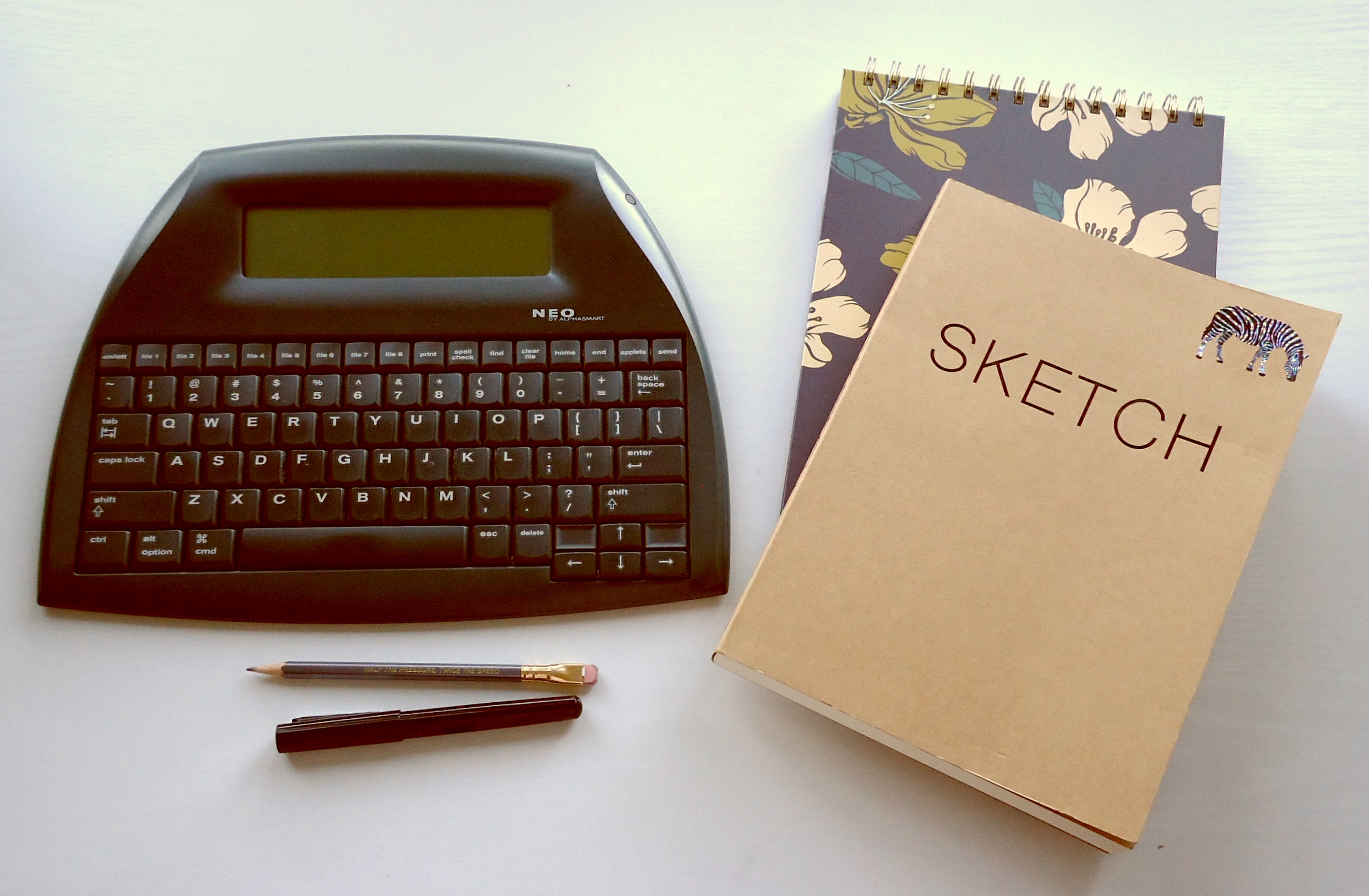
Tip of the Day: Although NaNoWriMo requires both planning and organization, you can still start a day or two late and be a winner. One way I'm focusing on writing, and writing only, is to clear my work space and limit my writing tools to the basics: my Alphasmart; a lined notebook for writing in cafes, parks, or the middle of the night; and a new sketchbook with a small number of my favorite pens and pencils. The sketchbook is for visual brainstorming in between writing sessions and to keep the creativity flowing whenever I need a break. Now to go write my 50,000 divided by 30 equals 1666.666 words for the day. Happy November! Happy Writing!

Wednesday, August 16, 2023

Return from #CampNaNoWriMo 2023

Lakeside, CampNaNoWriMo 2023  


Back home from CampNaNoWriMo at last! Well, okay, so I never went farther than the Albuquerque Museum Cafe and any relation to travel, camping, or singing 'round the campfire was all "let's pretend." But isn't that the definition of creativity? Using the imagination and taking it as far as it will go?

One thing I couldn't pretend away though, was how difficult CampNaNo turned out to be, and it wasn't just the very-real mosquitoes. Getting up every day to write close to 1700 words eventually became a Herculean effort and I did have to spend several days catching up with my word count, July 31st being the worst. I didn't finish writing that night until 11:44 PM. On the dot. It was a long evening indeed, but I made it across the finishing line just as the first street racers started roaring outside my windows down Route 66.

Now that two weeks have passed since the end of camp, I guess the big question is, WHY? Why did I want to do something so, well, challenging? Short answer: I wanted to see if I could. This year has been difficult for me on so many levels, and despite hours and hours of grief journaling, my creative writing often found itself buried under mounds of administrative paperwork. Signing up for CampNaNo was an opportunity to start over and see what direction I truly wanted to follow.

It was a good choice. As soon as I actually sat down to write I was back in one of the safest places I know: the blank page. I wrote in cafes. I wrote beside my condo's swimming pool. I wrote in the park. I wrote in bed. I got it done and I'm glad. There are so many benefits to joining in with a writing challenge, starting with:

  1. Discipline. No excuses. You just have to write--so do it!
  2. Commitment. Setting a challenge goal of 50K words or simply 50 pages is a promise to yourself, one you want to keep. It feels good to keep your promise.
  3. Finding a schedule. A challenge is a good way to figure out your best writing times of the day or night. For me it turned out to be mid-afternoon. With a latte.
  4. Visible progress. A writing challenge can bring a good dose of instant gratification. Watching your word counts and pages add up is immensely satisfying.
  5. Freewrite like you mean it. I love freewriting, letting the words pour onto the page without editing, censoring myself, or worrying about "what people will think." Participating in a challenge leaves little time to do anything other than write, write, write, and often you have to abandon linear thinking, switching scenes on the fly, inventing new characters, ignoring transitions. It's great.
  6. You're part of a global effort. It's fun to imagine all those other writers out there suffering enjoying themselves day after day, night after night. Writers tend to be loners, so what's better than a world-wide writer's group?
  7. That idea you always wanted to play with? Now's the chance to go for it.
  8. Beginner's mind. When you're writing fast you don't have time to think about the rules or the "right" way to approach your story. Every sentence is a new beginning, a new way to express yourself. You don't need answers, you just need to listen to that voice asking "what if?" and follow what first comes to mind.
  9. A chance to experiment with form and genre. Bored? Turn your mystery into a series of short stories. Or add some recipes. Or poetry. Mix and match styles and write outside the box--you might find a brand new voice for yourself, the one you've always been looking for.
  10. You can discover what it is you don't like to write. 20,000 words into your manuscript you might discover that you hate writing novels, and that's just fine. Maybe you would much prefer to specialize in personal essays, or you might never want to pick up a pen again, deciding that abstract landscape painting is your true calling. Now's the perfect time to find out.
  11. You'll have 50K words to edit. I'm sure you've heard the truism that writing is re-writing. Except you can't rewrite a manuscript without a first draft. Join a challenge and you're guaranteed a first draft to rewrite for as many drafts as it takes.
  12. You'll have a manuscript to publish. Yay! What more incentive do you need?

Regarding that last point about publication, as worthy as it is to eventually publish your work and while 50K is an excellent start, a full-fledged, polished manuscript really needs a minimum of 75,000 to 100,000 words to be a satisfying read. My plan is to go for that 100K goal after taking a several-month break. For the moment my pages are packed away in a folder, but as soon as November's National Novel Writing Month 2023 rolls around I plan to jump in with both feet and get that story finished. Until then, you can find me in the craft room painting more landscapes.

Tip of the Day: Now's the time to consider signing up for what will be the 24th year of NaNoWriMo. Begin by collecting writing prompts, character and other reference photos, and doing any research you might need to have in place before November 1. Even if it's a simple outline or a plan dividing 30 days into plot points and chapter breaks, it can be helpful to have your compass ready and your backpack full of ideas ready to go. As they like to say at camp, "Be prepared!"

Thursday, June 29, 2023

31 Writing Prompts for Camp NaNoWriMo '23

Two days to go and here I am, preparing for yet another July and another Camp NaNoWriMo! 50,000 words in 31 days; a totally off-the-cuff decision to participate, but one I'm actually pretty excited about. 

To get myself ready for the big event I've got a new notebook, my favorite pen and extra cartridges of my favorite violet ink (yes, I always write my first drafts by hand), a good supply of snacks, and a dozen or more excellent cafes to visit for those days when I have to write with a latte or else.

But with all the supplies and comforts in the world, there inevitably comes that moment when I'm half-way through my coffee as well as my daily quota (1,613 words per day to be precise) and I'm hit with: "Oh, no--I'm stuck! What comes next? What on earth should I write?" 

Which is why I've always found it more than useful to have a list of writing prompts ready to go.

Back in 2021 I shared a similar list that you can view here if you feel you need for even more suggestions to help the words flow. All of my prompts, this year and those before, are simply to get things moving again, especially for those times I've lost a sense of who my characters are and why they're doing what they're doing. The prompts can be used for new scenes, back story, or just to shake things up and go off on an unexpected tangent. I know this can sound a little scary to dedicated plotters, but as a life-long pantster, I highly recommend the surprise of the road not only less-traveled, but also going for the one you never knew was there in the first place.

So here we go: 31 prompts for 31 days. Use them, share them, change or tweak them to fit your own story needs. Whatever you choose to do, the main thing is to keep writing!

  1. Write about an inheritance that isn't about money.
  2. Add a character obsessed with the paranormal. How does this affect your plot?
  3. A character accidentally stumbles onto a movie set. How, what, why?
  4. Three secrets your main character will never tell.
  5. Three secrets your villain wants to tell the world about your main character.
  6. Characters: main, villain, secondary--one of them witnesses an illegal act. How will this pivot the plot into a new direction?
  7. Write about the time one of your characters went to summer camp when they were ten years old and hated it.
  8. The same character had a completely different experience at the same camp whey they were fourteen. What happened?
  9. An unexpected job offer. What and why?
  10. Write about your characters' feelings about relationships.
  11. A costume party with sinister undertones.
  12. Your main character is going to an event but loses the invitation or the tickets. What happens now?
  13. A visit to an animal shelter.
  14. Several of your characters are having an argument about religion. Why? What are they saying? What is the aftermath?
  15. Write about a new skill or hobby your main character is learning and why they want to learn it.
  16. Choose a favorite piece of music for each of your characters. Write about why it's their favorite and how they feel when they hear it.
  17. What is your main character's imaginary "safe place"? When do they most often go there?
  18. Write about your villain's favorite book and how it has influenced them to be who they are today. How will it figure in your plot?
  19. Write about a childhood rejection.
  20. What is your main character's most meaningful piece of jewelry and why? What would happen if it was lost? Lose it.
  21. A sudden, forgotten memory. What triggered it?
  22. An event your main character doesn't want to attend. Why?
  23. Write about a time your main character said "no" and regretted it.
  24. Write about a time your main characters said "yes" and regretted it.
  25. A neighbor knocks on the door in the middle of the night. Why? 
  26. Your main character finds a hidden letter in a used book.
  27. Your villain steals something valuable. What and why and how will this change everything?
  28. Write about your characters' feelings about children.
  29. What was the worst thing a parent or teacher ever said to your main character and how did that affect the rest of their life?
  30. Write about a dinner party that includes both your main character as well as your villain.
  31. No matter what point you've reached in your story--write the beginning to your sequel!
Tip of the Day: With any writing challenge there's always the temptation to write beyond your daily quota, particularly when you find yourself on a roll and think you could write nonstop for the next twenty-four hours. I can tell you from past experience it's not a good idea. Rather, it's the perfect set-up for burn-out. Writing 7,000 words a day might sound wonderfully productive and impressive and that you're beating the competition, but before you know it, you'll be too tired to keep up the pace for long and will do anything to avoid your next writing session. Worse still, you'll justify not writing because you have "extra words in the bank" you mistakenly think will tide you over. Believe me, I'm all for creative effort, but this is one time slow and steady really does win the race. Good luck, have fun, and don't forget your hat! It's hot out there.

Monday, June 5, 2023

Watercolor Lessons for Writers

I love to write; I love to paint, usually on the same day and often at the same time. Ink and watercolor, stories and images, my mind swirls with so many ideas it's a wonder I can settle down long enough to work on anything. If I could write and draw with both hands, that would be my ideal definition of time management.

Between the two, however, watercolors--no matter how many hands I use--will always be my most difficult challenge. Words come more easily to me than any skill with paint, probably because I consider writing to be talking on paper, and I'm not exactly an introvert when it comes to conversation. After I'd published my how-to book, The Essential Guide for New Writers, I was delighted when one of my writing students said, "The book just sounds like you!"

I don't know to what degree my watercolors "look like me" and I hope it's very little. At the moment they tend to be rather gloomy, not exactly how I want to be pictured for the rest of my life, but let's consider it a phase.


Unlike a manuscript draft which can be rewritten ad nauseum, you only get one chance with watercolors; start gloomy, stay gloomy. There's no going back. Once you begin, there you are. Watercolors simply cannot be "fixed." Whether it's a bug flying into a freshly painted surface, or my hand suddenly dropping a loaded paintbrush onto a pristine area that was meant to remain white, things happen. Yet with every "mistake" I have also discovered I can turn happy accidents into something worth keeping. So what if the white paper is now orange? Call it a sunrise. Bug smears? A vital part of my style.

The other day while I was painting outside on my balcony (not for glamor, but because it's the best place to make a mess), I started thinking about how I would feel if I had to give up one or the other. There was so much I had learned from each discipline and not about technique alone. Patience, realistic expectations, perseverance, these things are integral to my approach to creativity and stem from rock-solid basics:

1. My Favorite Supplies. Every new watercolor painting begins with paper, paint, and brushes, and preferably high quality paper, paint, and brushes. But something I've learned is that quality rarely has anything to do with price. In reality, quality is whatever is the most fun to use. A springy brush from the discount store or a smooth-gliding glitter gel pen can make me want to paint or write all day. Most of my painting disasters have stemmed from using the most expensive supplies because they weren't conducive with what I was trying to do. Student-grade paint, for instance, has turned out to be in many cases much richer in color than pricey "professional" brands. Brown paper bags are an amazing background for painting with opaque watercolors.

It's the same with writing tools: take those gorgeous leather-bound journals you see lined up in bookstores or gift shops. Gilt-edged blank pages, jewel-toned covers; they terrify me! They're so difficult to use: the covers don't fold back enough for writing on the go and the paper can be too textured, making my pen skip, stop, and eventually destroy the pages with ink blots and holes in the paper. For me, the very best journals and notebooks are spiral-bound and have cardboard covers I can collage with my own designs. The paper inside accepts any kind of pen, even an ink-dipped twig. I can't write in anything too genteel, nor with a designer pen that looks great advertised in a magazine, but is so heavy it could double as a snow-shovel. Struggling with supplies because they're beautiful and what "the professionals use," is a surefire way to write or paint nothing at all.

 
2. Work from light to dark. A frustrating aspect of watercolors is how you have to work in layers. It's nearly impossible, for instance, to create a shadow area in a painting with just a single stroke of dark color. To make matters even more frustrating, watercolor has a tendency to always dry lighter than what you thought the color would be. You have to lay down an initial wash, wait for what seems like forever for the paint to dry, and then add another layer of color. And then another. Sometimes this can go on for an entire day!

When we're writing, it's tempting to want to get everything right with only one draft. But more often than not we have to write, and write, and write some more to really achieve the exact meaning of what we're trying to say. Don't give up when you re-read a first, second, or third draft and find it to be too "light" or lacking the depth you want. Keep going. Experiment with different approaches to your subject matter. The main thing to keep in mind is that you will reach the right shade with perseverance. Keep going.


3. Let the paint dry! Depending upon where you live, waiting for a watercolor layer to dry can be fast or molasses-slow. In Albuquerque where I'm currently based, I don't have long to wait, but when I was living in Georgia, the humidity kept my paper wet for hours. Whether you're in the desert or at the beach, it's still boring to wait for paint to dry, but it's also essential. The quickest way to create "mud" on the page is to rush into adding fresh paint before the previous layers are dry. My solution has been to work on several pieces at once, which is also the way I write. At any given time I have about three manuscripts in progress: a short story, a journal of ideas and freewriting, and at least one novel. If my enthusiasm wanes for any of it, I can move to something new.

Multiple projects can be helpful with painting, too. If my paper is taking too long to dry, I like to doodle in my sketchbook, or put some color washes onto a new sheet of paper. While the clouds are drying on the first piece, I can start painting the hills on another. It's a handy trick that saves time and keeps me from wanting to rush in too quickly, and thereby destroy, whatever I'm working on.


4. Don't over-mix your colors. A common error many watercolor artists make is over-mixing their colors: putting, say, some blue and red on their palette and stirring it into purple soup. A much better technique is to wet your paper with clean water, then drop in some blue followed by a drop of red and let the two colors find their own chemistry. The ensuing violet shade will be much richer and more interesting than a standard recipe purple.

For writers, over-mixing colors is the equivalent of over-editing. Polishing and rewriting a piece too many times can edit the life right out of it. Sure, you want your words to be clear and understandable, but don't over-strive for perfect grammar or syntax if it's going to end up putting your reader to sleep.


5. Use your largest brush. Tiny, delicate paintbrushes are cute and look as if they're exactly what you need for painting hundreds of tree leaves or fur on a cat, but the truth is you can get into terrible trouble by being too finicky. It's a lot more liberating, and exciting, to paint bold and quick with your largest brush no matter how small your paper is. Using a flat, wide brush is the equivalent of freewriting, letting first thoughts, first words spill onto the page in broad strokes and unrestrained, uncensored expression. You can always go back later into a piece with a smaller brush, outlining and emphasizing your details. But start too small and you'll be fussing over your work for hours and days without any visible progress.

Tip of the Day: Find an old manuscript you've put away, one you've given up on either because you were tired of editing it, or tired of marketing it without adequate response. Taking the suggestions listed above as a guide, see if you can apply any of them to your story. Do you need to take a new approach to your theme with some freewriting? Are there scenes that would benefit from added layers of darkness? Have you been using too small of a "brushstroke" to paint your setting or your characters' emotions and reactions? See how far you can go in a new direction. (And don't forget: Extra credit for writers who try some watercolor paintings based on their plot!)