Showing posts with label Drawing. Show all posts

Saturday, June 6, 2026

Back from New Zealand and Filling the Well


Auckland, New Zealand and the 40-storey high rise
I called home for six weeks. Waving from Floor 24! 


Hello, Everyone! I'm finally back in Albuquerque and the high desert after six amazing weeks staying ("luxuriating" might be the better term) in downtown Auckland, NZ.

Until today, I haven't blogged for weeks. Months. It wasn't intentional. Before I left home I had all kinds of sincere plans to keep posting and sharing my life down under, but the truth is that after only a few days in my lovely apartment I decided I was on vacation

Instead of blogging--or any other kind of writing for that matter--I spent my time visiting wonderful friends, going to the movies, shopping at every bookstore I could find (I ended up bringing home a total of ten paperbacks. "Heavy" doesn't begin to describe my carry-on load.), eating at incredible restaurants (NZ food is still the best in the world), exploring Auckland's very clean and very green neighborhoods, and yes, sketching every chance I could with a small watercolor set I bought at the art museum. 

The sketchbook I used was one I found in a great little stationery store called Typo which appealed to me not just because of the name, but for what they carried, too. I managed to fill the entire book with my impressions including a day trip to Bethell's Beach (my husband's favorite childhood hang-out) where some Buddhist monks were also admiring the scenery.

Just a few miles outside of downtown . . .


I couldn't eat of enough of these.


Rain or shine, I never tired of the view.
 

A long time ago--decades ago--Auckland was home. New Zealand is where I finished high school, attended the university, got my first job, and most especially, it's where I met my husband. It's also where I became deeply influenced by the country's art--especially ceramics--as well as the literature, music, film making, and overall sense of "do-it-yourself." When I stop to think about it, I really have to say that without New Zealand there's no "me," nor is there any of my writing starting with my YA novel Better Than Perfect set in suburban Auckland. Without New Zealand, I don't think I would ever have ventured into art, beading, and pottery. New Zealand set the stage for the rest of my life, even being the reason I ended up in Albuquerque thanks to my husband's own unique business brand originating in, where else, but New Zealand.

But regardless of the past and all it means to me, returning wasn't easy. I had been gone for a long time, and Auckland has changed so much it took me several confused weeks to even know where I was. One of the strangest things was I had completely forgotten that Auckland is built on a series of hills and that walking anywhere can often feel like mountain-climbing. More than once, puffing my way home with an armful of books and groceries, I couldn't help but marvel at how strong I must have been in the "old days." Not once as a student had I ever thought it was difficult, or unusual, to run up and down numerous ravines to get to a lecture or to meet with friends for lunch in the park.

Besides feeling that I was on some kind of endurance test just to buy a sandwich, I couldn't help but also feel a genuine sadness at how much of the past had disappeared. Beloved shops and buildings had not only been demolished, but the buildings and businesses replacing them were light years away from my memories. Where there had once been shops selling gumboots and sheepskins I now found Prada and Tiffany's, Dior and Ferrari. Very fancy, very international, but oh, how I longed for the innocence and simplicity of the past when we only had one television channel and talked all night over a jug of beer rather than cocktails. I hope I didn't become too boring with my constant questioning: "Where is . . .?" "When did they go out of business?" "Where can I get a lamington and an asparagus roll? You know, afternoon tea?" 

Oh, well. Enjoy the new and go with the flow. And I finally, after a lot of searching, did find a lamington during a visit to the sugar factory. Yum!

A difficult choice between raspberry or chocolate. 
Both with the obligatory cream and coconut.

To prove I did more than look for cake, here are some other highlights:


Loved taking the ferries to cross the harbor.

As well as the places the boats landed,
e.g., Waiheke Island for lunch.


Coming back to town. Queen Street view
from the Ferry Terminal (pictured below).


My daily route on the way to buy groceries,
books, and art supplies.


One of the many views from my living room: I never stepped
onto the balcony, not once!

Although I did sit close enough to the window to
sketch my cardigan drying in the sunlight.


Auckland University's "wedding cake" where
I spent four years studying Spanish Lit. and politics.
It's also where I was led to eventually meet my
literary mentor, the late author, Hugh Cook.


Auckland War Memorial Museum, always my "go to"
on a rainy day, both in the past and this visit too.

Because who can resist a Giant Moa?


Or a gaggle of kiwis? (Don't ask why they have
a ferret friend. I have no idea.)

The Maori displays at the museum were unfortunately closed
for renovation, but these carvings inside the Auckland Library were a
good compensation for what I missed.


As was this contemporary Maori sculpture
at the Auckland Art Gallery (below), two blocks from my apartment.


Rangitoto, Auckland's most scenic volcano.
Photo taken at Takapuna Beach only hours before
a cyclone hit.

Last view of the Sky Tower.
I'll be back!

As I mentioned at the beginning of this post, I had truly planned to continue blogging when I set out on my travels. I didn't mean to stop, or for so long, but I'm glad I did. Because, more than anything else, I needed a break--from everything. I needed a genuine vacation; a chance to rest, watch the sunrise, read, go slow and in particular: fill the well. New Zealand, even this modern, unfamiliar version, gave me that in bucket loads. I feel re-inspired to paint, design more jewelry, and to keep writing. More than anything, I feel inspired to meet the future, not just dwell on the past.

Tip of the Day: One of the things I love best about travel sketching is how easy, and quick, it is to capture mood and atmosphere for future writing. Whether it's laying down an abstract watercolor wash in neutral grays, or going for a more detailed study of the greens and blues of sea, sky, and land, there's something about the physical act of painting and/or drawing, especially with some accompanying notes to the page, that a photograph can never duplicate. On this particular trip, I deliberately left my sketch kit at home so that I could check out, and purchase, foreign supplies. It was a good decision and one I recommend to anyone else wanting to experiment with some sketching of their own. Best of all, now that I know where the art supply stores are, I'll know exactly where to go on my next visit!

Tuesday, February 17, 2026

Back from England, Part 2: Traveling with Makeshift, Limited, and Unexpectedly Good Art Supplies


Faversham: How could anyone not paint?

In today's post I want to talk about what I painted, why I painted, and how I managed with minimal art supplies during my recent multi-week trip to Faversham, Kent.

One of my main reasons for going to England was to experience what my daily life would be like if I chose to eventually live there, even if only part-time, and that would include maintaining my daily writing and painting routine. With that in mind, I made sure to bring a few supplies with me:

Limited, but enough to get me started.


1. One Bic mechanical pencil with replacement leads stored inside the barrel. While not the best pencils in the world, these cheap little Bics are great for travel. There's no need to bring a pencil sharpener and the removable eraser actually works.

2. My beloved Sailor Fude Pen. I can't go anywhere without this Japanese fountain pen originally designed for calligraphy. The unpredictable wackiness of the angled nib lends itself beautifully to what gives any sketch a strong sense of energy: the element of surprise. Together with the pen I also brought a box of black ink refill cartridges.

3. One white Gelly Roll pen. You never know when you need some highlights.

4. Three water brushes: one flat and two rounds. The beauty of water brushes is a) they're self-cleaning, and b) you never have to worry about bringing, or finding, water for painting when you're on location, inside or out. There's no need for jars or cups, and certainly no worries about spillage.

5. Two torchons: one large; one small. These rolled paper stumps are wonderful for blending pencil marks and creating shadows.

6. One Faber Castell kneadable eraser in a cute little box. I rarely use erasers for actual mark-removal, but they are super-useful in the same way the torchons come in handy.

7. Two binder clips. For holding down the pages of my sketchbook.

8. Viviva watercolor sheets. The absolute star of the show. I had never used these before, but so many people had recommended them so highly I thought they would be perfect for my trip. And they were. The "pamphlet-style" design took up no space whatsoever; the colors were intense and required only a tiny drop of water to activate; and they lasted for days--weeks! I didn't run out of paint until the very end of my trip, a full seven weeks.

Just add water!


9. My small but trusty I Love Cats zippered pouch. Super-lightweight, sturdy, and made from recycled plastic bottles, it held all of my travel art supplies with room to spare. It also let people know how much I love cats.

The only thing missing from this whole set-up was a sketchbook, a decision I made on purpose. Besides not wanting to carry the extra weight, I thought it would be fun to buy something in England to remember my trip. What I didn't know is I would end up buying five of them.

The first sketchbook I came across was a small mixed-media spiral-bound tablet made by a company in Dorset: Coffeenotes, named such because their products are manufactured from recycled coffee cups. I loved the size, the cream-colored paper, and especially the strength of the smooth-textured sheets that took watercolor without excessive buckling. I need more!


The next one I bought wasn't quite as unusual, but highly necessary: a Moleskine A4 landscape watercolor journal. I used it every day and night for the entire duration of my trip.
 

One small snafu I encountered in Faversham was the lack of dedicated art supply stores and I was lucky to find what I did at the local bookstore, Tales on Market St.
 
 
Despite the small amount of choice, I did manage to buy two more sketchbooks when I popped into a pop-up store at the 1697 gallery (really built in 1697). Handcrafted by a Faversham bookbinder, Bindfulness, there was no way I was going to pass up these unique and very special concertina books.

As if I didn't have enough paper already, I also unearthed a pad of the best, best kraft paper I have every found--in a discount general merchandise store of all places. Tucked away on a bottom shelf, I saw it while I was searching for dishwashing liquid. Finding art paper was much more exciting than the thought of doing dishes, and I couldn't believe the quality, or the low price of this incredible paper. Made in India, the thick, grainy texture has an old-world feel missing from much of the modern kraft or "bogus" paper sold here in the States, a texture I'm always in search of. After a few initial ink sketches, I used the bulk of the pad for black-and-white acrylic background studies, something I wasn't planning to do, but the paint was on a shelf above the paper and I thought, hmm, why not?

After I found paper and paint, I realized I could get all sorts of cheap but surprisingly good supplies at a variety of discount stores: children's gouache and oil pastels; a set of twenty-four watercolor brush pens; a package of three synthetic watercolor brushes; three house-painting brushes; and two throwaway fountain pens. The prices were excellent; I don't think I paid more than $20.00 for the whole bundle including the black and white acrylic paint, which meant that I used every purchase with reckless abandon--the exact way paint should always be used, regardless of price.

Added to my stash of store-bought supplies were the items I gathered on my daily walks and took home to use as impromptu art tools: sticks and stones, leaves and acorns, flower petals, tiny apples, and best of all: seagull feathers.


Not dinner.

Before leaving home I knew I wanted to take some kind of a drawing class during my stay, and the one I found, Mindful Drawing taught by Nicole Antras at Faversham's Creek Creative couldn't have been better.


Entrance to Creek Creative studios and art space. Cake and hot chocolate, too.
 
The class was only for a single Sunday morning, but I learned so much in a few short hours that I continued to use Nicole's techniques and advice for weeks after.

My Faversham mini-studio with a sample of my classwork.

Switching to drawing from painting sent me once again to the discount store (they were beginning to know me by now) for more supplies (yes, I have a problem): this time a spiral-bound pad of heavy-weight white drawing paper (technically the fifth sketchbook I bought) and a generic set of both graphite and color pencils that turned out to be as good, if not better, than fancy-brand pencils I've paid a fortune for in the past. Unfortunately I then had to buy a rather bulky pencil sharpener; so much for bringing my "convenient" Bic pencil from home.

Sketching, and especially painting, in the English climate definitely had its challenges, starting with the constant cold and damp preventing me from doing anything on site. Worse yet was trying to get my paint to dry, even when indoors. It was the same with my brushes; always wet and soggy no matter what I did.

I overcame the "can't draw outside" dilemma by doing my best to memorize colors and abstracted landscape features every time I went out walking, which was every day, and usually twice. As I walked I would also try to give what I was seeing an emotional context that I could explore once I got home. As soon as I got out of my coat, cardigan, scarf and gloves, I would immediately set to work in a sketchbook.

Watercolor brush pens in my Coffeenotes book.

Dark and gloomy. Sheer gothic joy!

At the end of the day I think I did pretty well with minimal supplies and a lot of improvisation; discovering that "makeshift" doesn't always mean "inferior," and in fact can be a high road into a myriad of creative possibilities. Every time I came across new and unexpected supplies I asked myself, "What if . . . ?" the same question I ask whenever I sit down to write, and my answers never disappointed me. Especially when those answers then turned me toward an entirely new direction: a brand new book manuscript inspired by my dark and stormy sketches.

And that's what I'll be covering in Post #3: Writing the Book I Wasn't Supposed to Write. (I tell you, I was busy in Faversham!) Until next time--

Tip of the Day: After buying all those pens and pencils I needed some extra storage and Faversham's numerous thrift stores were the perfect place to buy mugs, jugs, cups and trays for everything from mixing paint to holding brushes. I got what I needed within minutes of entering the stores, but there was one thing I totally overlooked and didn't think of until I was back in Albuquerque: buying art supplies in those same stores. It never occurred to me that thrift stores have art and craft sections and I bypassed what could have been some genuine opportunities. Next time that's precisely where I'll start first.


Tuesday, March 26, 2024

13 Reasons to (Not) Cut Up a Magazine

Hello! Happy Spring! The last two months have found me on a blogging hiatus and for a very good reason: I was busy revamping my website, Valeriestorey.com. It was time for a change, and most of all, time to start selling my beaded bookmarks, jewelry, and artwork online. Hope to see you there!

Now that's done, however, it's back to blogging and one of my favorite topics: using magazines as a source for art and writing prompts.

I love prompts for any kind of creativity, even for game playing. Over the years I've used prompts in so many ways I can barely remember a time when I didn't use them. From Susan G. Wooldridge's Poemcrazy and her idea of creating "word pools," to simply having stacks of photo references for NaNoWriMo, magazine prompts have been my go-to method of writing forever. In my opinion, nothing matches an intriguing photo or a mysterious phrase to get a new scene or manuscript really going.

There's just one small problem: I can't find enough magazines! Always in the past free magazines seemed to be everywhere I went. I found them in local tiny libraries or for the grand price of twenty-five cents in thrift stores. Friends would happily give me several at a time, saying, "Oh, you like to cut things up. Take these--please!"

But lately my sources have dwindled. People don't subscribe like they did before, or they read online. So when I do come across a magazine full of great pictures or stories, I don't automatically grab my scissors. Instead, I'm keeping the pages intact and using every little thing they have to offer.

The upside to keeping magazine pages whole rather than shredded is I have a fresh outlook on how I use them, almost as if they were a type of multi-purpose reference book. I've discovered that I can more easily carry an individual magazine with me any time I choose to write outside or at my favorite cafe--no more dropped cut-outs scattering each time there's a breeze. Another benefit to working from a single magazine is I've discovered each issue will have a certain consistency that brings cohesion to a theme or a "look" for when I'm searching out characters or settings. For instance, take:

1. Characters. Because so many magazine issues are built around a single theme or subject, especially the month-by-month issues, it's easy to find groups of people (characters) who belong together. Whether they're all on vacation, all bankers, all celebrating Easter, or all wearing the strangest clothes ever designed in the whole of human history, page after page will feature people in related poses or situations. Regarding them as a group can create a cast of characters with a natural reason for knowing or meeting each other. Even the people and pets in the ads can fit into this united gathering.

2. Settings. Travel destinations. Art galleries. Home improvement. Magazines dedicated to single subjects will have multiple articles and ad repetitions of offices, bathrooms, bedrooms, kitchens, gardens, hotel rooms and restaurants providing so much detail, detail, detail you might never stop writing. When these details come from the same source, you once again have a more unified vision of where your characters interact and why.

3. Phrases. Article titles or ad-copy headlines are perfect for structuring story themes, or even adding to dialogue when they share a common purpose. For instance, art and design magazines will use a lot of technical references; literary magazines tend to be more poetic. Having a full list of phrases from a single source can be an excellent way, for instance, to title chapters or create a logical plot.

4. Found poetry. I love found or "black-out" poetry, taking shortened versions of existing phrases or lines out of context and placing them into new--often startling--arrangements. My personal preference is to use food magazines, but any magazine focusing on just one topic can provide an underlying consistency to your work, resulting in a more complete and better-crafted poem. To keep the magazine in top shape, consider photocopying the pages so that you can experiment with different ideas more than once.

5. And speaking of food . . .  Recipes! It's rare for a magazine that includes recipes to simply present a grab-bag of ideas somewhere on the back pages. Individual issues will instead usually choose one food type, such as salads, pasta, or a thousand-ways-with-eggs to complete each month's edition. "Recipe groupings" are great sources for character "show, don't tell" when you want to describe any of your characters' food preferences, dislikes, or allergies. They can eat the same thing over and over but cooked in a variety of ways, or avoid certain dishes with valid authority rather than "I don't like it."

6. Respond to a magazine's theme. Study each page and/or article as a whole and freewrite your feelings about what you read or saw. Sometimes the general color scheme alone can inspire a wealth of emotional response.

7. Add your own article or story. When you're finished reading a magazine, write something of your own to add to it. You might even want to write a piece in the voice of one of your characters to explore what truly interests them or how they feel about any given subject.

8. Get mad! Conversely, something about a magazine might bother you. You don't like the message, or how it was presented. Get snarky, be rude! Throw it at those horrible people in their dreadful glass houses with too much furniture and artwork. Let 'em have it. And make sure your characters behave even worse.

9. Get published. Why not? Magazine editors are always complaining about submissions that have nothing to do with a magazine's theme or requirements. But if you like a magazine, have studied it thoroughly, and think you have something to contribute, write a piece and submit it. Contact information and submission guidelines are usually listed in the first few pages.

10. Don't just sit there--read. With a magazine in your sketch- or writing-kit, you'll never be bored and will always have something to read wherever you go. You can't do that with a folder full of cut-outs.

11. DIY. Fashion, decorating, style--the things we're attracted to might be things we'd like to imitate or make ourselves. Creative prompts aren't exclusive to writing or painting. Ideas for knitting, pottery, or sewing can be as readily based on a magazine prompt as a story.

12. Art school. On a completely different note, magazines are fun to sketch with. I like to copy, trace, or find color palettes as exercises to fill my sketchbooks.

13. Break the rules. Draw on the pages. Add doodles, improve the view, change the colors of everyone's clothing. Use gesso to glue pages together and turn the whole thing into an altered book for more drawing or collage. (Of course you now have to go find a new magazine for new prompts, but at least you had fun!)

Tip of the Day: If you haven't already, gather a limited number of magazines that inspire you. I find six is a good number without being too cluttered. Personally I like to have a combination of art, fashion, interior design, food, and some kind of subject I wouldn't normally choose, say, a pet magazine. A good literary magazine is essential too. And don't overlook shopping catalogs. When you're ready for a new collection, simply pass your used copies on to your other writer friends and start all over again!

Monday, March 21, 2022

Creating With the Seasons, Part I: Artwork

Happy Spring!

For everything there is a season . . . A time to write, and a time to paint. A time to be totally inspired and a time to completely lose it--

Hello, everyone! Time, where does it go? It seems like forever since I've had "time to blog" or do much of anything else for that matter.

My time shortage started early this year when I found myself fostering a stray kitten at work. I was well aware that 2022 was the Year of the Tiger, but the last thing I ever expected to find outside my back door was a tiny, hungry baby cat. She was adorable and I would have done anything to keep her (impossible at this current point in my life). Despite my lack of space and ability to be with her as much as I wanted, I did everything I could over a six week span to get her healthy, playful, and ready for adoption. It was one of the most fun things I've ever done and I still miss her to pieces, but now that I know she's in good hands and safely onto the next stage of her journey, it's time to get back to work: writing, painting, and yes, blogging.

Prior to kitten-sitting I had been planning to write a post about my intention to draw and paint within a series of some kind for the year. I'd often heard of artists painting a series of pictures as a way to go deeper into a single subject or theme and also bring some unity to their work. The idea appealed to me as I thought it could bring more focus and discipline to my daily sketching practice, focus that would help me produce more finished, polished pieces. The trouble was I didn't know what kind of series I wanted to try.

I tossed around a lot of ideas, e.g., choose a building I liked in town and paint it multiple times from different angles; create a series of pictures based on the displays at the dinosaur museum; sketch people and dogs at the dog park. Unfortunately, none of these ideas felt like something I wanted to work on more than once. Yes, they were interesting enough on their own, but to paint over and over? I was worried I would become so bored after my third attempt to sketch the downtown Wells Fargo building I'd never want to open my sketchbook again. It wasn't until my husband suggested I try basing some work on the seasons of the year that everything fell into place.

Suddenly I had specific goals to pursue. My first step was to sit down and make numbered lists under the broad headings of each season, brainstorming subjects that fit each particular time of the year. After that I created lists of sub-categories, for instance, under the heading of "autumn" the first images that came to mind were acorns and squirrels, sweaters and scarves, bonfires, steaming mugs of tea, rainy skies, and beautiful trees. Once I had those things listed I continued mapping entirely new ideas for a seasonal series based on each subject, e.g., squirrels in summer, squirrels in spring, squirrels bounding through the snow . . . it eventually became quite endless.

Another advantage to this plan that I liked besides never having to decide "what to paint" again is that, at least for me, the seasons signify different emotional and spiritual states to explore. Themes such as renewal, growth, and letting go, topics I would usually write about are now themes I can express through color and composition, showing joy or even a little sadness through a seasonal lens. 

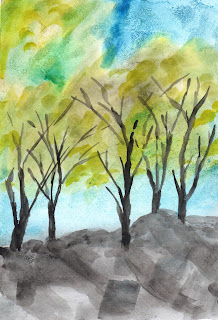
Right now my first attempts to go with the seasons revolve around my sketchbooks and a small painting-a-day practice. I'm currently concentrating on trees including the quick sketch I've put at the top of this post, but soon those trees will be full of birds, flowers, squirrels and even kittens. I only hope I have enough time each day to keep going!

Tip of the Day: Spring is in the air, a great time for both writers and artists to consider starting a nature journal. Always keep in mind that you don't have to draw or paint to create a beautiful journal. Instead of drawing, try some collage using items like seed packets, handmade papers, or fabric. Experiment with dipping leaves, sticks, or pods in ink or paint and printing your impressions onto your journal pages, or paste in the actual plant materials. Take photographs and add them to your words. 

And speaking of words, that's exactly what I'll be taking a look at in my next post: Creating with the Seasons, Part II: Writing. See you soon!

Wednesday, September 23, 2020

Having Fun at Domestika!

Work in progress: Watercolor sketch of Albuquerque's Sawmill Market

Hi Everyone! Today I'm excited to share a website for an online learning course that has brightened my locked-down life considerably: Domestika.org.

Always looking to improve my urban sketching style and skills, several months ago I was browsing through Youtube.com in search of a good drawing video. The one I eventually found started (as most Youtube videos do) with an ad, which I first thought of skipping, but then--crazy as it sounds--it completely hooked me in. Maybe it was the music, the background color scheme, I don't know what it was that caught my attention, but after a few seconds I realized the ad was for an online class taught by an artist whose work I have long admired: Alex Hillkurtz. The class he was offering was on architectural sketching in ink and watercolor, just what I was looking for, and he was in PARIS! Oh, wow! No two ways about it, I had to sign up on the spot.

Although the course didn't actually include a trip to Paris, everything else turned out better than I had hoped. I enjoyed the progression of lessons, from sharing in the members' forums to learning about creating thumbnail sketches and framing our finished work. There were also many added bonus features such as photo references to download and suggestions for books to read during, or after completing the class. Altogether it was just the prescription I needed to get me through these dreary months of isolation and limited activity.

Since finishing the class with Alex, I have signed up for two more with other artists: one on experimental watercolor technique and another on naturalist bird drawing. Neither was an easy choice. There are so many courses to choose from I could barely make up my mind and kept wavering between "Sumi-ink design looks like so much fun!" and "Yes, I really do need to take that one on picture book narrative." In the end I decided to go with the basics first and then tackle sumi, picture book layout, and character creation later.

Most impressive to me about Domestika.org are what I consider the very low cost and the quality of instruction. Perhaps best of all is that once a class is purchased, it's yours and you can go back to watch and review each lesson as many times as you need. (For me it's the one on perspective which despite the clear and precise guidelines will always elude me.)

Thumbnail sketch of the Sawmill Market.

First practice sketch on "good" paper.


More practice sketching. This time the Wells Fargo building . . .

The only, and very small, negative about the site is that with the exception of Alex Hillkurtz, the other instructors I've enrolled with present their classes in Spanish. This has been both a good and bad thing--the bad is that I have to turn the sound off and only read the subtitles the first time I watch the videos. For me personally, it's a tad confusing to try to watch, listen, and read at the same time. However, once I get the gist of the lesson, I then turn the subtitles off and listen to the Spanish version. I'm amazed at how many words and phrases I can recognize as I go along: Spanish lessons while I learn to paint. Now if I could just take my travel journal to Spain everything would be totally perfect!

Tip of the Day: Reaching the end of your tether? Learn something new and re-energize yourself in preparation for a creative and happy 2021. If you're a writer, try painting; artists, go for some writing. Good luck and remember, never give up! We will get through this; one sketch, one story at a time.