Wednesday, December 2, 2020

Gesture Drawing, Gesture Writing

Gesture drawings on newsprint using my favorite Koh-i-Noor Magic Pencil
 

Way back in January 2020 when the world was a bit more normal I did two things that while temporarily gone now, managed to keep me from throwing in the creativity towel. The first was when I joined a local drawing group that met on Thursdays after lunch, and the second was attending life drawing sessions with the New Mexico Art League. The one element these two groups had in common was an emphasis on figure drawing, and in particular, gesture drawing.

At the time of joining these groups, I wasn't a stranger to gesture drawing, I just hadn't done very much of it. I'd certainly read about it in various art books, and even got to try it out several times during some basic art classes. But other than those rare instances, I'd never really taken the idea seriously, or made it a part of my daily drawing practice.

All that changed in January, especially in the Thursday group where gesture drawing practically took center stage. Every week it was the first thing we did as soon as we were seated around the art table with big pads of newsprint, soft pencils and pastels, sometimes paint, and of course our model--which was always each and every one of us. We took turns holding poses for up to a minute or so at a time with usually about five to six different contortions: some hilariously funny, some more difficult to maintain than others, and all of them, I now realize, incredibly valuable. Being comfortable with a loose and imperfect drawing style that centered on shapes rather than details grew my confidence as an artist, especially when I found myself side-by-side with a roomful of professionals at the NM Art League! 

Although I only got to attend a limited amount of sessions with these two very different art groups before Covid closed everything down, I miss them terribly. In retrospect I learned so much from those timed drawings: go for the energy; don't think, just draw; find the most important and dynamic lines. One of the main things that struck me was how similar gesture drawing was to freewriting: write, don't think; don't stop to edit; don't censor yourself; first thoughts are often the best thoughts.

When Albuquerque went into lockdown I was truly saddened by the harshness of our restrictions and how I was left without access to friends or creative groups of any kind. I wasn't sure how I would stay on track as far as self-discipline went for either writing or drawing. That's when I realized I had to continue with my gesture drawings, even if it was only me and my laptop. With a small amount of research I was able to find dozens of timed drawing sessions on YouTube complete with excellent models and relaxing soundtracks. Now I can't imagine a day going by without doing some sort of gesture drawing practice.

More than anything, whether we're in lockdown or not, gesture drawing feels good. I love the immediacy of throwing myself into a fast drawing accompanied by the sensation of using my whole body to draw--the exact same way I jump into my freewriting. Some tips that can help your drawing or freewriting sessions to feel equally alive are to:
  • Time your sessions, starting with small increments of 1, 2, or ten minutes and building up to a half- or full hour.
  • Keep turning the pages; don't be afraid of starting and stopping a line without perfecting or adding detail. Keep going for the new, the fresh, the strongest points of interest.
  • Seek out the story wherever you are or from whatever your eye catches. Gesture drawing isn't only about people; cats, dogs, trees, tropical fish, table lamps and laundry can provide you with insightful "poses" that you can use to draw or write about with genuine meaning.
  • Use a magazine for reference if you really don't have anything to inspire you on the spot. Open the cover and go through the pages from first to last, moving from one eye-catching photograph or headline to the next. Keep your pen moving.

Both gesture drawing and freewriting are often thought of as preliminary warm-up exercises before we get to the "real thing." But I think that's a little dismissive and contrary to the heart of creativity: sometimes the quickest sketches--written as well as drawn--can be the most compelling and beautiful. The value of our art shouldn't be measured by the time spent making it.

Lastly, when you're finished drawing or writing for the day, don't be too hasty to toss or tear up your work because you thought it was solely for exercise. Put your pages aside and wait a week or two before evaluating which pieces you like best and which you want to keep, or not. You can either use them as the foundations for a more finished body of work, or simply to save and enjoy for being themselves.

Tip of the Day: One of the best parts of gesture drawing is the chance to experiment with different mediums, something you can use to liven up your freewriting, too. For instance, try writing in an oversized sketchbook with colored gel pens (including gold and silver of course!), soft artists' pencils, or dip pens and bottled ink. It's amazing how breaking away from the familiar (e.g., a computer keyboard) can open entire worlds of possibility and unexplored creativity.

Monday, November 16, 2020

My 12 Top Reasons for Loving NaNoWriMo (Even if I Can't Join in This Year)

 
Here we are: halfway through National Novel Writing Month, the greatest novel writing challenge on earth; 50,000 words in thirty days. If I wasn't so absorbed with polishing my final draft of Ghazal, I'd be right in the thick of things, too, armed with my favorite fountain pen and a brand new journal.

Sitting out this year, however, doesn't mean I'm ignoring the NaNoWriMo.org website, one of the best resources writers have for discovering fresh advice, solid encouragement, and a wide array of writing tools. And for anyone who's sitting on the fence wondering it they should have signed up, well, go for it! Even if there are only two weeks left, you can still have more fun than a barrel of monkeys because:

  1. You can write for yourself. Completely, indulgently, luxuriously, unashamedly. Who cares if your manuscript gets published, or rejected, or even liked by someone else? Just write and use the month to please yourself and no one else.
  2. It's a unique opportunity to experiment. Always wanted to write a murder mystery? A novel in verse? A dystopian literary romance? Here's your chance. Go for it.
  3. When you decide to join the NaNoWriMo community you join as a writer, not a "wannabe," a word I've never really liked much, but one that many new writers wrongly apply to themselves. If you're putting words on paper, you're a writer. NaNoWriMo gives you your credentials.
  4. You can write the most overblown, purple-tinged, excessively detailed info drops and descriptions without a twinge of discomfort. The wordier the better. Why? Well, to start with you need the words, as many as possible, in order to achieve your daily word count. More importantly however, the longer and crazier you can make your sentences and paragraphs, the more certain you are to hit pay dirt when you edit. Writing in minute detail the contents of your main character's closet, for instance, will give you more information than you would ever dream of including in a final, edited draft, but it may give you the hidden gun or stolen armadillo shell that will propel your plot, conflict, and motivation into a bestseller.
  5. NaNoWriMo is an opportunity to discover how much free time you really do have to write a novel. If you can find the time to write during November, you can find the time to write all year long. Small sacrifices such as reducing the time you spend on social media sites or binge watching television programs add up to big gains. Thirty minutes here, ten there, it's all waiting for you to seize and use for writing time.
  6. 2020 may take the cake for being one of the most challenging years of our lives, but that doesn't mean we get a free pass to wallow and stare out the window. Taking part in NaNoWrimo 2020 may be one of the most positive and productive things you've been able to do all year. No one can ever lock you down or restrict your creativity.
  7. Breaking away from the need to be entertained during these difficult times is good for your brain and self-esteem. Taking charge and creating your own entertainment rather than being a passive viewer is good for your overall emotional, physical, and mental health. Focusing on your creativity rather than the many things you may fear or feel you can't do is one of the best "vitamin supplements" on the market.
  8. NaNoWriMo is a community. 2020 participants may not be able to gather in the all-day, late-night socializing and group write-ins of past years, but they can certainly share and converse with each other through a variety of forums, not the least being the actual NaNoWriMo site itself. Make new friends!
  9. When you are free to experiment without expectations you have permission to express and discover what you don't like about writing or what you don't like to write. For decades you may have been dreaming about writing a medieval romance set in France, but after two weeks in you may find you detest "happily ever after" and your real passion is hard-boiled true crime. Great! Toss France out the window and go for murder on the high seas with a dash of larceny for luck, the story that truly feeds your soul.
  10. On the other hand, though, if medieval France turns out to seriously be your thing, NaNoWriMo lets you go full immersion. Spending quality time on research, language studies, and even travel plans for the future to add realistic details to your story can set the stage for a productive and engaging 2021.
  11. Whether you write 100,000 words or five pages during the month of November, you will have something to show at the end of the day. Something that with a little dedication and discipline can be turned into a real, live manuscript.
  12. And best of all, even if you started out on the NaNoWriMo path with the intention to just play, guess what? You've got the makings of a book! Which is how many of the best published books you've ever read started out, a little idea that made history.

Tip of the Day: If for some reason you're like me and can't participate in NaNoWriMo this year, you can always plan ahead for next year. Start a file folder with ideas, writing prompts, and magazine cut-outs so that you'll be raring to go for 2021!

Wednesday, September 23, 2020

Having Fun at Domestika!

Work in progress: Watercolor sketch of Albuquerque's Sawmill Market

Hi Everyone! Today I'm excited to share a website for an online learning course that has brightened my locked-down life considerably: Domestika.org.

Always looking to improve my urban sketching style and skills, several months ago I was browsing through Youtube.com in search of a good drawing video. The one I eventually found started (as most Youtube videos do) with an ad, which I first thought of skipping, but then--crazy as it sounds--it completely hooked me in. Maybe it was the music, the background color scheme, I don't know what it was that caught my attention, but after a few seconds I realized the ad was for an online class taught by an artist whose work I have long admired: Alex Hillkurtz. The class he was offering was on architectural sketching in ink and watercolor, just what I was looking for, and he was in PARIS! Oh, wow! No two ways about it, I had to sign up on the spot.

Although the course didn't actually include a trip to Paris, everything else turned out better than I had hoped. I enjoyed the progression of lessons, from sharing in the members' forums to learning about creating thumbnail sketches and framing our finished work. There were also many added bonus features such as photo references to download and suggestions for books to read during, or after completing the class. Altogether it was just the prescription I needed to get me through these dreary months of isolation and limited activity.

Since finishing the class with Alex, I have signed up for two more with other artists: one on experimental watercolor technique and another on naturalist bird drawing. Neither was an easy choice. There are so many courses to choose from I could barely make up my mind and kept wavering between "Sumi-ink design looks like so much fun!" and "Yes, I really do need to take that one on picture book narrative." In the end I decided to go with the basics first and then tackle sumi, picture book layout, and character creation later.

Most impressive to me about Domestika.org are what I consider the very low cost and the quality of instruction. Perhaps best of all is that once a class is purchased, it's yours and you can go back to watch and review each lesson as many times as you need. (For me it's the one on perspective which despite the clear and precise guidelines will always elude me.)

Thumbnail sketch of the Sawmill Market.

First practice sketch on "good" paper.


More practice sketching. This time the Wells Fargo building . . .

The only, and very small, negative about the site is that with the exception of Alex Hillkurtz, the other instructors I've enrolled with present their classes in Spanish. This has been both a good and bad thing--the bad is that I have to turn the sound off and only read the subtitles the first time I watch the videos. For me personally, it's a tad confusing to try to watch, listen, and read at the same time. However, once I get the gist of the lesson, I then turn the subtitles off and listen to the Spanish version. I'm amazed at how many words and phrases I can recognize as I go along: Spanish lessons while I learn to paint. Now if I could just take my travel journal to Spain everything would be totally perfect!

Tip of the Day: Reaching the end of your tether? Learn something new and re-energize yourself in preparation for a creative and happy 2021. If you're a writer, try painting; artists, go for some writing. Good luck and remember, never give up! We will get through this; one sketch, one story at a time.

Friday, August 28, 2020

Creativity Kit To Go

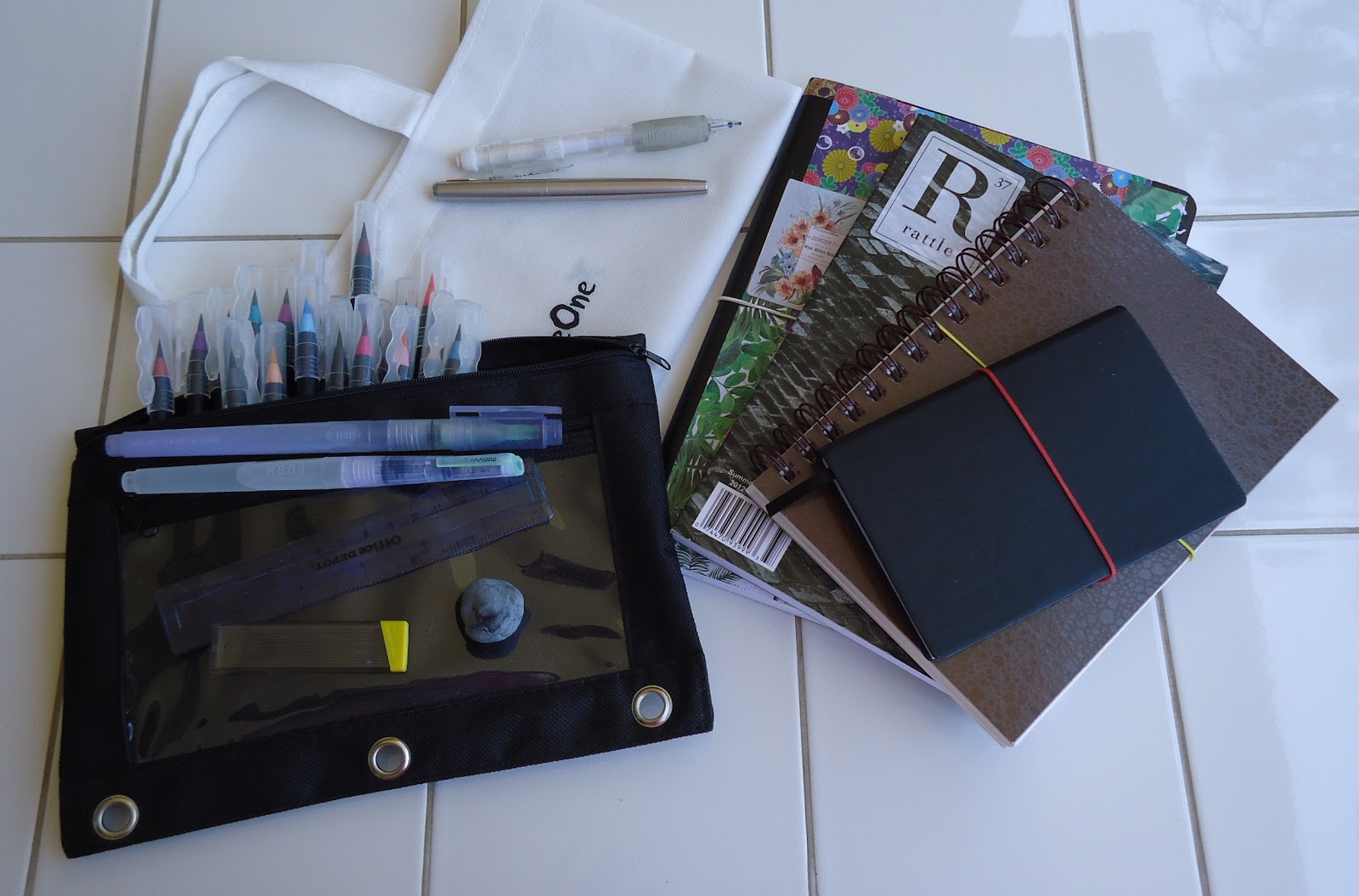
My Creativity Kit to Go . . . somewhere . . . anywhere . . .

Been anywhere exciting lately? No? Me either. So far this past week, the most thrilling outings I've had--other than scurrying back and forth between my apartment and the laundry room--have included: three one-hour walks through my neighborhood; two visits to the grocery store; and five round-trip car journeys to work. 

Over the weekend I decided that this wasn't a very inspiring, or productive, way to use my out-of-the-house time. Prior to isolation, I used to love carrying my sketchbook or writer's notebook with me absolutely everywhere: to the museum, the mall, the park, the community center, and yes, even to work (especially to work!). But lately when I've gone out, I simply walk or shop as quickly as I can before rushing back home to write or draw within the confines of my balcony. Without any nice air-conditioned cafes or comfortable seating areas (or the bathrooms to go with them) I've been reluctant to stand outside on the sidewalk to sketch under the scorching sun. It's also been pretty lonely wandering the deserted city streets by myself while the masked strangers I do pass cross the road the minute they see me. I miss my old life, I really do, but recently I've realized that I can't just wallow forever; hence my "creativity kit to go."

The purpose of the kit is to have some art and writing supplies always at the ready, whether it's to scribble in the park sitting on a blanket with a homemade ice coffee, or driving to an empty parking lot to write a quick short story in my car.

I'm still in the process of tweaking things, but for now my kit contains:
  • A 20-color set of my favorite Akashiya Sai watercolor brush pens. Twenty pens might sound like a lot, but they're slim and portable and having a full range of color to play with is just plain fun.
  • Two water brushes (for spreading and diluting the color from the pens): 1 large flat, 1 large round.
  • A mechanical pencil with a packet of extra leads. No sharpening required!
  • One kneaded eraser.
  • One black ink roller ball pen.
  • One black ink fountain pen with two extra ink cartridges. 
  • Two small sketchbooks: one for pencil and ink, one for watercolor.
  • One damp microfiber cloth in a plastic bag.
  • Two folded paper towels.
  • One 6-inch ruler (great for sketching buildings and practicing perspective).
  • A composition book for writing down ideas, freewriting, poetry, or simply journaling.
  • A literary magazine filled with stories, poems, and evocative photography. When taken out of context, the individual lines, titles, and pictures make for excellent writing and art prompts. And if you're feeling tired or out of sorts, hey, just read and renew your spirit for a little while.
  • Lastly, a pencil pouch to hold all the pens, pencils, brushes and erasers, with everything then placed in a small tote bag along with the larger items.
  •  
The best part of having my kit packed and at hand is that I can make the decision to go outside and draw and write without a ton of preparation. It also serves to remind me that I am still a writer, still an artist, still a creative being. I may be isolated, but I'm certainly not incapable of making the best of things. So who's with me? I'd like to invite you to make a kit of your own and to try and use it at least once a day, even if it's just to go into your own backyard. Let's go!

Tip of the Day: Writers and artists are used to working alone, but working in our current state of enforced isolation, complete with face masks, takes solitude to an entirely new level. It can be difficult to inspire yourself day after day, but a surefire way to keep the ideas coming is to try adding a prompt, written or visual, to each page of your sketch- or notebook.

Thursday, July 30, 2020

More Things to Do at Home: Start a Book Journal

© creativecommonsstockphotos/Dreamstime.com

I've been reading so many excellent books over the past few weeks: Children of God by Mary Doria Russell; When We Were Orphans by Kazuo Ishiguro; The Lying Game by Ruth Ware. The only problem is, thanks to isolation and social distancing, I don't have anyone to talk to about these great reads!

I'm sure that like many others in my predicament, one of the things I'm truly missing right now are book clubs. Of course there must be plenty of clubs online and chances to share opinions on review and similar sites, but in-person book discussions (and yes, all those passionate, intense "my-favorite-book-is-better-than-your favorite-book" arguments!) will still always be the best for me. However, there's still one good trick up every reader's (and writer's) sleeve: keeping a book journal, and if you haven't already started one, now is the perfect time to begin.

A book journal can be tailored to any format that suits you best, but I personally like to divide mine into sections and I prefer using lined paper for the simple reason that this is one type of journal that requires order over creativity. My favorite notebooks to use as book journals are those ruled composition books you can find anywhere from the grocery to the office supply store. They're cheap and I can collage and decorate the covers to my heart's content. But after I've put away the glue sticks and scissors it's all business and my next task is to create my various sections with things such as:
  • What's on my TBR pile? (Or Kindle line-up if you've switched to reading on a device.) Listing what to read next, and when, can help you from feeling overwhelmed from buying or owning too many unread books.
  • Answering the questions sometimes printed at the back of a book in the form of a "reader's guide." When I was able to attend in-person book clubs, I was often assigned the task of finding these guides on publisher's websites if they weren't included in the actual book.
  • Listing and writing about my favorite books: books from my childhood; books that motivated or inspired me; how-to books; books that marked significant moments or passages in my life.
  • Favorite authors and notes about their lives together with places I might like to travel to in order to visit their homes, museums, or archives.
  • Creating a reading wish-list for both myself and lists of books to give to friends or family as gifts.
  • Book club selections with records of what we've read, how the group responded to the book, and lists of books for future meetings.
  • Lists of books I've given away in case I want to reference them again one day, either by purchasing them or borrowing them from a library.
  • Books I didn't like, and why! It's fun to vent about a book you truly dislike, but it's also very revealing to discover the real reasons for liking one book over another. Note: I never think it's a good or wise decision to write one-star or very negative book reviews for publication on sites such as Amazon.com or Goodreads. But in the privacy of your journal you might want to express why a book bothered you so much. It's also a good way to discover more about your own writing: what genres appeal to you? What styles, voices, and types of characters are the ones you can--and want--to keep learning from? What mistakes do you want to avoid
  • Another tip for writers is to have a section in your journal that can be used for classifying and categorizing "comparison titles," books that you can offer to agents or editors as the ones that influenced you, or that your own book is similar to.
  •  Fan fiction. How would you continue the story or plot line if you could? Who were your favorite characters and what more would you like to discover about their lives? Use your imagination and write it down! I especially love doing this when the conclusion to a book is "open ended" and I'm left hanging: do the characters stay friends or become enemies? Are they able to create happier lives? Escape a war zone? Meet new romantic partners or give up on relationships altogether? Enquiring minds want to know!

Whichever way you want to go with your book journal always remember to write for yourself and never worry about what anyone else thinks about your taste in reading material. Go deep and ask yourself what you honestly loved, hated, or wished was different about the story or the way it was presented

Tip of the Day: It's lonely out there, but books can still be a great way to connect with friends. As a special treat for someone you haven't seen for awhile, how about making a book journal as a gift? Section off pages with questions and areas for them to fill in and complete. Be sure to include a list of some of your favorite titles and authors to recommend for future reading.