Thursday, February 4, 2021

On the Subject of Erasers

© commonstockphotos / dreamstime.com
 

As much as it would be great to erase 2020, it's a good thing I can't. The year taught me more than I could ever have imagined, and I'm grateful for what I was able to learn and even enjoy during one of the strangest times of my life. And it's not over yet!

2020 makes me think of when I was first learning to draw: it was hard, but I was determined to not give up, even when my art teacher said: "Never use an eraser." Never? Never ever? You're kidding! It sounded horrific, but I was also intrigued and my curiosity impelled me to give it a go.

Coincidentally, it was around this same time that I was reading Natalie Goldberg's Writing Down the Bones and her advice on freewriting:  just write, don't think, don't cross out or erase what you've written. Wow; don't erase applied to writing too? 

It does, and I've never looked back. First thoughts and first marks are often our freshest and most honest, especially when we're working on the first draft of anything: a short story idea, the final chapter of a work-in-progress, a sketch of the garden, a journal entry--just write, just draw, and most of all, don't worry. Here's why:

  • When we are learning to write or draw or even plant petunias, yes, we want our work to be "right." And of course it's important to eventually learn correct and pleasing proportions, grammar, and sentence structure, but erasing won't make that happen. Only doing the work will teach you what "right" means and what's right for you. If you think a line in your drawing is crooked or wonky and you really hate it--just draw a new one next to it. Same with your writing. Think you've written a "dumb sentence?" Write another one, one you like better. Keep going. (If you're afraid of wasting paper, try writing or drawing on junk mail, old envelopes, used paper bags, or the backs of manuscript pages. Whatever helps you to practice freely and fearlessly, do it.) 
  • Not using an eraser teaches you to make confident lines. That's why drawing in ink or writing by hand is such a good discipline--it's not so easy to get rid of what you think you don't like. And who knows? You might love what you've drawn or written the next time you review it. How terrible it would be lose what might be the best of the entire piece.
  •  Abandoning erasers can lead to developing your own style more quickly, especially with drawing. Keep in mind that a "perfect" drawing is often a boring drawing, one that could be made by any old "Anonymous." (Ditto for many a book.)
  • At this point you might be asking, what about erasing the guidelines on a drawing that are the basis or outlines for a painting? Well, if you've got that far, congratulations! Leaving, or erasing, your pencil outlines is entirely up to you, but personally I love seeing pencil lines in a painting. Not only do they add, in my opinion, a lot of extra energy and charm to the finished work, but they help me to see what the artist was thinking and what his or her process was to develop the piece.
  • Finally, not using an eraser can turn your drawing or writing practice sessions into memorable creative outings. Standard challenges such as "write for twenty minutes without stopping," or "draw an object or a skyline without lifting your pencil or pen," are far more authentic when you don't erase. Gesture drawing in particular is a wonderful exercise that encourages you to draw from the heart without concern for results. (You can read more about gesture drawing in my recent post on the topic here.)

If it sounds as if I'm totally against erasers, believe me, I'm not. Revision work is an entire art in itself, and that's when it's the appropriate time to examine what material to leave in and what to leave out. For artists, erasers in all their many forms are amazing tools for purposefully removing areas of graphite or charcoal to create highlights and white lines such as whiskers on a cat, or veins on a leaf. As for writers, pushing the "delete" button is invaluable when you've given your main character at least three different names and changed your setting midway from Ohio to France without realizing it. The secret is knowing when and why to use your eraser, and always with a light touch. Moderation in all things!

Tip of the Day: Here's a nifty trick for those unused erasers: try making rubber stamps. Whether you use the kind on the end of a pencil or those larger pink rectangles you remember from school, you can easily cut and carve your own design(s) with the aid of an craft knife. Tap the finished stamp into ink or paint to create plenty of new lockdown fun. (Note: Please be very, very careful--those blades are sharp! The Voice of Experience.) See you next time.

Monday, January 11, 2021

Start a Creativity Journal for 2021


© creativecommonstockphotos / dreamstime.com

Happy 2021! What are you going to write or make this year? Whatever it is, a good way to get started and stay on track is to use what I call a "creativity journal." Unlike a journal that records general daily thoughts and events, a creativity journal is a dedicated space solely for dreaming, planning, and keeping all of your "how to" notes and supply lists in one convenient place.

The notebook I'm using this year is the "Celeste" edition from Paperblanks and is meant to represent "a Venetian morning alight with marvels." (Sounds good to me!)

The journal is a handy 7" x 5", just right for quick thoughts as well as more serious contemplation. I especially like the elastic band (not shown) attached to the back cover that keeps the journal closed when I'm not using it. I also like the creamy, high-quality paper and the nifty pocket glued to the inside back cover, great for business cards, receipts, and oh, you know, stuff.

One of the first things I like to do with my creativity journal is divide the pages into various sections and headings that I can complete, and refer to, throughout the year. Once these sections are in place I can go back to them at any time. For instance, I have sections for each month of the year with further areas to list how I plan to fill in the weeks. Other sections are specifically to log my ongoing progress with tasks such as manuscript drafts, painting series, or maintaining my blog. My final journal pages are left blank for all those deep, meaningful questions always at the top of my mind, e.g., What do you long to make if time, money, and skill wasn't a problem? Very important issues!

More journal sections I've included in the past that you might like to try using are:  

  • A place to record accomplishments, finished projects, sales and reviews.
  • A section for how-to notes taken from books or magazine articles.
  • Areas to paste in small motivational magazine photos and quotes.
  • Pages for baby steps: things to do on a daily basis that will take me to the finishing line.
  • A place to list favorite supplies or ones I'd like to try in the future.
  • Sales opportunity pages: lists of agents, editors, craft fairs, online sales outlets
  • Pages devoted to ideas for branding, asking myself, What's my message; what's my theme?
  • A place to list possible workshops, classes, books to read, or any areas I need to research in order to accomplish my goals.
I'm sure you have plenty of other ideas for things to include in your own journal, but the one section I most enjoy is my vision board. This is something I usually spread over two facing pages, or better yet, the journal cover itself (unless, of course, I'm using a Paperblanks "Celeste" journal and wouldn't dream of pasting on a single sticker!). 
 
To make a vision board in your journal, simply start by asking: Where do I want to be by the end of the year? What kind of creative life do I want that will express my highest potential? 
 
Rather than writing out your answers, go with your intuition and fill your board with collage and artwork. Use magazine cut-outs, glitter pen doodles, fortune cookie sayings, vintage ephemera, bits of junk mail, anything that visually portrays your goals for a colorful, exciting, and satisfying year ahead.

Tip of the Day: Go slow. Take your time with your journal and remember creativity is a process. You've got a whole year ahead to fill in your journal pages with lists, plans, and ways to make your dreams come true; there's no need to rush. Some years I've had to wait all the way until December to know exactly what it was I wanted or needed to do. The main thing is to look upon your journal as yet another part of your creativity, so make it a joy to use. 

Wishing you the happiest of journal discoveries for a bright new year!

Wednesday, December 23, 2020

Happy Holidays! The Best of 2020

© Joseph Cortes / Dreamstime.com

The end of 2020. We made it! And I, for one, am totally worn out by the whole experience.

All the same, and despite never-ending isolation and the constant struggle to stay motivated and connected (heck, I don't even have a telephone!), I was still able to come up with my traditional "best of" list for the year. 

2020's  list may not include my usual favorites such as travel destinations, theater-released movies, writing conferences, or in-person workshops, but it does contain a full measure of joy and happy memories. That, and a lot of self-discovery; for instance, I learned that I love working with silver clay and that I can walk for a full two hours without needing to find an open cafe or a restroom. Who'd have thunk it?

But TMI aside, and without further ado, here's my "Best of 2020" list. I hope within it you'll find some useful ideas and inspiration to carry into 2021:

  • Best TV Series: Boy, we sure watched a lot of TV this year. Many of my favorite programs were old British crime series that I found on YouTube, but the one that really stands out for me is Trial and Retribution. Great acting, great story lines, and each season is only 2 parts so there's always something new to look forward to. I'm currently watching Season 8, and will definitely be sad when I reach the end.
  • Best Book (Fiction): Set in Shanghai and London, When We Were Orphans by Kazuo Ishiguru was not only the best book I read in 2020, but maybe ever (though I do tend to say that about most every book I read . . . oh, well, what can I say. There are a LOT of good books in the world). What struck me in particular about this one, though, was the ending--completely threw me. And that's all I'll say--no spoilers from me! But I really like this book.
  • Best Book (Nonfiction): Life Meditations by Edward J. Lavin, SJ. Right around the middle of the year I realized I needed a serious spiritual boost. Things that had worried and bothered me at the start of the pandemic were beginning to weigh me down in ways that were unbearable: I couldn't sleep, I felt angry and confused, I avoided my WIP manuscript, and the only things I wanted to draw or paint were dark, abandoned cities or bleak, barren landscapes, usually in black. Even my happy little bird paintings began to resemble nightmare figures. Then quite by chance I came across a copy of Life Meditations on a free, giveaway pile of used books. What a gift, and what a turnaround. Needless to say, I'm feeling a lot, lot better these days.
  • Best Art Supply Purchase: Art Graf sticks, simple and effective drawing tools exactly like huge pencil leads without the wood casing. I bought my first sticks to add drama to my depressing city-scapes but then quickly learned they were great for cheery sketching too. Made in Portugal, the sticks can be used on their ends or sides, leaving wide swathes of graphite you then wet with a brush for instant shadows, clouds, and value contrasts. Amazing!
  • Best Online Activity: Signing up for Domestika, an online art community based in Spain and offering so many types of art and creativity classes it makes my head spin. Check out my recent post on the topic here.
  • Best Restaurant: The state of New Mexico seriously cracked down on indoor--and outdoor--dining this year, but many of us who could did our best to save our restaurants: curbside, patio, 25% indoor during the rare times it was possible--I was there! Albuquerque has some excellent places to eat, but to my mind one of the best is our local French bistro: Le Troquet, a tiny treasure straight out of a Parisian novel. The food is delicious and the staff is sincere in their wish to serve. Yum!
  • Best New Project: As mentioned above, working with silver clay has given me an entirely new, and exciting, range of items to add to my jewelry-making efforts. The only downside is the price; silver is expensive, but as my hope is to start selling my jewelry, maybe next year, the cost of materials will be well worth the initial price.
  • Best Walking Route: It might not be Barcelona, but I certainly have found some wonderful places to walk in Albuquerque over these last long and lonely months. So far my absolute best is to walk along the ponds at Tingley Beach and from there carry on to the (closed) Albuquerque Aquarium where I can at least sit on the very attractive patio to catch my breath before heading home.
  • Best Discovery: Tiny libraries! I never even knew this was a thing, but I've found these delightful little structures scattered all over my neighborhood offering books for the taking and shelves to fill with whatever I have to give back. It's now become part of my walking routine to leave a book as I set out and take a new one at the end.
  • Best Accomplishment: I got quiet. Real quiet, and in the process I learned to slow down and take my day step by step. I got things done, I made progress, and was grateful for every finished page.

So there we are. I hope 2020 hasn't been too sad, scary, or uneventful for you, and if it has, take heart, we're almost at the finishing line. The madness will end. Until then, wishing you a stronger, happier, and wonderfully creative 2021!

Tip of the Day: No matter what happens, we can always dance:

Wednesday, December 2, 2020

Gesture Drawing, Gesture Writing

Gesture drawings on newsprint using my favorite Koh-i-Noor Magic Pencil
 

Way back in January 2020 when the world was a bit more normal I did two things that while temporarily gone now, managed to keep me from throwing in the creativity towel. The first was when I joined a local drawing group that met on Thursdays after lunch, and the second was attending life drawing sessions with the New Mexico Art League. The one element these two groups had in common was an emphasis on figure drawing, and in particular, gesture drawing.

At the time of joining these groups, I wasn't a stranger to gesture drawing, I just hadn't done very much of it. I'd certainly read about it in various art books, and even got to try it out several times during some basic art classes. But other than those rare instances, I'd never really taken the idea seriously, or made it a part of my daily drawing practice.

All that changed in January, especially in the Thursday group where gesture drawing practically took center stage. Every week it was the first thing we did as soon as we were seated around the art table with big pads of newsprint, soft pencils and pastels, sometimes paint, and of course our model--which was always each and every one of us. We took turns holding poses for up to a minute or so at a time with usually about five to six different contortions: some hilariously funny, some more difficult to maintain than others, and all of them, I now realize, incredibly valuable. Being comfortable with a loose and imperfect drawing style that centered on shapes rather than details grew my confidence as an artist, especially when I found myself side-by-side with a roomful of professionals at the NM Art League! 

Although I only got to attend a limited amount of sessions with these two very different art groups before Covid closed everything down, I miss them terribly. In retrospect I learned so much from those timed drawings: go for the energy; don't think, just draw; find the most important and dynamic lines. One of the main things that struck me was how similar gesture drawing was to freewriting: write, don't think; don't stop to edit; don't censor yourself; first thoughts are often the best thoughts.

When Albuquerque went into lockdown I was truly saddened by the harshness of our restrictions and how I was left without access to friends or creative groups of any kind. I wasn't sure how I would stay on track as far as self-discipline went for either writing or drawing. That's when I realized I had to continue with my gesture drawings, even if it was only me and my laptop. With a small amount of research I was able to find dozens of timed drawing sessions on YouTube complete with excellent models and relaxing soundtracks. Now I can't imagine a day going by without doing some sort of gesture drawing practice.

More than anything, whether we're in lockdown or not, gesture drawing feels good. I love the immediacy of throwing myself into a fast drawing accompanied by the sensation of using my whole body to draw--the exact same way I jump into my freewriting. Some tips that can help your drawing or freewriting sessions to feel equally alive are to:
  • Time your sessions, starting with small increments of 1, 2, or ten minutes and building up to a half- or full hour.
  • Keep turning the pages; don't be afraid of starting and stopping a line without perfecting or adding detail. Keep going for the new, the fresh, the strongest points of interest.
  • Seek out the story wherever you are or from whatever your eye catches. Gesture drawing isn't only about people; cats, dogs, trees, tropical fish, table lamps and laundry can provide you with insightful "poses" that you can use to draw or write about with genuine meaning.
  • Use a magazine for reference if you really don't have anything to inspire you on the spot. Open the cover and go through the pages from first to last, moving from one eye-catching photograph or headline to the next. Keep your pen moving.

Both gesture drawing and freewriting are often thought of as preliminary warm-up exercises before we get to the "real thing." But I think that's a little dismissive and contrary to the heart of creativity: sometimes the quickest sketches--written as well as drawn--can be the most compelling and beautiful. The value of our art shouldn't be measured by the time spent making it.

Lastly, when you're finished drawing or writing for the day, don't be too hasty to toss or tear up your work because you thought it was solely for exercise. Put your pages aside and wait a week or two before evaluating which pieces you like best and which you want to keep, or not. You can either use them as the foundations for a more finished body of work, or simply to save and enjoy for being themselves.

Tip of the Day: One of the best parts of gesture drawing is the chance to experiment with different mediums, something you can use to liven up your freewriting, too. For instance, try writing in an oversized sketchbook with colored gel pens (including gold and silver of course!), soft artists' pencils, or dip pens and bottled ink. It's amazing how breaking away from the familiar (e.g., a computer keyboard) can open entire worlds of possibility and unexplored creativity.

Monday, November 16, 2020

My 12 Top Reasons for Loving NaNoWriMo (Even if I Can't Join in This Year)

 
Here we are: halfway through National Novel Writing Month, the greatest novel writing challenge on earth; 50,000 words in thirty days. If I wasn't so absorbed with polishing my final draft of Ghazal, I'd be right in the thick of things, too, armed with my favorite fountain pen and a brand new journal.

Sitting out this year, however, doesn't mean I'm ignoring the NaNoWriMo.org website, one of the best resources writers have for discovering fresh advice, solid encouragement, and a wide array of writing tools. And for anyone who's sitting on the fence wondering it they should have signed up, well, go for it! Even if there are only two weeks left, you can still have more fun than a barrel of monkeys because:

  1. You can write for yourself. Completely, indulgently, luxuriously, unashamedly. Who cares if your manuscript gets published, or rejected, or even liked by someone else? Just write and use the month to please yourself and no one else.
  2. It's a unique opportunity to experiment. Always wanted to write a murder mystery? A novel in verse? A dystopian literary romance? Here's your chance. Go for it.
  3. When you decide to join the NaNoWriMo community you join as a writer, not a "wannabe," a word I've never really liked much, but one that many new writers wrongly apply to themselves. If you're putting words on paper, you're a writer. NaNoWriMo gives you your credentials.
  4. You can write the most overblown, purple-tinged, excessively detailed info drops and descriptions without a twinge of discomfort. The wordier the better. Why? Well, to start with you need the words, as many as possible, in order to achieve your daily word count. More importantly however, the longer and crazier you can make your sentences and paragraphs, the more certain you are to hit pay dirt when you edit. Writing in minute detail the contents of your main character's closet, for instance, will give you more information than you would ever dream of including in a final, edited draft, but it may give you the hidden gun or stolen armadillo shell that will propel your plot, conflict, and motivation into a bestseller.
  5. NaNoWriMo is an opportunity to discover how much free time you really do have to write a novel. If you can find the time to write during November, you can find the time to write all year long. Small sacrifices such as reducing the time you spend on social media sites or binge watching television programs add up to big gains. Thirty minutes here, ten there, it's all waiting for you to seize and use for writing time.
  6. 2020 may take the cake for being one of the most challenging years of our lives, but that doesn't mean we get a free pass to wallow and stare out the window. Taking part in NaNoWrimo 2020 may be one of the most positive and productive things you've been able to do all year. No one can ever lock you down or restrict your creativity.
  7. Breaking away from the need to be entertained during these difficult times is good for your brain and self-esteem. Taking charge and creating your own entertainment rather than being a passive viewer is good for your overall emotional, physical, and mental health. Focusing on your creativity rather than the many things you may fear or feel you can't do is one of the best "vitamin supplements" on the market.
  8. NaNoWriMo is a community. 2020 participants may not be able to gather in the all-day, late-night socializing and group write-ins of past years, but they can certainly share and converse with each other through a variety of forums, not the least being the actual NaNoWriMo site itself. Make new friends!
  9. When you are free to experiment without expectations you have permission to express and discover what you don't like about writing or what you don't like to write. For decades you may have been dreaming about writing a medieval romance set in France, but after two weeks in you may find you detest "happily ever after" and your real passion is hard-boiled true crime. Great! Toss France out the window and go for murder on the high seas with a dash of larceny for luck, the story that truly feeds your soul.
  10. On the other hand, though, if medieval France turns out to seriously be your thing, NaNoWriMo lets you go full immersion. Spending quality time on research, language studies, and even travel plans for the future to add realistic details to your story can set the stage for a productive and engaging 2021.
  11. Whether you write 100,000 words or five pages during the month of November, you will have something to show at the end of the day. Something that with a little dedication and discipline can be turned into a real, live manuscript.
  12. And best of all, even if you started out on the NaNoWriMo path with the intention to just play, guess what? You've got the makings of a book! Which is how many of the best published books you've ever read started out, a little idea that made history.

Tip of the Day: If for some reason you're like me and can't participate in NaNoWriMo this year, you can always plan ahead for next year. Start a file folder with ideas, writing prompts, and magazine cut-outs so that you'll be raring to go for 2021!

Wednesday, September 23, 2020

Having Fun at Domestika!

Work in progress: Watercolor sketch of Albuquerque's Sawmill Market

Hi Everyone! Today I'm excited to share a website for an online learning course that has brightened my locked-down life considerably: Domestika.org.

Always looking to improve my urban sketching style and skills, several months ago I was browsing through Youtube.com in search of a good drawing video. The one I eventually found started (as most Youtube videos do) with an ad, which I first thought of skipping, but then--crazy as it sounds--it completely hooked me in. Maybe it was the music, the background color scheme, I don't know what it was that caught my attention, but after a few seconds I realized the ad was for an online class taught by an artist whose work I have long admired: Alex Hillkurtz. The class he was offering was on architectural sketching in ink and watercolor, just what I was looking for, and he was in PARIS! Oh, wow! No two ways about it, I had to sign up on the spot.

Although the course didn't actually include a trip to Paris, everything else turned out better than I had hoped. I enjoyed the progression of lessons, from sharing in the members' forums to learning about creating thumbnail sketches and framing our finished work. There were also many added bonus features such as photo references to download and suggestions for books to read during, or after completing the class. Altogether it was just the prescription I needed to get me through these dreary months of isolation and limited activity.

Since finishing the class with Alex, I have signed up for two more with other artists: one on experimental watercolor technique and another on naturalist bird drawing. Neither was an easy choice. There are so many courses to choose from I could barely make up my mind and kept wavering between "Sumi-ink design looks like so much fun!" and "Yes, I really do need to take that one on picture book narrative." In the end I decided to go with the basics first and then tackle sumi, picture book layout, and character creation later.

Most impressive to me about Domestika.org are what I consider the very low cost and the quality of instruction. Perhaps best of all is that once a class is purchased, it's yours and you can go back to watch and review each lesson as many times as you need. (For me it's the one on perspective which despite the clear and precise guidelines will always elude me.)

Thumbnail sketch of the Sawmill Market.

First practice sketch on "good" paper.


More practice sketching. This time the Wells Fargo building . . .

The only, and very small, negative about the site is that with the exception of Alex Hillkurtz, the other instructors I've enrolled with present their classes in Spanish. This has been both a good and bad thing--the bad is that I have to turn the sound off and only read the subtitles the first time I watch the videos. For me personally, it's a tad confusing to try to watch, listen, and read at the same time. However, once I get the gist of the lesson, I then turn the subtitles off and listen to the Spanish version. I'm amazed at how many words and phrases I can recognize as I go along: Spanish lessons while I learn to paint. Now if I could just take my travel journal to Spain everything would be totally perfect!

Tip of the Day: Reaching the end of your tether? Learn something new and re-energize yourself in preparation for a creative and happy 2021. If you're a writer, try painting; artists, go for some writing. Good luck and remember, never give up! We will get through this; one sketch, one story at a time.

Friday, August 28, 2020

Creativity Kit To Go

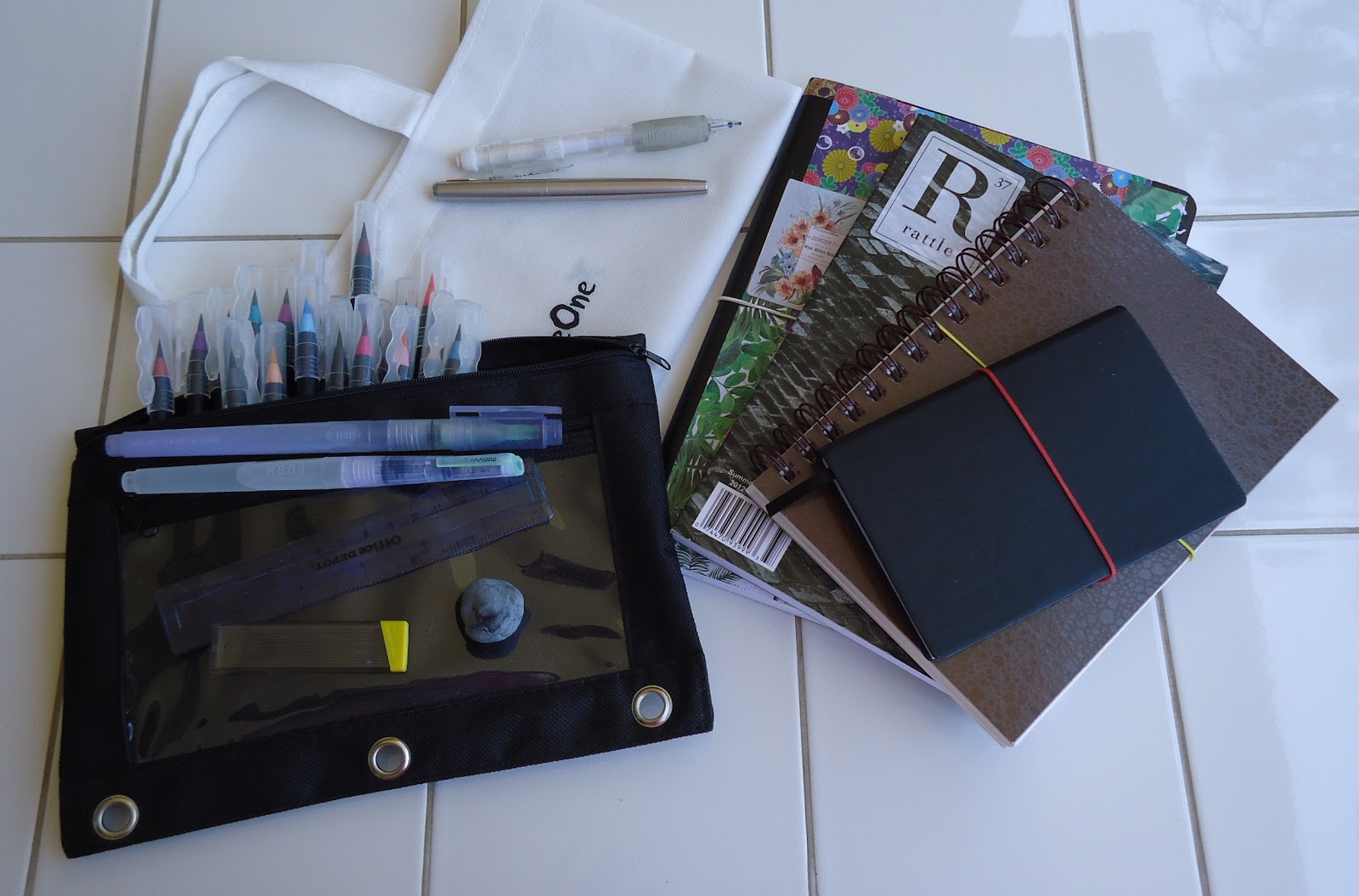
My Creativity Kit to Go . . . somewhere . . . anywhere . . .

Been anywhere exciting lately? No? Me either. So far this past week, the most thrilling outings I've had--other than scurrying back and forth between my apartment and the laundry room--have included: three one-hour walks through my neighborhood; two visits to the grocery store; and five round-trip car journeys to work. 

Over the weekend I decided that this wasn't a very inspiring, or productive, way to use my out-of-the-house time. Prior to isolation, I used to love carrying my sketchbook or writer's notebook with me absolutely everywhere: to the museum, the mall, the park, the community center, and yes, even to work (especially to work!). But lately when I've gone out, I simply walk or shop as quickly as I can before rushing back home to write or draw within the confines of my balcony. Without any nice air-conditioned cafes or comfortable seating areas (or the bathrooms to go with them) I've been reluctant to stand outside on the sidewalk to sketch under the scorching sun. It's also been pretty lonely wandering the deserted city streets by myself while the masked strangers I do pass cross the road the minute they see me. I miss my old life, I really do, but recently I've realized that I can't just wallow forever; hence my "creativity kit to go."

The purpose of the kit is to have some art and writing supplies always at the ready, whether it's to scribble in the park sitting on a blanket with a homemade ice coffee, or driving to an empty parking lot to write a quick short story in my car.

I'm still in the process of tweaking things, but for now my kit contains:
  • A 20-color set of my favorite Akashiya Sai watercolor brush pens. Twenty pens might sound like a lot, but they're slim and portable and having a full range of color to play with is just plain fun.
  • Two water brushes (for spreading and diluting the color from the pens): 1 large flat, 1 large round.
  • A mechanical pencil with a packet of extra leads. No sharpening required!
  • One kneaded eraser.
  • One black ink roller ball pen.
  • One black ink fountain pen with two extra ink cartridges. 
  • Two small sketchbooks: one for pencil and ink, one for watercolor.
  • One damp microfiber cloth in a plastic bag.
  • Two folded paper towels.
  • One 6-inch ruler (great for sketching buildings and practicing perspective).
  • A composition book for writing down ideas, freewriting, poetry, or simply journaling.
  • A literary magazine filled with stories, poems, and evocative photography. When taken out of context, the individual lines, titles, and pictures make for excellent writing and art prompts. And if you're feeling tired or out of sorts, hey, just read and renew your spirit for a little while.
  • Lastly, a pencil pouch to hold all the pens, pencils, brushes and erasers, with everything then placed in a small tote bag along with the larger items.
  •  
The best part of having my kit packed and at hand is that I can make the decision to go outside and draw and write without a ton of preparation. It also serves to remind me that I am still a writer, still an artist, still a creative being. I may be isolated, but I'm certainly not incapable of making the best of things. So who's with me? I'd like to invite you to make a kit of your own and to try and use it at least once a day, even if it's just to go into your own backyard. Let's go!

Tip of the Day: Writers and artists are used to working alone, but working in our current state of enforced isolation, complete with face masks, takes solitude to an entirely new level. It can be difficult to inspire yourself day after day, but a surefire way to keep the ideas coming is to try adding a prompt, written or visual, to each page of your sketch- or notebook.