Monday, July 25, 2016

Shake Up Your Writer's Group!


This month my writer's group is trying something new: art journaling together. It isn't the first time we've "changed the rules" and jumped into fresh territory, but adding artwork to our writing is a bit of a departure for us. 

To start things off, we agreed to each choose a special sketchbook or journal to work in. In keeping with many of my "how wrong can this go" attempts to get things right, I chose a sketchbook that came with impossible-to-remove stickers on both the front and back covers. After an hour of attempting to remove them, I ended up with a thousand little bits of paper still clinging on like limpets, as well as some deep gouges and tears in the cardboard. Solution? Start my art journal with some cover collage!


Lemonade out of lemons, right? 

Despite my somewhat rough start to the project, I think it's going well. We've had two art journal-based meetings so far; chosen themes for our journals (I've only changed mine twice); written down our intentions for our journaling practice, and started filling pages.

Regardless of whether we're working on journaling, short stories, or poetry, our group meets every two weeks, usually in a bookstore or museum cafe, and the one thing we've always done is have fun. The second objective that has kept our group strong and lively is that we concentrate on writing together rather than critiquing. It's made a difference to a) not have "homework assignments" between meetings; b) be able to support each other's creativity without playing editor, imposing our opinions where they don't really belong, and/or stifling a work at any stage of the draft-process. 

Writing together has had all sorts of benefits, new manuscripts being the least of them. More than anything we've learned to: 
  • Write on demand regardless of where we are, how we're feeling, or how lousy we think our work is at any given time. 
  • Be fearless. After we write, we read aloud. Although we've always provided the option to not read if something feels too personal or too raw for sharing, I've never known any one of us to use that option. 
  • Ink. In every color of the rainbow. We write by hand when we get together, and the results have never been anything less than impressive. (Hear that, writer's group? You are fantastic writers!!)
Some of the other ways we've kept the inspiration high has been to:
  1. Write flash fiction or poetry using word and picture prompts cut from magazines. Sometimes we'll all use the same picture, e.g., a strange setting, an evocative character, or an unusual object. At other times we'll combine them, or have a little package of our own (passed out during the meeting) containing two or three individual images. I never cease to be amazed at how different our stories are, or how publication-ready the writing is. 
  2. Go for timed writing. We give ourselves anywhere between thirty to forty-five minutes to write. Once the time is up, it's pens down. 
  3. Take field trips. We haven't had as many of these as I would like (note to group: take more trips!), but the trips we have taken have been unforgettable. I'm especially thinking of the time we all went up to Santa Fe and back by train. 
  4. Bring pot-luck brunch and meet at someone's house. Yum. 
  5. Treat ourselves to a restaurant lunch. No clean-up involved. We had pizza last time. Super yum. 
  6. Watch a how-to video together. Great for discussion (and eating. We combined the video with another pot-luck.). 
  7. White elephant parties. We got so good at this we've had to give them up, but essentially what we did was bring unwanted items from home, play a silly game to hand them around, and anything we didn't want was collected and taken to the thrift store the next day. Now that we're all beautifully de-cluttered, we've decided to keep our homes as junk-free as possible meaning the parties are over, but they were entertaining while they lasted.
I can't wait to see how our art journaling experiment works out. Although we are pretty much trying a free-form approach, we are also using this helpful list of 50 ideas I found at Blacksburg Belle for when we get stuck and need a small prompt (or a big shove). This motivational blog is loaded with lots of other excellent creative tips, so I highly recommend a visit. In the meantime, get out those glue sticks, write your hearts out, and keep the lemonade flowing.

Tip of the Day: Break out of the box. Even if you love your writer's group exactly the way it is, it never hurts to shake things up a bit. Meet somewhere new, read a book together, brainstorm some fresh possibilities. Drop a line a let me know how it's going.

Wednesday, June 29, 2016

Break Out of Your Shell!

"Mussel Shells"
Faber-Castell Polychromos Pencils
on Canson Pastel Paper
The drawing challenge from my color pencil group this month was to draw seashells. As you can see, I tackled four of them including the inside surfaces. Despite my initial resistance (too hard, too repetitive, not my thing, etc., etc.), I learned a lot from this exercise, much of which can be also be applied to my writing life, starting with practice, practice, practice. 

Thanks to my reluctance to start, I procrastinated like a pro. I answered email, cleaned my house, wrote more poetry; anything to avoid drawing. Finally the day came when I either had to get to work or go to my group empty-handed, aka "being a quitter." Not my favorite option. So with deep misgivings I started in with just one. Hmm. Not so bad. So I tried another. And another. And before I knew it I had drawn all four. Hey, I did it! Which made me realize:
  1. Repetition is valuable. One of the main things holding me back was fear of boredom: how could I draw four similar shells without losing my mind? The truth, however, was very different: first, the shells were NOT similar, and second, by repeating the process several times my technique improved as I got to the last shell. Practice, practice, practice! Whether you want to improve your drawing, write exciting action scenes or learn the intricacies of arranging a pantoum, it takes more than one attempt to get it right.
  2. Don't hide away in your "I can't do it" shell. Rather than setting yourself up for failure by aiming for the most incredible work in the whole of human history, start a dreaded project by drawing or writing in your most basic style: just get some shapes or words down on paper. Once that's done, tweak a little here, add a little there--before you know it your right-brain will be engaged and intrigued with all the possibilities. At this point, I dare you to stop.
  3. Shells make great writing and art journal prompts. The first time I wrote about a seashell in my art journal was an entry about playing with my grandmother's collection of shells from the Gulf of Mexico when I was a little girl. I loved holding those shells to my ear and "listening to the sea." You might have a similar memory, or you might want to write about your first trip to the beach, or your own collection of seaside finds. On the fiction side, including a seashell in a short story, poem, or novel could trigger all sorts of themes, associations, and plot twists--especially if the shell is rare and valuable!
  4. Artwork isn't always about drawing. How about brushing some ink or paint onto a shell and using it as a stamp in your art journal or mixed-media piece? Or pressing a shell into earthen or polymer clay? Drilling a hole into the top of a shell to add to a jewelry piece? Or simply painting and/or collaging the shell itself for a whole new look? 
  5. Using shells for meditation and mindfulness. No matter how small or seemingly insignificant, there's something profound about a seashell. Whether it's the patterning, the colors, or just the fact it once housed and protected some small and distant creature, shells make a good start to pondering life's mysteries. Add them to household altars, your writing room or studio, your garden or any other kind of creative sanctuary you like to visit. Personally I like to keep them all over the house in various nooks and crannies. 
Shells have always fascinated me, but that's no reason to take them literally and hide out inside one of my own. The drawing challenge for July is to draw green leaves. I'm so fired-up by the prospect I'm going to start and base an entire art journal on the subject. No hesitation, no holding back, just going for it. Parsley, sage, rosemary, and thyme! 

Tip of the Day: One of the things I love about drawing is how it relaxes and pulls me into what I could almost call a different dimension. Memories; new ideas for writing; the book I'm currently reading: my mind seems to just float along with the tide. While I was working on my seashell piece I was reminded of one of my favorite books that I hadn't thought of for a long time: Anne Morrow Lindbergh's Gift from the Sea. If you've never read it, or haven't read it for a long time, I can't think of a better text to check out for summer inspiration. Enjoy!

Friday, June 17, 2016

Sssh: Writer At Sleep


Sleep, glorious sleep--for a long time it's eluded me, and from what I hear, many of my creative friends have much the same problem. For roughly about the last two years, I've spent most nights tossing and turning, my mind going a zillion-miles-per-hour as I worry over plot lines, imaginary illnesses, remembering I have to pay a bill in two weeks, and oh, don't forget to return those library books by the weekend. . . . On and on. I'd say it's been a nightmare, except I haven't enjoyed any of the sleep that goes with a bad dream! If I got four hours a night in Slumberland, I considered myself lucky.

And then I got my Bucky pillow. Oh, my goodness.

I don't endorse many products outside of recommending some of my favorite art supplies, but I felt compelled this morning to tell everyone about my new pillow. I've had it for exactly two weeks now, and during these two weeks I've slept right through the night, EVERY NIGHT! Peeps, this is a miracle.

One of the reasons (I'm pretty sure) that I've had so much trouble sleeping is that I haven't used a pillow for decades. Every pillow I've ever tried has given me a headache, tried to suffocate me, or slid off the mattress (either that or I've thrown it overboard). Things got so bad a few weeks ago I even contemplated buying a new mattress. Then, out of the blue, I thought of trying a buckwheat pillow. Prior to this I had only read about these pillows in Japanese novels, and I've always been intrigued by the concept. However, the time had come to stop wondering and discover for myself what they were all about. 

I went to my local European-style pharmacy and sure enough they had them for sale (and on sale!). I bought two--one for me, one for my husband, and that first night I slept and slept and slept like I would never wake up. It's been that way ever since. I can't believe it. My husband is sleeping much better, too. Over the weekend I asked him if he wanted to go back to his old pillow. His reply? "Never!"

The pillows I bought for us are organic buckwheat on one side, millet on the other. They're smaller than a standard bed pillow, can be configured in a variety of heights and densities, and provide the best neck and shoulder support I've ever experienced. Although I have no scientific proof to back me up here (so please don't quote me), I have a feeling that the pillow is hitting all the right acupressure points in the back of my skull to induce sleep. I can't think of what else it can be, but whatever it is, it's truly amazing!

Sleep is vital to creativity. Heck, it's vital to life! I can't overstate how much better I'm feeling during the day, and how much less back pain I wake up with (currently none at all. Keeping my fingers crossed. . . .)

My next purchase will be to buy the Bucky travel versions of this incredible invention. Now that I've become such a total fan I can't imagine leaving home without one. And as my husband says, in case of global disaster, we can always eat them. A good deal, all round, I'd say.

Tip of the Day: There are many brands and types of buckwheat pillows available, "Bucky" being only one of them. But if you're suffering from any kind of insomnia or sleep-related problem, changing over to this type of pillow might be just the answer you're looking for. And if it doesn't work for you at night, I think you'll still be pleased at the way it makes an extremely firm and supportive head-rest for reading in bed or on the couch. Sweet dreams!

Monday, June 6, 2016

Poem Sketching

From my weekend sketchbook: Pentel Stylo pen, Sumi ink, and watercolor.
I've been studying Chinese painting techniques, especially trees--
very meditative and just right for poetry!

How did it get to be June? And how have I managed to skip out on blogging for so many weeks? It seems like the A-Z challenge was only a few days ago . . . 

May was a hectic month: Someone drove into my new car (all fixed now, yay!), I wrote at least ten versions of a new query letter and synopsis of The Abyssal Plain (finally settling on one I liked, thank goodness), and my day job was intense--I went to the post office so often it's a wonder they didn't offer me a cot so I could just stay the night.

So in between driving here, there, and everywhere and buying postage, I started writing poetry, and then I started sketching poetry illustrations, and before I knew it, I was living on another planet--a secret creative place that shut out the whole world. I didn't Tweet, I didn't email (sorry, email friends), I didn't blog, I just zoned out and concentrated on doing what I wanted to do: write and draw. 

The poems, as well as the drawings, are based on my trip to Taiwan last year. Ever since I got home I've been trying to duplicate my feelings and experiences through my artwork, but there always seemed to be something missing. Now I know it was the words to go with my pictures. While I was still searching for those missing pieces, I knew I didn't want to write some sort of travelogue (I did enough of that in my Taiwan Travel Diary blog posts), and I certainly didn't want to start a new novel or short story collection. But I wanted to express myself in some strong and meaningful way, and poetry seemed to be the perfect vehicle.

I try to write at least one poem a day, basing it on various aspects of my journey: from riding the bus, to savoring tea and cake while thinking about monkeys in a museum tea shop. To get the ball rolling, I use a brainstorming technique I learned in Writing From the Inside Out by Sandford Lyne. Before I start writing, I take a piece of paper and head up two columns: one titled "Inner" and the other "Outer." "Inner" is for everything that involves feeling, e.g., what were my thoughts, emotions, even my state of health? "Outer" is for everything that was happening around me, including the weather as well as the people, places, and details of what I observed. Once I have all my memories and notes in place, I weave them together into a poetry draft, seeking connections and making leaps into new directions for more writing. It's a helpful and enjoyable process, and sometimes it almost seems as if the poems write themselves.

The most exciting part of this new work, however, is that I now have a good use for my paintings of Taiwan, as well as a reason to continue painting them: illustration! Best of all, I can use the same pen to draw and write with, LOL!

Old tree trunk: Pentel Stylo pen, sumi ink, 
and Japanese watercolor.

Tip of the Day: You don't have to be a published poet or MFA candidate to write poetry. All you need to be is someone in love with words and the chance to play with language. The next time you sit down to journal or freewrite, try putting your feelings into a poem. It doesn't have to rhyme or have verses, or even have proper line breaks--it just needs to be you experimenting on the page with a fresh approach. If you need some inspiration, read a few published poets first and then try the "Inner and Outer" technique to organize your thoughts and feelings.

Thursday, May 12, 2016

#AtoZChallenge 2016 Reflections


I knew May was going to be a busy month, but what nobody told me was that instead of blogging every day, I'd be building a new website every day. Believe me, it's not something I wanted to do, but my web hosting service is in the process of upgrading and I've been notified to go with the flow or get left behind. Consequently I’ve had to learn a whole new set of tech-skills faster than you can say "pixel" and my head is still spinning. At this point in the game I'd do just about anything to set back the clock and return to the simple world of going through my ABC's. At least I have next April to look forward to!

Before I landed in this big website morass, one of the things that made this year's A-Z challenge so special for me was my theme of art journaling. To make my posts authentic, I had to create a daily art journal page to illustrate what I was writing about. Despite the extra work, I feel I got much more out of the challenge than I bargained for; I love the small journal I created for the month and it will always be a “Yes, I can do it!” reminder and reward for participating.

Besides the fun of creating a new journal, other benefits I received from the challenge include:

  • Learning I could write under pressure. During the challenge I still had to go to my day job and fulfill all my other routine obligations. But I always posted!
  • Learning that I could create an art journal with limited time and resources. You can do a lot with a little—no excuses.
  • Met many great bloggers--and from all over the world.
  • Felt easier than I usually do about opening up and sharing without my inner critic interfering. There just wasn’t any time to listen to her cautionary ranting. (Thank goodness.)
  • I felt comfortable calling myself a “blogger.” Often I just consider myself an author with a blog and that's the end of it. But I like blogging, and I enjoy having my blog. So I guess it's okay to call myself an honest-to-goodness real-life blogger!
  • I particularly liked having the routine and discipline of posting every day. Although I won’t be able to maintain that kind of schedule (once or twice a week fits my life much better) it made me realize how I can use that same time for a creative exercise every day, and with satisfying results.

So will I return for 2017? You bet! I had a great time with the challenge, and I hope you did too, bloggers and readers alike. Thank you to the A-Z team who made this exciting event possible, and thank you to everyone who took the time to visit and comment on my pages. 

Finally, and as promised, I have selected (using Random.org) a winner from my visitors who commented on my posts over the month for a copy of Overtaken! Name to be announced in my next post. See you then!

Tip of the Day: In order to participate in the challenge, I gave myself about an hour every day to both write my posts and work on my accompanying art journal pages. By carving out just a little extra time I found I could do a lot. The secret was in telling myself I had to do this—I had promised, I was committed. Now that the challenge is over, what can you commit to with that same dedication? Blogging, painting, journaling, beading? Whatever you choose, promise yourself you'll do it--seize the day.

Tuesday, May 3, 2016

Light as a Feather


I never thought I would miss blogging every day, but already I'm feeling nostalgic for that early morning ritual of stumbling to my computer in the dark to write yet another post!

I'm also missing reading all those great posts from other bloggers that would fill my in-box every morning--hopefully they'll all start up again soon, too. 

At the same time, I feel like I've been through an initiation of some sort, an "ordeal by blogging." To celebrate the end of a long (and intensely interesting) month, the first thing I did when the Challenge finished was go to my drawing table to draw these feathers. Not only did I feel "as light as a feather" to have put blogging behind me for a day or two, but I'd been postponing this small project for a few weeks and really wanted to try it out. 

The feathers came from the last meeting of my colored pencil group when we were all given a handful of wild turkey feathers with the assignment to draw them for the next meeting. On Sunday I finally had some spare time, so I used my new Faber and Castell Polychromos pencils and three different kinds of paper. The subject seemed to fit my mood to a T. While I was drawing, my mind was also jumping all over the place with plans for the coming month, including:


  • New re-prints of two of my books: The Great Scarab Scam and Better Than Perfect. More on this coming soon!
  • Submitting my new novel, The Abyssal Plain with new query letters and synopses.
  • Going back into ceramics. Before the#AtoZChallenge I bought a fresh batch of stoneware clay and made three pots that are now ready for a bisque firing (maybe this weekend?). As soon as they're out of the kiln I'm going to try decorating them in an Asian splash-ink style based on last year's trip to Taiwan. This is an entirely new direction for me and I'm excited to see the results.
  • And finally, speaking of Taiwan, out of the blue I've started to write a series of poems to go with my Taiwan paintings, drawings, and now pottery. This has been a huge surprise to me--talk about a change of plans! The first poem came to me in the middle of the night last week and I had to get up to write it. Now I can't stop!

It's going to be a busy month--how about you? Any plans you want to share? Leave a comment, and have a Happy May!

Tip of the Day: Working through the alphabet isn't just for blogging or the month of April: how about trying an A-Z art journal, poetry or short story series, a picture book for children, or even an entire novel outline with each chapter based on a letter of the alphabet? The possibilities are endless--and once you finish one project, you can start all over again with a fresh approach.

Saturday, April 30, 2016

#AtoZChallenge, Z is for Zip-a-dee-doo-dah!


Here we are--the very last day of the challenge! Huge congratulations to my fellow bloggers for sticking with the program; it's been a pleasure to meet you.

I'm not sure what today's collage is all about, but that's one of the great joys of art journaling: discovering where you're going, what you're looking for, and what you want to say as you create the page. Basically I think it simply expresses my "Zip-a-dee-doo-dah" joy in making it through the month!

Early on in both my writing and my art work I learned that I could only write or paint what I had a real and true zip-a-dee-doo-dah for, or in other words, what I was passionate about. Working for hire on an insurance brochure brought that home very quickly, as did the summer I took a class on painting only what the teacher insisted we produce: ultra-realistic portraits in blue watercolor. Flat yukky blue--no electric ultramarines allowed. After four sessions I dropped out and spent the rest of the year discovering how much I loved oil pastels and in every color of the rainbow.

Writing these blog posts day-in and day-out, and making my accompanying art journal pages, has proven to me how much I enjoy art journaling. I really do have a passion for it! I hope I've been able to impart some of that same enthusiasm to you, and that you have been encouraged to maintain journals of your own.

For me, my journal is both a refuge and a portable studio. I can take it with me wherever I go, and I can try out numerous experiments with color, design, and text without fear of failure or judgment. Anything goes, and that goes for you too--HAVE FUN!!

So with that said, it's Saturday, it's Spring, and we've got a whole weekend to play. If you haven't started your journal yet, maybe this is the day to begin. Best wishes and thank you so much for stopping by. Catch you later.

Tip of the Day: For a completely relaxing and no-stress art journal, try creating one without any words, or even any specific meaning. Simply collage the pages, and in no particular order. Start in the middle, add some red to the end papers, a picture of a "Z is for Zebra" when you come across one, a peaceful beach scene just because you love it.  Add various elements to your pages at your leisure and where you think they fit best. Don't worry about a thing--I promise it will be beautiful and something you'll cherish long after you've run out of glue!

Friday, April 29, 2016

#AtoZChallenge, Y is for Yearning (and a Special Surprise Giveaway!)


If I were to isolate a single word that sums up all of creativity, I would offer up the word "yearning." So much of what we aim to do in our art journals, fiction, screenwriting, poetry, the visual arts is, I believe, based on yearning. The yearning to be whole. The yearning to be authentic. The yearning to tell our unique and soul-specific stories.

Today's art journal page is based on my Gothic novel, Overtaken. It's the story of a portrait artist yearning to find not only her missing husband, but her true identity, as well as her strongest artistic self. Of all the art journal pages I made for the #AtoZChallenge, this is one of my favorites. I've always enjoyed a touch of romantic melancholy and nostalgia, a little bit of mystery and regret, a dash of "beauty in the ruins." Writing Overtaken satisfied many of those same yearnings and I'd like to share that story with you.

In order to accomplish that, I'm giving away a paperback copy of Overtaken chosen at "R is for Random" to anyone who comments on any of my #AtoZChallenge posts (past comment-leavers are eligible too!) until 11.59 PM, Sunday May 8, 2016. I figured I'd give a little extra time for last-minute comments as I know from past experience it's sometimes easier to stop by after the challenge than during it. The winner will be chose on Monday, May 9, 2016.

Tomorrow is the last day of the challenge. I admit to feeling rather sad to reach the end. I can't say I'm exactly yearning to start all over with another 26 days, but it has been fun and I've enjoyed the self-discipline of art journaling along with the blogging every day. How about you? Let me know--you could win a free book!

Tip of the Day: What are you yearning for? Write it all down, every single little angsty bit of it. Find or paint images to reflect your feelings rather than the actual items or states of being. 

Thursday, April 28, 2016

#AtoZChallenge, X is for X-Ray Vison


I wouldn't be surprised if a lot of us are using the theme of "X-rays" in today's posts, me included. X isn't the easiest letter of the alphabet and my mind always goes straight to the word "xylophone" when I think of it. The trouble is I don't play the xylophone, so have nothing to say on the topic. Therefore, X-rays it is!

X-rays have always played an important role in my life. As a child I spent many hours in my father's chiropractic office while he developed his patients' X-rays. Sometimes I would go into the darkroom with him, a mysterious and magical closet illuminated by a single red bulb. Fascinated, I would watch what resembled a type of alchemy: sheets of X-ray film dipped into odorous trays of solutions and water before being raised to the light to reveal skulls and spines, vertebrae and ribs--the human skeleton in all its twisted and imperfect agony. I learned to stand up straight by studying those ghostly images, and I'm sure they had an impact on my entire attitude to healthcare: stay well!

For today's art journal page I painted a sheet of paper with black gesso and pressed my hand down into the paint. The results intrigued me--what did my hand have to say to me? In real life I've never liked the look of my hands. Childishly small and usually stained with ink, burned from taking something out of the oven, grazed from clay, scarred with endless paper and knife cuts (more cooking accidents), and dry, thanks to the Albuquerque weather, they are not the long, elegant hands I envy. Yet when I see my palm with "X-ray vision" as it appears here, I'm not so disappointed. Slightly feathery around the edges, it's a capable and gentle hand, and I'm suddenly filled with gratitude for its hard-working, "accept any challenge" attitude. After all, my hands have never let me down, and have been as eager to plunge themselves into mud as they have been to try embroidery and bead-making.

Fortunately, I've never broken a bone or injured my hands in any serious way, the worst accident being a milk bottle in New Zealand splintering in my hand and cutting my thumb with such severity I still have the scar to this day. The nerve endings are still a little tender there, but other than that it's fine. But whenever I feel that twinge or see the deep line where the glass cut through, I'm reminded of so many things: the milk boys rattling their carts up and down the street at twilight delivering those treacherous bottles, the way the rain fell while I ran cold water over my hand. . . I feel it in my bones.

Art journaling is another way to feel "with the bones." What does your body have to tell you? What memories are waiting to develop and emerge? Today, let the darkness speak.

Tip of the Day: The single most important book that set me firmly on the writer's path is none other than Natalie Goldberg's Writing Down the Bones. Any of the exercises in the book can help you uncover what it is you want to say about the images you create in your art journal. If you don't already own a copy, don't worry, it's a staple at most libraries. Check out a copy today!

Wednesday, April 27, 2016

#AtoZChallenge, W is for Writing by Hand


I didn't start out life with very good handwriting skills. It seemed to take years of practice for me to even master the basics, with many after-school hours spent practicing and practicing. I just couldn't "get it," how to make the perfect letters my teachers seemed to insist upon. Then one miraculous day I wrote my name and it looked good! I think I was in the fifth grade, and the teacher finally said, "Well done!" I remember feeling proud and happy that I could write with a pen "like a grown-up."

Over the years my handwriting has gone from "just like the book" to wild and messy (note taking in college), then on to small and neat when I was writing my first manuscripts, to where I am today: large and scrawly and sometimes so chaotic even i can't read it.

Whatever stage my handwriting is at, though, I've always regarded writing by hand an important part of the creative process, especially when it comes to writing the first drafts of my manuscripts. And I can't imagine for the life of me typing a journal entry. But when it comes to art journaling (as in today's page above) I think my letters need some improvement. Just sayin'.

The other day I was at an art group meeting when the woman I was sitting next to suddenly started to add some beautiful calligraphy to her sketch. It was amazing to watch her form an elegant caption in colored ink to her drawing of some sunflowers. In seconds her drawing went from "very nice" to "Wow! I wish I could do that!"

I expressed my admiration and she laughed, saying anyone could do what she was doing. She explained that calligraphy was really just another form of drawing. With a little practice, she said, it was easy to get the hang of it. 

As soon as the #A-ZChallenge is over I'm going to purchase a book on lettering and calligraphy and see if I can make some gorgeous loopy letters myself. I think it's going to add an entirely new dimension to all my artwork. Something I've always envied about Asian painting is the nice vertical line of calligraphy often added along the side of the picture, usually a poem or affirmation of some kind. I don't think I'll go as far as learning Chinese, but it would be great to add my own line or two in a creative font (and one that I can actually read!).

So that's the goal: ruled paper, big pencil, lots of erasers--definitely entering my  second childhood!

Tip of the Day: If learning calligraphy seems like yet another item to add to an already top-heavy to-do list, a quick and easy method can be to print out some nice fonts from your computer onto labels or decorative paper and then paste them into your journal. Nobody said journaling had be to hard. Keep it fun, and I'll see you tomorrow!

Tuesday, April 26, 2016

#AtoZChallenge, V is for Vision Board


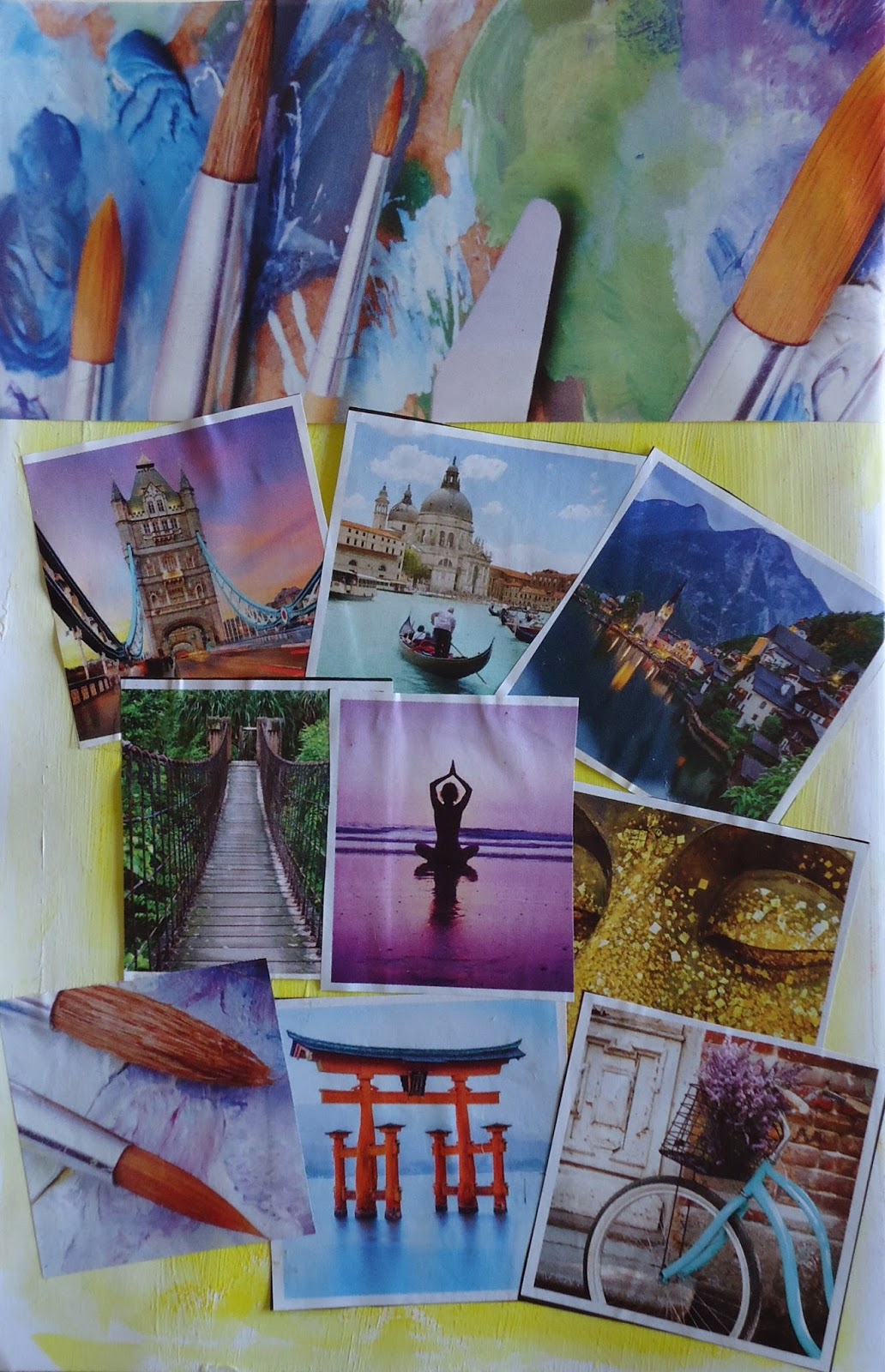
If I wasn't participating in the #AtoZChallenge this year, I think my vision board for the month would be a nice, white, blank page--completely empty and as restful as white sheets on a freshly-made bed. But that would be totally boring for you, my dear readers, so for today's post I've tried to bring you something a little more colorful. And after assembling this mini-board full of travel and art supplies, I do feel re-inspired, re-charged, and re-energized to make it all the say to Z (only 4 more posts to go!).

Vision boards have always played a large part in my life and my journals, and I can testify to them always coming true. Always. Whatever I've collaged and focused upon has entered my life in one way or another, and often with much better results than I ever allowed for in my original vision. 

Some of the boards I've made have included:

  • Houses and cities I've wanted to live in. (Best example: When I was fourteen I made a collage for my Home Economics class describing how I wanted to live in London one day. Nine years later I was living and working there--and in a flat almost identical to the one I had collaged for my teacher!)
  • Trips I have wanted to take.
  • Work and teaching opportunities.
  • Creative work: manuscripts, paintings, drawings, pottery and jewelry I've aspired to make.
  • Getting published and selling my work.

Friends have told me that their vision boards have brought them all of the above and more, things such as improved relationships, better health and well-being, longed-for pets, and new jobs with better financial stability. Dream it, believe it, and write it down with some great images to accompany your inner vision . . .  I can't think of a better use for an art journal!

Whether you choose to make a large or small-sized journal-page "board," keep in mind that it doesn't have to include your entire bucket list. In fact, sometimes it's more effective to create a single page or section of your journal for each individual goal or aspiration. The most important thing is to dream big. After all, the imagination has no limits, so why should you? Go for it!

Tip of the Day: If you don't mind the chance of letting other people see your dreams, the cover of your journal can be the perfect spot for your vision board. Not only will it make an otherwise dull cover brighter and more interesting, it will help you to visualize your forward path every time you see your journal.

Monday, April 25, 2016

#AtoZChallenge, U is for Unsent Letters


The first time I ever saw a letter and it's accompanying envelope as part of a book was in the Griffin and Sabine series by Nick Bantock. Bantock's work has been a big influence on my own and many others journal work and placing little hidden notes throughout my journals has now become a mainstay.

Writing unsent letters can be a healing and cathartic experience--and you never have to worry about accidentally pressing the "send" button before you're ready! No regrets, no unintended hurt feelings, no misinterpretations. The only person reading your letters is you, even if you've addressed them to all sorts of people. For instance, you might like to write an unsent letter to:
  • The editor. The one who rejected you, and not very nicely.
  • Mean-spirited book reviewers.
  • Those kids in high school. You know the ones . . . 
Feel better? Once you've got that out of the way, other letters can be written to:
  • Your child-self, or who you were as a teen or young adult.
  • Someone you've never met, but always have wanted to thank for inspiring you.
  • Fictional characters in books or movies you've loved.
  • Your future self.
  • Anyone you still have an unresolved conflict with, but it's impossible or inappropriate to contact them.
  • Write to your manuscript or any work-in-progress that is troubling or perplexing you.
Letters don't always have to go into envelopes, but it's fun to give them their own space, especially if you decorate the envelope in some way, or tuck other small items in along with the note. In the past I've included  mini-photos and even a dollar bill! (I don't know why; it just felt right.)

If you're concerned about maintaining the privacy of your unsent letters, two techniques that have worked for me are to:
  • Write out the full letter on a journal page and then collage over the entire text. The letter is there, but completely hidden by images relevant to the letter's contents.
  • Try "stacked journaling," a technique that turns your handwriting into an elaborate and abstract work of art that will be unreadable to anyone. Basically you simply write in one direction, then write again over the lines in another, and so on, back and forth. Use several different ink colors to really make the piece "pop." 
Personally, I miss the days of sending actual, handwritten or typed letters to friends and family: choosing nice stationary (onion-skin for airmail, heavy cream linen for query letters); waiting for the mail to arrive; everyone being okay with weeks or even months between replies. All of that can be reproduced in my journals, and with an added bonus--I don't have to go to the post office!

Tip of the Day:  Buy yourself a greeting card or two. Whenever I've gone to buy a birthday or other type of card it takes me forever to decide on which one--I want them all! I've solved my dilemma by buying a few extra for myself and using them throughout the year to write "surprise" notes in my journal.

Saturday, April 23, 2016

#AtoZChallenge, T is for Travel Journals


Of all my journals, my travel journals have to be among my favorites. Every time I go through them I'm taken back in time and place and feel like I've just been on a mini-vacation.

Some of my tips for art journaling on the road include:


  • Travel light. Choose a sketchbook that fits into your purse, carry-on, or back pack so you can have it with you at all times.
  • Whatever your medium, take a sketchbook with heavier, rather than lighter paper. You might start out thinking you don't like watercolor, but then end up buying a set somewhere during your travels. Be prepared for new choices. 
  • Pens and pencils: I'm a big fan of water-soluble pencils. You only need between 6 and 12 to have a wide range of colors. Throw in a waterbrush, a black ballpoint or roller pen, a mechanical pencil, and you're ready to go!
  • Before you leave home, pre-tone some of your sketchbook pages. Laying down a light watercolor wash or a background of soft pastel can save a lot of time when you reach your destination. It will also help to give your sketches a more finished look.
  • A large-size, heavy-weight plastic zip-lock type of pouch or folder is a must-have for collecting museum brochures, ticket stubs, menus, flyers . . . you know, stuff! Bring along a glue-stick as well if you'd like to paste anything into your journal on site, although it's often easier to collage once you get home.
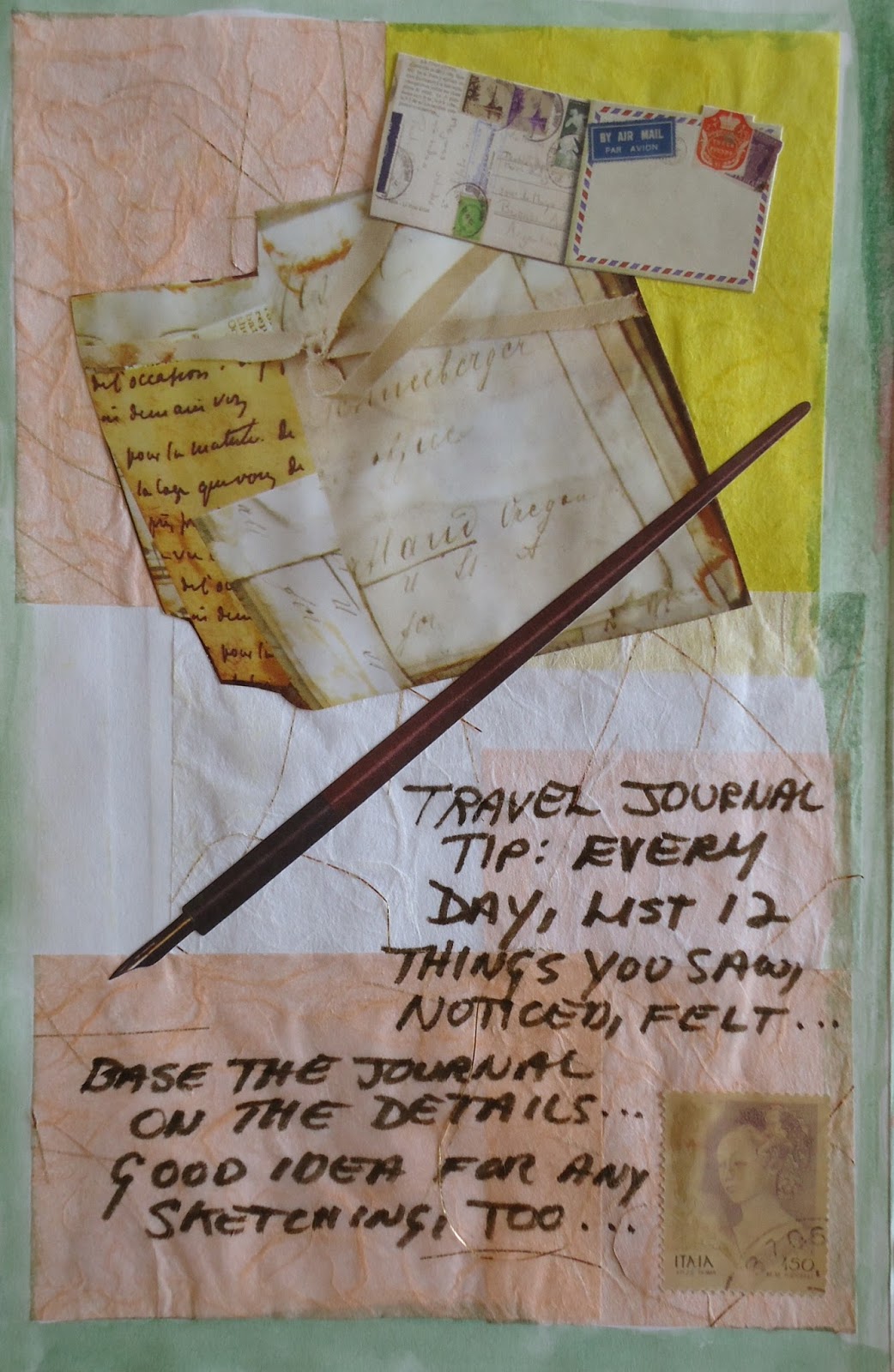
  • A small viewfinder. I used to think I could get away with not having one, but now I think it's indispensable. For me, at least, seeing a new mountain vista or city-scape for the first time can be overwhelming. A viewfinder helps me to break down the scene into sketch-size pieces. It's also a helpful tool for isolating detail I might want to make a special note of.


Whatever type of sketchbook and materials you choose, keep in mind that you don't have to travel to an exotic or expensive locale to start a travel journal of your own. How about looking at your hometown through the eyes of a tourist? Take a journal to local museums, galleries, parks, and restaurants and record what you find. Pretend you're seeing it all for the very first time--perhaps you are, especially if you visit places you may not have considered worth seeing before. Off you go!

Tip of the Day: Another kind of travel journal you can make, and without leaving home, is to create a journal based on a location you've always dreamed of visiting, but haven't got there yet. Find images online, in travel magazines, and from friends' personal hordes and photos. Bon voyage!

Friday, April 22, 2016

#AtoZChallenge, S is for Stamp it Up!


Raise your hand if you remember making a carved-potato stamp in grade school? Big piece of newsprint, runny tempura paint? Having the best time ever?

Those potatoes have stuck in my mind for a long time. One Christmas we used cut-up sponges instead and made our own gift wrap. My parents probably wondered what their tax dollars were being spent on, but craft projects were always my favorite part of the school day.

Today I still play with stamping, only I usually go for fancy store-bought ones, as well as real, live postage stamps. I like to collect both kinds when I travel: on today's art journal page I used a postage stamp from Taiwan, a good old 1-cent USA stamp, and one I cut out of a travel magazine. I also used a couple of rubber stamps, placing the butterfly on yet another of my practice apricot sketches similar to the one I pasted onto "A is for Art Journal." (This example shown here was drawn on a piece of fabric interfacing--a very interesting experiment and highly recommended.)

But going back to rubber stamps, the one problem is that they're pricey. I always buy them when they're on sale, which saves a lot of money, but there's other ways to stick to a budget:


  • Avoid the art supply stores and shop instead at dollar and discount stores. Sometimes they have fantastic deals and selections.
  • Carve your own stamps from rubber and plastic erasers (including the ones at the tip of a pencil) with an X-acto knife.
  • Carve old wine corks.
  • Cut out shapes from thick or corrugated cardboard.
  • You can make all sorts of designs from dried modelling and paper clays.
  • Don't forget those potatoes! Other root vegetables can work too (I promise this isn't an April Fool's joke).
  • Sponges.
  • Household items: hairbrushes, toothbrushes, embossed wallpaper scraps. Use your imagination.
  • Lino-blocks

 Many of these techniques, especially the potatoes and cardboard, will probably have a one-time, one-project use, but that's okay. It's easy to get bored with your stamp collections (one of the reasons I don't like to pay too much for them) and after several butterflies and seahorses you're soon longing for a kitten- or parrot stamp.

The only other thing you'll need for stamping besides shape and design is some color. Ink pads for stamps come in so many shades and styles today it's difficult to choose; some provide a faded "vintage" look, others have a gilded, metallic appearance. Just like making your own stamps, however, you don't always need a commercial stamp pad. Watercolor, washable felt tip pens, acrylic and other paints work just as well if not better depending on your project.

So the next time you receive a card, letter, or package with an attractive stamp adhered--save it. I like to keep a little bit of the actual envelope's torn pages "framing" the stamp, as well as the entire postal imprint--almost as good as a free rubber stamp, especially if its from overseas! 

Tip of the Day: Of all my stamps, the one that means the most to me and that I'll never get bored with is my personal stone seal I ordered from Taiwan: Happy Little Cat. If you'd like something similar, I recommend the company I went through: Asian Brush Art. They also have lovely pre-carved Chinese character stamps that you can purchase to enhance your work with balance and a happy thought for the day.

Thursday, April 21, 2016

#AtoZChallenge, R is for Randomness


True confession: I'm one of those #AtoZChallenge bloggers the committee warned you about--I'm blogging every day without a plan! None of my posts have been pre-written, pre-scheduled, or pre-ordained. In other words, I'm a genuine pantster, and proud of it, LOL!

And that's why today's post is a tribute to the joy of Randomness, letting the bits and pieces of your creative mind fall into place on their own without (too much) interference.

My favorite ways to work with random selection include:


  • Go for a walk and seek out 6-12 random objects. If possible bring them home, or at least photograph them. Weave them together into an essay, story, or piece of art.
  • As a variation, look for random objects in a certain color scheme. For instance, 6 things in red, or 6 things in gray.
  • Empty your purse or briefcase. What can you write or draw that ties these items together in some way? Can you assign them to a fictional character?
  • Just create random collages--then write about them later.
  • The good old, tried-and-true magazine cut-outs. Pair disparate images together and find the connections! Same with writing and word prompts. The stranger the combination, the more exciting the possibilities can be.

It's amazing what kinds of "happy accidents" can result from trying out these exercises. Entire passages of my novels have been written this way, totally unplanned and totally unexpected, kind of like today's art journal page. I haven't had time yet to sit down and find what a goat, an egg, a circus rider and the Arc de Triomphe have in common--but I'm sure I'll find the key somewhere. The trick is believing it's there and trusting the story will come to me. It's never failed me yet.

So what's your favorite way of going random and free-floating through the universe? Drop a line and let me know! 

Tip of the Day: If the idea of randomness makes you nervous, try journaling about the reasons why. Some of my own worries about being "too random" include fear of never finishing a project due to too many unrelated ideas, not seeing the forest for the trees, or losing focus by casting my attention too far and wide. On the other hand, I often think there may not be any such thing as complete randomness, and perhaps the things we choose "at random" are actually waiting for us to find them so we can make the relevant connections--another good topic to explore! See you tomorrow.

Wednesday, April 20, 2016

#AtoZChallenge, Q is for Questions


Many, if not most, of my journal entries start with a question. There seems to be an awful lot I want or need to know! But questions lead to answers which then lead to inspiration and insights and, of course, more questions for next time.

Today's page is made up of some purplish mulberry paper I found ultra-cheap at Big Lots; I think I paid about $3 for 100 12" x 12" sheets in a rainbow of colors. I love the texture and tough-delicacy of the sheets and have used them for a variety of projects. I particularly like this true "mulberry" color and for today have paired it with some strips of paper that I recycled and cut from an old colored-pencil drawing I had done of some eggplants--dozens of eggplants, too many eggplants, if truth be known. I couldn't stop drawing them. And then I didn't know what to do with the piece until I thought "collage material." 

As for the photograph, it's a vintage pic I cut from a magazine (where else?). I think it's supposed to be in Hawaii, but I chose it because it reminded me of old family photographs I've seen of my grandmother who was born and raised in Fiji. I never knew her as she had passed away before I was born, but her life was straight out of a novel: the daughter of a Boston whaler and his wife, my great-grandmother, a desperate, stranded former nanny who had three previous children from a bigamous marriage. It turned out the dashing sea captain she'd married in the islands already had a wife safely stowed back in England.  Her situation, and the ensuing scandal, has always made me ask why and how and who--good questions for both the fiction and nonfiction writer in me.

Needless to say, they are also questions I've never had good answers to, leaving me free to solve the mysteries in my own creative ways, such as with my art journal. Family stories aside, some other types of questions I like to work with in my journal are:

  • What are my goals for the week, month, year?
  • How will I achieve them?
  • What creative work (painting, drawing, poetry, novel . . .) do I want to tackle right now? What's calling to me? What are my priorities? What's next?
  • Manuscript questions: plot holes, character interviews, back stories.
  • Visual art: what colors should I use for a particular piece? What's the emotion I want to convey? Is there a story to the piece?
  • Real-life conflicts and difficulties: how to solve, how to let go, how to move on.

Whatever you choose to ask your journal, keep in mind it can really be about anything: from the meaning of life to what to cook for dinner. It can even be as simple as asking: What should I write about today? Just so long as it starts with the letter "Q" you'll be fine! See you tomorrow.


Tip of the Day: Not every question can be answered immediately. Finding good answers can take time, the important thing is to write your questions down in your journal and leave enough space to fill in the blanks. A good technique I've found is to write a question at the top of a page and then skip several pages before I write down the next one at the top of another page. The spaces in between can be filled in later and in no particular order. Having your questions pre-written can serve as a useful prompt, especially when you're feeling a little stuck.

Tuesday, April 19, 2016

#AtoZChallenge, P is for Pearls


. . . Pearls of wisdom, that is, although I did add a few stick-on pearls to complete today's art journal page. Many of my most-beloved "pearls" come from my favorite books, lines of dialogue, description, often the opening scene. Today's page was inspired by Lawrence Durrell's Alexandria Quartet, the book I blogged about the first time I took the A to Z Challenge in 2014. 

The first book of the quartet, Justine, starts with these evocative lines:

The sea is high again today, with a thrilling flush of wind. In the midst of winter you can feel the inventions of spring. A sky of hot nude pearl until midday, crickets in sheltered places, and now the wind unpacking the great planes, ransacking the great planes. . . . 

I have escaped to this island with a few books and the child -- Melissa's child.

And I'm hooked once more! 

The Alexandria Quartet is one of the few books I re-read again and again. I don't think I will ever stop learning from the language, or discovering new nuances and themes in the text. For today's page I most wanted to capture that pearl of a sky, and as wonky as it might appear (as with all my art journal pages), it does do what I wanted it to do for me: remind me of the book. 

Always keep in mind that in spite of what I'm demonstrating for the challenge--sharing a page a day--art journals are essentially private. They're for you to explore, experiment, and be as fondly sentimental and personal in as you want to be. Never worry about what other people will think of your journal, or how they will judge it. Which is probably a good little pearl of wisdom for yourself: don't judge your journal too harshly, either. 

Now go scribble, play, write your heart out, run with scissors--and take some time to re-read a favorite book!

Tip of the Day: If you're still on the fence about starting an art journal, or looking for some new inspiration, there's nothing better than creating an illustrated commonplace book (the link leads to a post I wrote on the subject you might like to read for more information). People started making commonplace books centuries ago as a way to compile their own small stores of general wisdom, from daily aphorisms to recipes for salves and poultices. Today they make the perfect theme for an art journal. Just like our ancestors did, you can fill your book with inspiring quotes, soap and shampoo recipes, and guidelines to live by. Don't forget to add the pictures!


Monday, April 18, 2016

#AtoZChallenge, O is for Ordinary


First things first: I didn't paint this picture I glued onto today's journal entry, but I sure wish I did. Unfortunately I can't even tell you who the artist is--one of the hazards of cutting out pictures from old magazines without paying too much attention to the credits.

Whatever its history, though, looking at this calm and colorful scene makes me happy. I like to imagine the people who live in this house and how they got there. It's the kind of dream-house they used to feature in old movies; any minute I expect Cary Grant to come laughing through the door, or Olivia de Havilland with a basket of freshly-cut roses hanging from her arm. In many ways, the scene is perfectly ordinary: a country home, an open door, a sunny day. Nothing special. And that's what makes it so appealing to me. 

Of course, I could be completely wrong, and all kinds of extraordinary things could have occurred here that have nothing to do with the peaceful life I envision. For instance, the family who lives here might be sick to death of the place and say things like, "That view is so dull! Why don't we concrete in the grass and install a Ferris Wheel?" Or, "Please don't play the piano again tonight, Jolyon. If I hear Claire de Lune one more time I'll have you committed."

And that's just for starters. What if Jolyon the piano player gets so mad he strangles the woman who hates Clair de Lune? Or war has just been declared and the entire family has fled the house without even turning off the lights? Or a flying saucer has abducted everyone except the youngest child and his nanny? Appearances can be deceiving. You just never know; what might appear ordinary to one person could be absolutely mind-staggering to another.

Which is what makes the ordinary such an interesting topic to explore in our journals. How ordinary is ordinary? Maybe it's only the way we perceive it. For instance my commute to work has become so boring to me I'm on auto-pilot half the time, but to someone from out of town they might think: Albuquerque! What a charming place to live! Or when I go shopping for groceries and buy milk and eggs and ice cream again, another shopper might be thinking: Ice cream. Milk and eggs for cake. She must be throwing a party. What we take for granted as dull and routine might stir someone else's imagination in a wholly new, and unexpected direction.

Some of the ways I like to experiment with being that "someone else" is to:

  • Drive down unfamiliar streets. Take note of the architecture and general ambience. Park and journal for a bit.
  • Buy some grocery items I often ignore. Cook them, taste them, write!
  • Look for the beauty in "clutter": a sink of dirty dishes, a pile of laundry: what's the story? How could I turn that into an interesting drawing or painting?
  • Go to clothing or other kinds of stores I don't usually shop at. I'm a huge fan of window-shopping, but sometimes it's fun to surprise myself with some new and out-of-character purchases.
  • Check out some library books on subjects that I've always considered difficult or unappealing. Getting out of my reading/creative comfort zone has lead me to subjects I would never have considered before and that I've grown to thoroughly enjoy.

At the same time, it's important to keep in mind that there's also a unique and special beauty in the ordinary. Not only can it be secure and comforting, but it can also be what provides you with a firm bedrock for your creative endeavors. A clean and bright workspace, a well-organized manuscript and WIP notebook, paints and pencils where you can find them . . . celebrate it all in your journal with colors, sketches, collages, and words.  

Tip of the Day: Another good use of your art journal is to break free of the ordinary. For instance, explore new mediums or color combinations. Go through "dull" magazines for counter-intuitive inspiration and unexpected images to cut-out. Or make a list of all your "ordinary" activities and look for ways to jazz them up.

Saturday, April 16, 2016

#AtoZChallenge, N is for Negative Space


I learned to draw (well, as some would say, I'm still learning . . . ) by looking at “negative space,” the space around an object, rather than concentrating on the object itself. It's one of the methods Betty Edwards teaches in Drawing on the Right Side of the Brain, and it really works.

Having experimented with the technique many times, I’ve grown to love negative space, and frequently find myself on the look-out for new ways to express it. For instance, studying the gaps between the leaves on a plant, or taking note of the patterns created by shadows falling into a room--negative space can sometimes be the most interesting part of a painting.

In daily life, however, negative space can sound frightening. We work so hard to cultivate the light, to stay upbeat and positive that negativity is an emotional state to shy away from. But without the dark spaces in our lives, how can we ever know what, and where, the light is?

Your art journal (or any kind of journal for that matter) can be a useful and cathartic place to take your negative feelings. Everybody needs to vent, to rant, to whine, to cry over what hurts. Some ways I like to express my negativity in my journal are to:


  • Paint or collage my feelings.
  • List my grievances. 
  • Let my Inner Critic have a field day.
  • Sit in the dark with my journal.

Once it's all on paper, I'm free to:


  • Write a gratitude list.
  • Reply to my Inner Critic’s barbs with positive affirmations.
  • Light a candle.
  • Write a poem.
  • Let it go.

And if I really want it out of my life, I tear out the page and burn it.

Something that has truly surprised me about working with my feelings this way is how powerful my "negative" artwork has been for others. Some of the pieces I've had the most positive feedback on have been created when I was at my lowest ebb. Just goes to show that a) the work we do isn't always for ourselves, and b) sadness can truly be transformed into joy with just a little dose of creativity. See you on Monday!  

Tip of the Day: The next time you're feeling down, don't turn away from negative space. Even the most trivial of incidents or slights can take on serious proportions if it's not addressed and/or examined for possible solutions. Don’t be afraid. Go into the shadows. Make your journal your friend--the one who listens and understands, no matter what you say.