Thursday, June 16, 2011

Lessons From a Bead Class

Last Saturday I took a bead stringing class, something I've wanted to try for years.  It was super fun--and super exhausting.  I don't think I've ever been quite so focused on such a (deceptively) simple task in my life; after I got home I fell asleep for three hours straight. 

Up above you can see the results of my efforts after 7 1/2 hours of class instruction:  1 wire-strung bracelet; 1 "floater" necklace using knotted silk cord; and 1 wire-strung necklace.

Unfortunately the class was too successful and I now have a new obsession:  beads in all shapes, forms, sizes...  Like I really needed one more creative outlet.  But now that it's too late and the damage is done, here are some of the great things I learned:
  • Don't point the awl (a sharp and scary little tool) toward your eye or the person sitting next to you.  Of course with my typical inability to follow instructions, as soon as the teacher said, "Be careful!" I dropped the pointed end right onto my leg.  And continued to do this for the rest of the day.
  • On a more positive note:  Keep a bead journal.  I liked this tip very much.  The goal is to create a sketch/scrapbook of ideas, colors, photos of your various creations, sales, and anything else you want to put in there.  I thought this was a lovely idea, and I plan to buy a special journal just for this purpose.
  • Find beads at yard sales and thrift stores.  I never thought of this, and it's an excellent suggestion.  Even the most unattractive piece of old jewelry might have one or two interesting beads well worth the price of the entire necklace.
  • Use a bead board template.  A wonderful tool for measuring, laying out, and rearranging pieces until you get them just the way you want.
  • And finally--just do it!  By the end of the day I had learned to use my awl correctly (small miracles), make a variety of knots (intentional ones), "crimp" beads onto the end my wires, bend "clam shell" end-holders together, and feel confident enough to continue bead stringing on my own.
Perhaps the most interesting lesson for me was how I chose my beads.  The pre-class material list said to "bring lots of beads."  I wasn't sure what "lots" meant as I had no idea what we would be making, or how much of any one type of jewelry item.  Going to the bead store didn't make the task any easier.  Seeing walls and walls and cases and cabinets filled with glowing, sparkling, amazing beads in every shape and color had me stumped; where to start?  In the end I gave up and purchased two "grab bags" of random, mismatched beads; one in green and the other in purple.  It turned out to be the best decision I could have made.

Stringing necklaces from random beads is exactly, I discovered, how I write, especially when I use writing prompts or magazine cut-outs.  One of my favorite things about writing is making connections between apparently unrelated events.  I like quirky, unusual, and different approaches to story problem-solving, and this is how I had to tackle my beads, especially when I didn't have enough of any one color or style of bead to make a perfectly matched set.  But as they say on Project Runway, who wants "matchy-match" anyway?

At the start of the class the teacher warned that bead stringing could become compulsive--but it could also be an excellent way to relax, dream, and zone out for awhile.  She was right; in spite of my initial tension (don't drop the awl...don't drop the beads...) I found that by the end of the day I was stringing my beads and also thinking of characters, scenes, and plots for future stories.  Using my brain in a way that was both methodical and creative seemed to put me in a space that looked forward to my next writing session.  As soon as I woke up from my after-class nap, I wrote five brand new pages I then had to collage right away.  Best of all, I got to reward myself with a bunch of new bling!   

Tip of the Day:  Summer school:  What kind of creative class is calling to you?  Take it!  In the meantime, what if you thought of your various scenes as beads?  What is the most pleasing, and most original, way you can string your story together?

Monday, June 6, 2011

Monday Congratulations!

Just a quick post to share some good news with you all, starting with the winners for the Holly Schindler Giveaway.  First place went to Erika of One A Day Y.A., and our second place winner is Claudsy of Claudsy's Calliope.  Congratulations, winners!  And thank you, everyone, for participating in my very first book giveaway.  We'll have to hold another one soon.

Next, I wanted to let readers know that one of my blog followers, Man Martin, has a new book released tomorrow that you can order today: Paradise Dogs.  Published by Thomas Dunne Books, the novel sounds absolutely hilarious and has already received great reviews from such prestigious reviewers as Publisher's Weekly, Kirkus, and Atlanta Magazine.  Congratulations, Man!  And what a super cover:
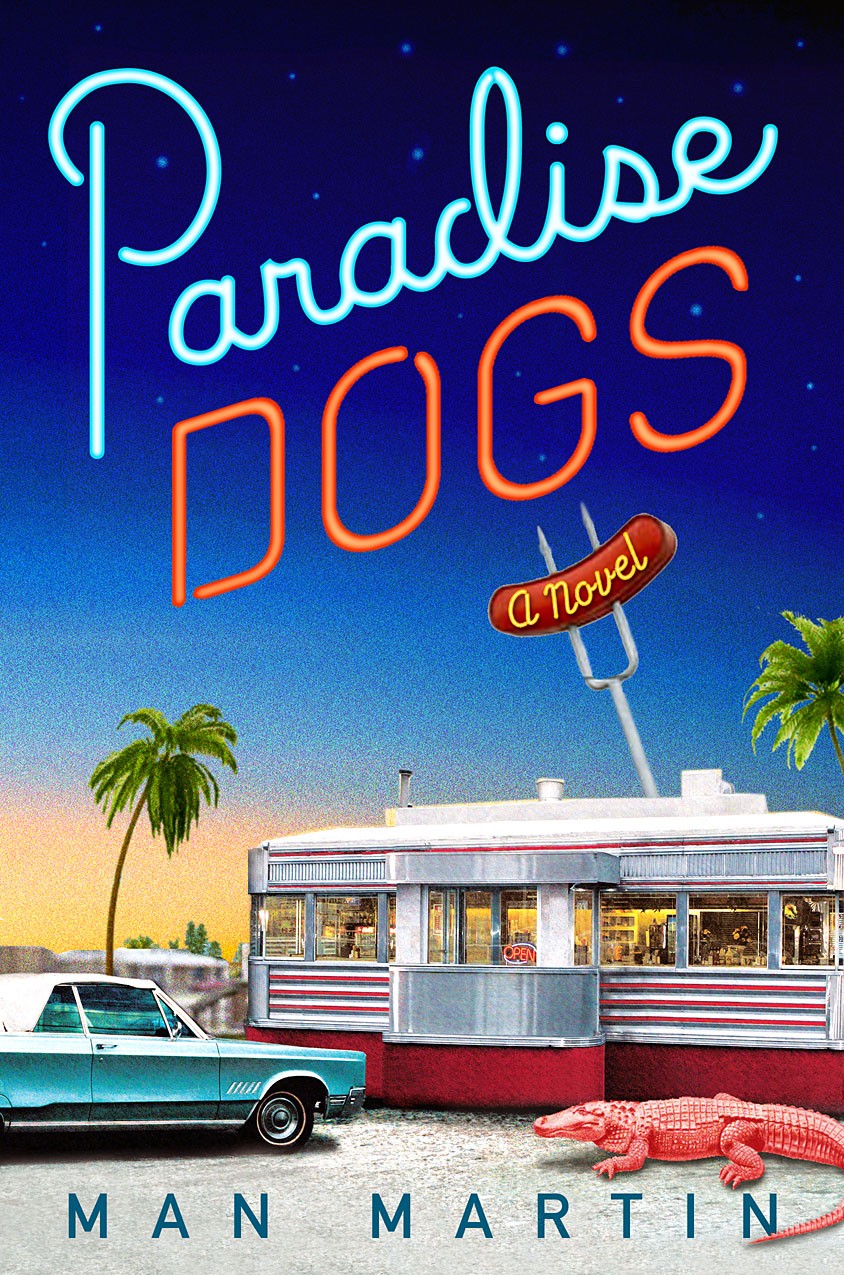
 
Last of all, I just heard from the organizer of the 2011 New Mexico Women Authors Book Festival in Santa Fe, and I've been invited back to present another workshop.  This year I'm scheduled for October 9th at 11.30 AM, and my topic will be "Book Trailers:  How and Why You Need One."  Right now I have two trailers you can view on my sidebar here, but by the time of the festival I will have released two more.  I'm very excited because not only is Santa Fe a wonderful place to visit, but the book festival is so much fun to attend.  And I'll be signing copies of my next novel, Overtaken, so in essence the festival will mark that book's big debut.

In the meantime, wishing you all a happy and productive week.  Congratulations again to our giveaway winners and to Man Martin.  Good job!

Tip of the Day:  Put those pens and paintbrushes down for a couple of hours.  It's summer, time to read and fill up the creative well with a good book (or several).  So everybody get to the bookstore, the library, your best friend's book shelf.  Run, don't walk!

Thursday, June 2, 2011

Awards, Prizes: Today is a Good Day!

Happy Thursday, and Happy Blog Giveaway Day!  First off, I'd like to thank everyone who took the time to leave a comment on Holly Schindler's guest post.  It was great to hear from you and I'm only sorry that I had to pick just two winners. 

Speaking of which, a few minutes ago I ran the list of commenters (that's a word, right?) through a great selection service:  Random.org and got back a new list putting the names in winning order.  The first two names will be contacted this afternoon and will have 48 hours to let me know their mailing addresses.  If I don't hear back in time, I'll go down to the next names on my list.  So until then, the names will still be kept a secret.  Stay tuned!  With any luck winners will be announced over the weekend.

In the meantime, I also wanted to let you know that I received a new blog award:  The Versatile Blogger, from Nomar Knight at knightchills.blogspot.com.  It's a fun award and here are the rules: 

1.  Thank and link to the person who nominated you.
2.  Share 7 random facts about yourself.
3.  Pass the award on to 5 new-found blogging buddies.
4.  Contact the winners to congratulate them.

So from the top:  Thank You, Nomar!  It was great to hear from you; much appreciated!  (Nomar's link is posted just above the "rules.")

7 Random Facts About Me (not selected by Random.org):

1.  I write morning pages, but I don't keep them.  After I've made note of any "instructions" I might have written to myself, I toss them out.
2.  I took violin lessons in junior high school and loved them.  Loved them!
3.  When I lived in Georgia it took me two hours to mow my lawn with a rider mower.  It was fun and meditative, and I used the time mowing to plot out my stories or think about my characters.
4.  I sweep my kitchen floor every night before I go to bed.  I do this in memory of one of my sweet little cats who loved to watch me sweep, then try to catch the broom.  (He's now gone to cat heaven along with his two senior citizen kitty pals.)
5.  I miss my cats terribly, but I've decided to remain pet-free.  Now my pet nurturing instincts go into supporting shelters and humane societies.  (Please take a minute to click on my sidebar link that helps feed homeless pets.  Thanks!) 
6.  I'm taking a new art class next week:  Experimental Drawing.  Can't wait.
7.  I don't like camping.  No, no, no.  Hotels and hot water and clean towels are my idea of a vacation.  Dirt in my toothbrush just makes me cry.

So that's me, randomly.

5 great blogs I've discovered in the last few months:

1. stephaniepellegrin.com
2. pennyjars.wordpress.com
3. waltzwithwords.blogspot.com
4. jodyhedlund.blogspot.com
5. nutpress.co.uk

Note:  wouldn't you know, with perfect irony, the lovely Kathryn Eastman of Blog #5, The Nut Press, has just posted about-- going camping.  But I'm sure camping in the UK is an entirely different experience than here in the Southwestern desert--I might even like it! 

So thank you, Bloggers, for inspiring me, and thanks again to Nomar Knight for giving me the award in the first place.

Tip of the Day:  Reading new blogs is always fun--and educational.  Please take the time to check out the six blogs mentioned in today's post.  I'm sure you'll enjoy your visit and will find plenty to inspire, motivate, and keep you on the creative path.  Enjoy!

Tuesday, May 24, 2011

Guest Author, Holly Schindler (and a Super Give-away!)


Today I'm giving a big welcome to Young Adult novelist, Holly Schindler--my first guest blogger!  Holly is the author of A Blue so Dark and the recent Playing Hurt.

My introduction to Holly and her books came through the children's writing network, Jacketflap.com.  A little later I found Holly at her web site, hollyschindler.com and at her blog, hollyschindler.blogspot.com.

Holly's books are are what I consider top-of-the-line young adult writing: a strong and realistic voice, sophisticated detail, unforgettable characters, and an authentic identification with her young readers.  In my opinion, it doesn't get much better than that!  Here's what Holly has on her book covers:


A BLUE SO DARK:
Fifteen-year-old Aura Ambrose has been hiding a secret. Her mother, a talented artist and art teacher, is slowly being consumed by schizophrenia, and Aura has been her sole caretaker ever since Aura’s dad left them. Convinced that “creative” equals crazy, Aura shuns her own artistic talent. But as her mother sinks deeper into the darkness of mental illness, the hunger for a creative outlet draws Aura toward the depths of her imagination. Just as desperation threatens to swallow her whole, Aura discovers that art, love, and family are profoundly linked—and together may offer an escape from her fears.


PLAYING HURT :
Star basketball player Chelsea “Nitro” Keyes had the promise of a full ride to college—and everyone’s admiration in her hometown. But everything changed senior year, when she took a horrible fall during a game. Now a metal plate holds her together and she feels like a stranger in her own family. 

As a graduation present, Chelsea’s dad springs for a three-week summer “boot camp” program at a northern Minnesota lake resort. There, she’s immediately drawn to her trainer, Clint, a nineteen-year-old ex-hockey player who’s haunted by his own traumatic past. As they grow close, Chelsea is torn between her feelings for Clint and her loyalty to her devoted boyfriend back home. Will an unexpected romance just end up causing Chelsea and Clint more pain—or finally heal their heartbreak?

I love these blurbs--they're wonderful examples of what I share in my workshops when I tell students "what you should be writing in your query letters!"  In just a few short lines we have character, plot, and a the promise of a huge emotional pay-off that  makes us want to know more, much more.

So how does Holly come up with all this good emotional content?  How about "Crying at the Movies"?

"I am one ugly crier. Some women—I’m thinking of actresses on the soaps, especially, who seem to be able to turn on the waterworks anytime they want—can look pretty while the tears roll down their cheeks. Me? My lips turn red, and I puff up like I’m having an allergic reaction.  I really hate crying at the movies for just that reason. And I usually hold it back. But I’ve had plenty of times that I felt myself tearing up, or feeling a tear break forth despite my best efforts to hold it in.  And I think that makes me a better writer. 

Both of my published YAs—A BLUE SO DARK and PLAYING HURT—feature characters whose experiences are completely unlike my own. In BLUE, I’ve got a protagonist with a schizophrenic mother who fears that she is mentally unstable, too. In PLAYING HURT, I’ve got a couple of former athletes…and dual protagonists, one of which is a man.  Talk about different. I couldn’t play a decent game of basketball to save my life. Yet, the opening scene of PLAYING HURT involves a basketball game. 

In order to pull it off—to make situations I have never lived seem real—I have to have extraordinary empathy for my characters. Their pain, their triumphs have to be my own.  I have to chuckle when they tell jokes, I have to feel my heart race when they’re in trouble, and, yes, I have to tear up when they encounter tragedy.  

If you’re a crier—if you sniff at Hallmark commercials, or cry out in victory when the winner of Top Chef is named—you’ve already got a leg up on the competition. If you can empathize, you can be a great writer."

Thanks, Holly--much appreciated!  And in appreciation of our readers, Holly has generously provided a book give-away:  a signed copy of Playing Hurt.  For our first lucky winner, I'm going to add a copy of my how-to-write book, The Essential Guide for New Writers, From Idea to Finished Manuscript.  A second name chosen will receive a copy of The Essential Guide plus a signed bookplate and bookmark from Holly.  To be eligible for the drawing, all you have to do is leave a comment on this post today or sometime during the next week before midnight, June 1, 2011 (6/1/11, 12.00 AM).

Tip of the Day:  Thanks again to Holly, we have some special writing advice on video.  Enjoy, and don't forget to leave a comment!


Tuesday, May 17, 2011

Writing With All Five Senses

 
Right now I'm reading a great book by New Zealand novelist, Rachel King:  The Sound of Butterflies.  The story is set in 1904 England and the Brazilian rain forest, and inside the front cover there are eleven review excerpts.  Starting from the top, some of the key words repeated throughout the reviews are:  sensuous, lush, luscious, and exotic.  Other reviews use the terms: rich, evocative, opulent, sultry, seductive, and rippling.  (I do like rippling.)

Lush, luscious, and yes--rippling--writing is a worthy goal for all of us, I think.  Even if you're writing "just about your own backyard" miles away from the Amazon or London's Richmond Park, there's no reason to make it dull.  Pull us in; help us to see, hear, taste those motor mowers and dandelion puffs.  In other words:  all five senses, people!

To really get those senses moving, we need to go beyond mere description--we need to associate the senses with the power of emotion and memory.  For instance:

1.  Sight.  Sight is the sense we most commonly turn to when adding description to our manuscripts, and it's the one most certain to trip us up and bore readers.  You know the sort of thing: there was a gray rock on the cement steps only inches away from a brown stick covered in mud. The mud looked dirty.  But let's ramp this up a few notches:  the rock, a chunk of brain-shaped coral, could be covered in blood because it has just been used as a murder weapon, instilling terror in your main character when she stumbles over it on her way to deliver a cake for the victim's birthday.  The rock could also be very unusual--a vivid shade of purple, and similar to one she's seen inside her new boyfriend's aquarium.  Seeing the rock now means something; it starts a chain of action, reaction, emotion, and future plot twists.  It's also a very unforgettable rock because of the color, the blood, and the association with a brain, and it sets a tone unique to the story.
  
2.  Sound.  We live in a world of noise that can sometimes be overwhelming, forcing us to tune it all out--much to our disadvantage.  An excellent exercise is to sit with your journal and listen, really listen, for 5 to 30 minutes and then record what you hear.  Do this for your characters too.  Imagine them in their individual settings, and then listen along with them to whatever is intruding on their environments.  Whether it's a string of Gregorian chants or the sound of a jackhammer three streets over, make it important to your character's well-being or distress.  Make it real.

3.  Touch.  The way particular items feel to your characters can add volumes of emotional reaction and involvement to your writing.  A scratchy collar, a much-washed baby blanket, the sting of a wasp, the weight of a good book in your hand.  We've all been there.  Let your characters experience their story world in as tactile a way as possible, showing, rather than telling, why they prefer the feel of one item over another.

4.  Taste.  I enjoy descriptions of food, not just for the ingredients or how to put the recipes together, but because of the combination of mood and memory food writers seem to excel at.  I've mentioned before how helpful I find food magazines to be for found poetry and collage work precisely for the sensuous language contained in the articles.  But taste covers more than food.  How about the taste of rain or snow, a barely detected poison, or the taste of a lead pencil--the one your main character is chewing on throughout his four-hour math test?

5.  Smell.  I hope this isn't too much disclosure, but my favorite smell in the entire world is kittens' feet.  I think kitten paws are the sweetest, prettiest little things ever.  Katherine Mansfield described them in her journal as "unripe raspberries" and I've always considered that description right-on perfect.  One reason I love them so is they always make me a think of a little white and orange kitten I wanted as a small child and couldn't have.  Wah!  That kitty smelled delish and I've never forgotten.

Tip of the Day:  Make two lists:  one with your favorite sights, sounds, touches, tastes, and smells, followed by your most disliked items in these same five categories.  Once you have your lists, freewrite on why you love/hate these things, what they remind you of, how empty your life would be without them.  Now do the same for some fictional characters, either from your current WIP or a brand new story.

Breaking News:  Next Tuesday, May 24, 2011 Young Adult author Holly Schindler will be guest blogging right here at Dava Books.  Holly has written a special post, plus she'll also be sharing a writing exercise.  To celebrate, we're having a super giveaway--a copy of her new novel Playing Hurt, accompanied by a copy of my how-to-write book, The Essential Guide for New Writers, From Idea to Finished Manuscript.  Details of how to win will be revealed next Tuesday--don't forget.  In the meantime, keep those words rippling!

Thursday, May 5, 2011

12 Tips to Finding Your Voice

"How do I find my voice?  How do I know I'm using the right one?"  Just like the word "style," "voice" can be a confusing term when you're just starting out and writing to please an editor.  But all you really need to know is:

1.  Write like you talk. One of my favorite comments from a former workshop participant who had just finished reading The Essential Guide for New Writers was, “The book sounds just like you.  Every time I read it, I'm right back in your class.”  Bingo!

2.  Write like you're writing a journal entry.  A great way to let your natural voice emerge is to pretend you're only writing for yourself.  I find it always helps to write my first drafts in my journal, and by hand. 

3.  Freewrite, especially when you're "stuck."  Try setting a timer anywhere from 5 to 30 minutes and just start writing.  Don't think, just write.  You'll be so busy you won't have time to worry about the "sound" of your writing, and that means the sound will be natural and 100% you.

4.  Avoid censoring your "first thoughts."  So what if your freewriting grammar is non-existent, you've misspelled every other word, and your "first thoughts" are far from pretty?  Who's to care?  The point is to get words on paper--words that are yours alone.

5.  Examine why you feel the need to censor.  Sometimes when we let loose with those first thoughts, they can be pretty shocking.  We think of all the people our words could hurt or embarrass, or who might reject us for being ourselves--especially for being our "shadow selves."  One way to conquer these worries is to set aside some time to list the people you think would be upset by your writing and why.   Once you have your list, work on solutions.  For instance, you might need to write under a pseudonym, or you might want to keep your writing private until after it's published.

6.  Walk in your characters' shoes.  Another good trick to find your authentic voice is to let your characters do the talking.  Ask them interview-type questions:  "What is the worst thing that ever happened to you as a child?"  "What do you love/hate about your current job?"  "Where would you go on your dream vacation?"  Then sit back with your pen and paper and take dictation-style notes.

7.  Write in the first person.  The easiest way to get into a main character's head and voice is to write from the first person point of view.  If you don't particularly care for that POV in the finished work, you can always rewrite in third person later.  The idea is to be as open and true to your character(s) as possible in your first draft so that you have something to work with down the road.

 8.  Give your "worst" thoughts/voice for your characters.  Assign your shadow side to your characters--especially your villains.  Give them every negative thought you've ever had and let them run with it.  Not only is this extremely cathartic, it's also an excellent way to personalize a believable voice. 

9.  Write poetry.  Really! Poetry practice can lead you to your individual sense of rhythm and language.  Poetry forces you to take breaths between words and lines, thereby helping you discover if your true voice is direct and to-the-point, or more comfortable weaving back and forth in a tapestry of emotion and nuanced subtlety.  Poetry can also force you to reach for unusual word combinations and uses, sparking your creativity.

10.  Keep a shelf of authors whose voices you admire.  Go to your bookshelves and pick out not just your favorite books, but the books that in your opinion have the strongest voices.  Read and re-read to discover what it is that speaks to you, then do your best to use some of those same techniques in your own attempt to find voice.

11.  Don't try too hard.  Nothing is worse than reading an author who tries so hard to comply with "how everyone else writes" that the voice is not only false, it's irritating.  Chick-lit, wise-cracking snappy twenty-somethings who enthuse with irony over every broken fingernail; pages and pages of dialogue dripping with "Y'alls" and "Dah-lins" when the author has been no further south than Maine; cerebral attempts to fake street smarts and slang...  It's way easier to just be yourself.

12.  Don't worry about it.  Write what you love and you'll be writing in your own voice.  Try to keep in mind that writing is an act of creativity--follow your intuition, follow your gut, follow your heart.  Do those three things and you'll be using your real voice without a second thought.

Tip of the Day:  Read aloud from a wide selection of titles.  Listen to the way the words and sentences sound.  What do you admire when you hear the phrases?  What do you dislike?  How can you change your own writing so that it sounds more pleasing or realistic to your ear?


Tuesday, April 26, 2011

Are We Having Fun Yet?

Recently I’ve been re-reading my blog posts, and the one thing that stands out for me is how often I use the phrase “Have fun.” “Just have fun.” Which made me wonder, what exactly do I mean by “fun”?
 
Obviously fun doesn’t mean the same thing to everyone. For some people it’s taking as many rollercoaster rides as possible in one lifetime while raising tarantulas in the living room. For others it’s spending years and years painting, and repainting, one perfect and extraordinarily life-like bouquet of tiger lilies—an activity that would have me tearing out my hair and run screaming for the hills. Just like trash and treasure, fun is all in the eye of the beholder, or in the actions of the doer. Whatever it is for each of us, though, I think it’s a very important part of the creative process. Because if you’re not having fun, you might also be:
  • Avoiding the work.
  • Agonizing about avoiding the work.
  • Resisting any opportunities to show or submit the work.
  • Apologizing for the work when you do show it.
  • Unfavorably comparing your work to others—others you are convinced are immeasurably more brilliant, talented, and capable of having much more fun than you. Which is just plain silly.
So how do you bring more fun to the table when you sit down to work on your latest creative project? I’m sure there’s a fascinating range of answers, from putting on theme music, to drawing cats in pajamas in your manuscript margins, but to me “having fun” means the following:
  • Not taking myself so seriously. Note I didn’t say “not taking the work seriously.” But whenever I think there is some absurd “writerly standard” I must live up to, one that for instance involves never smiling when I talk about my writing because I am a “serious writer,” or one where I have to consider myself as a “person of literature” if I’m allowed to even call myself a writer, I know I’m in trouble.
  • Risk taking. Asking the “what if” questions and then following through. “What if I paint black gesso all over this board? What if I rewrite a fairy tale? What if my character goes to prison and my entire plot changes—for the better?” Yes, why not? Fun to me is all about surprise—making each step of the journey the equivalent of opening an unexpected birthday present and finding the perfect gift—or joke—inside.
  • Art supplies in all the wrong places. I write with plum fountain pen ink, paste stickers on absolutely everything, and doodle in glamorous journals. So what if manuscript submissions have to be on pristine white bond paper, double-spaced and printed in a sharp black font? That doesn’t mean I can’t write them in mud and lemon juice if that makes me happy during the first draft stage. I can even add cats in pajamas if I want—so there.
  • Writing or creating what you love. It seems that in every creative person’s life there comes the golden opportunity to work on something you hate—either for money, a much-needed byline, or a chance to get your foot in the door. And it’s awful! Even with the-very-good-reason to take on the job, it’s something I recommend you only do once, or twice at most. That’s why it’s so important to write what you love to read, or to create the kind of art you’d want to see in your own home or favorite gallery. Anything else isn’t fun—it’s torture.
  • Putting the thing to sleep. Not every idea is a great idea. Sometimes they’re not even passably good and the day you’re willing to say, “Hey, let it go,” can actually be one of the happiest (and most fun) days of your life. Abandoning a project that doesn’t pan out or doesn't make you happy isn’t the end of the world. The time you spent on it is no different from time spent taking a writing or art class, or completing the exercises at the end of a how-to book. The important thing about all of these activities is you’ve practiced your craft, you learned from the experience, and you discovered what you do think is fun. So move on already. Life is too short to spend it polishing and rewriting and suffering through what you know isn’t your only idea. I bet you’ve got an entire filing cabinet of much better ones—ones that are downright serious fun.
Tip of the Day: What current work-in-progress is keeping you from having fun? Why? What can you do to make it more enjoyable? Do you need to put it away for awhile and start something new that’s a lot more interesting—and fun?